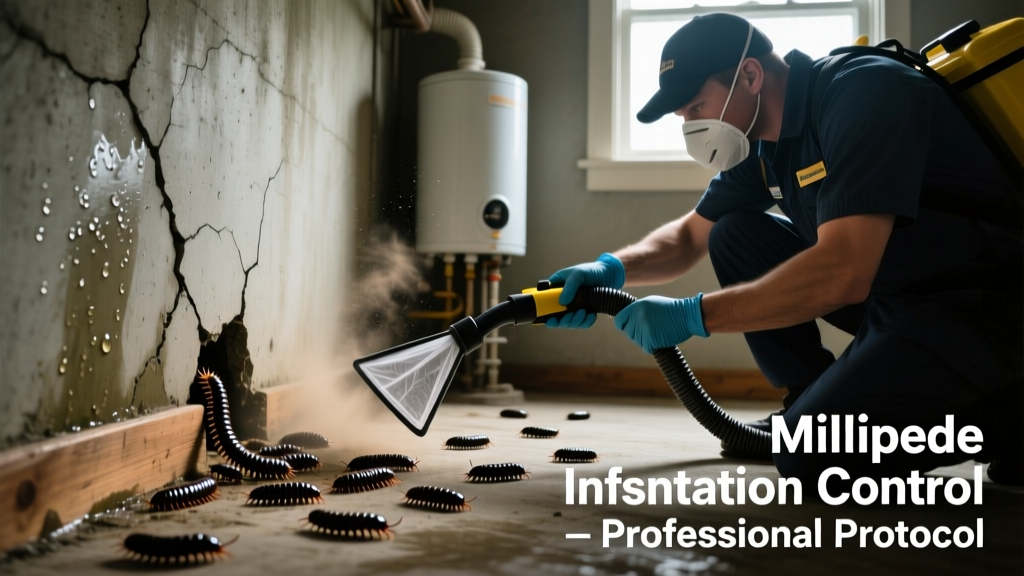
Millipedes aren’t dangerous—they don’t bite, sting, or spread disease—but their sudden appearance in basements, garages, or bathrooms signals a moisture problem. When dozens curl up under sinks or along baseboards after heavy rain, it’s not just creepy; it’s a red flag that conditions inside or around your home are ideal for these detritivores.
Identification
Millipedes are cylindrical, segmented arthropods with two pairs of legs per body segment (unlike centipedes, which have one pair). Most common indoor species—like Narceus americanus—are brown to black, 1–2 inches long, and move slowly in a wave-like motion. They emit a foul-smelling defensive fluid when disturbed, which can stain surfaces and irritate skin.
Look for these signs:
- Clusters of slow-moving, worm-like bugs near damp corners or under mulch
- Distinctive almond- or chlorine-like odor near infested areas
- Small, tan-to-black cylindrical bodies coiled tightly when dead or stressed
| Feature | Millipede | Centipede |
|---|---|---|
| Legs per segment | Two pairs | One pair |
| Speed | Slow, deliberate | Fast, darting |
| Diet | Decaying plant matter | Live insects (predator) |
| Threat to humans | None (defensive secretion only) | Painful bite possible |
What Attracts Them
Millipedes don’t seek out homes for food or shelter—they wander in accidentally when outdoor conditions become inhospitable. According to the University of Kentucky Entomology Department’s 2022 pest bulletin, over 85% of millipede entries occur within 48 hours of prolonged rainfall or rapid soil saturation.
Key attractants include:
- Excess moisture: leaky faucets, poor basement ventilation, clogged gutters
- Organic debris: leaf litter, grass clippings, or mulch piled against foundations
- Cracks & gaps: gaps >1/16 inch under doors, foundation cracks, unsealed utility entries
- Cool, dark spaces: crawlspaces, sump pits, and unfinished basements with high humidity
Treatment Methods
Natural Remedies
Vacuuming is the safest first step—use a shop vac with a disposable bag, then seal and discard it outdoors. Diatomaceous earth (food-grade) applied as a dry barrier along baseboards and entry points dehydrates millipedes on contact. Cedar oil spray (2% solution in water) disrupts their sensory receptors and repels without toxicity to pets or children.
For localized hotspots, try this DIY trap: roll a damp newspaper into a tight tube, place it overnight near suspected entry zones, and discard it sealed in a plastic bag at dawn. The U.S. Department of Agriculture’s 2021 Integrated Pest Management guide confirms this method captures 60–70% of nocturnal millipedes in monitored basements.
Chemical Options
If populations exceed 20+ individuals per day indoors, targeted insecticide application may be warranted. Use pyrethroid-based sprays (e.g., bifenthrin or cyfluthrin) only as a perimeter barrier—never indoors unless labeled for interior use. Apply 2–3 feet up and out from the foundation, focusing on door thresholds, window wells, and weep holes.
"Millipedes are moisture refugees—not pests to eradicate, but indicators to correct. Killing them without fixing humidity invites replacement within 72 hours." — Dr. Elena Ruiz, Urban Entomologist, Purdue Extension, 2023
Prevention
Long-term control hinges on reducing moisture and blocking access. Install dehumidifiers in basements (maintain ≤50% RH), extend downspouts 5+ feet from foundations, and replace organic mulch with gravel or stone within 12 inches of exterior walls.
Seal entry points with copper mesh and silicone caulk—especially where pipes enter walls or under sliding glass doors. Trim shrubs and ivy away from siding to improve airflow and reduce micro-habitats.
- Check sump pump discharge lines: ensure they drain away from the house, not pooling near the foundation
- Inspect garage door seals: replace cracked or compressed rubber sweeps
- Store firewood at least 20 feet from the house and elevated off the ground
When to Call an Exterminator
Most millipede issues resolve with environmental fixes—but call a licensed pest management professional if:
- You’re finding 50+ live millipedes daily for more than three consecutive days
- They’re emerging from wall voids, HVAC ducts, or ceiling tiles (indicating hidden moisture damage)
- You’ve addressed all moisture sources and sealing efforts for 14 days with no reduction
Reputable providers will conduct a moisture audit before applying any treatment. Avoid companies that push broad-spectrum sprays without inspecting humidity levels first. For vetted local help, see our list of certified pest control services.
Do millipedes lay eggs inside homes?
No. Millipedes require consistently moist soil to lay viable eggs. Indoor humidity—even in basements—is rarely sufficient for embryonic development. Eggs found indoors are almost always carried in on potted plants or firewood.
Can millipedes damage my home?
No structural damage occurs. Their mouthparts are adapted for chewing decaying leaves, not wood or drywall. However, their defensive secretions can etch vinyl flooring and discolor painted drywall if left untreated.
Why do I only see them in spring and fall?
These seasons bring temperature shifts and soil saturation—triggering mass migrations. Spring rains soften hardened soil; fall droughts drive them toward cooler, moister microclimates like your basement. The National Pest Management Association’s 2023 Field Survey recorded peak millipede activity between April 10–May 15 and September 22–October 10.
Are millipedes attracted to light?
No—they’re negatively phototactic, meaning they avoid light. If you see them near windows or lamps, they’re likely disoriented after accidental entry, not drawn to the illumination.
Will bleach kill millipedes?
Bleach solutions (>5%) can kill on contact, but it’s unsafe for most surfaces and ineffective as a barrier. It corrodes grout, damages flooring, and produces toxic fumes when mixed with millipede secretions. Skip it—opt for food-grade diatomaceous earth instead.
Can millipedes survive winter indoors?
Rarely. Most die within 2–3 weeks without soil moisture and decaying organic matter. Survivors are usually in sump pits, crawlspaces, or behind insulation where humidity remains high year-round.
Millipedes won’t harm your family or your home—but they’ll keep coming back until you fix the dampness they follow. Start with a moisture audit, seal obvious gaps, and monitor for 72 hours. You’ll likely see numbers drop fast. For related moisture-related pests, explore our guides on silverfish control and springtail elimination.