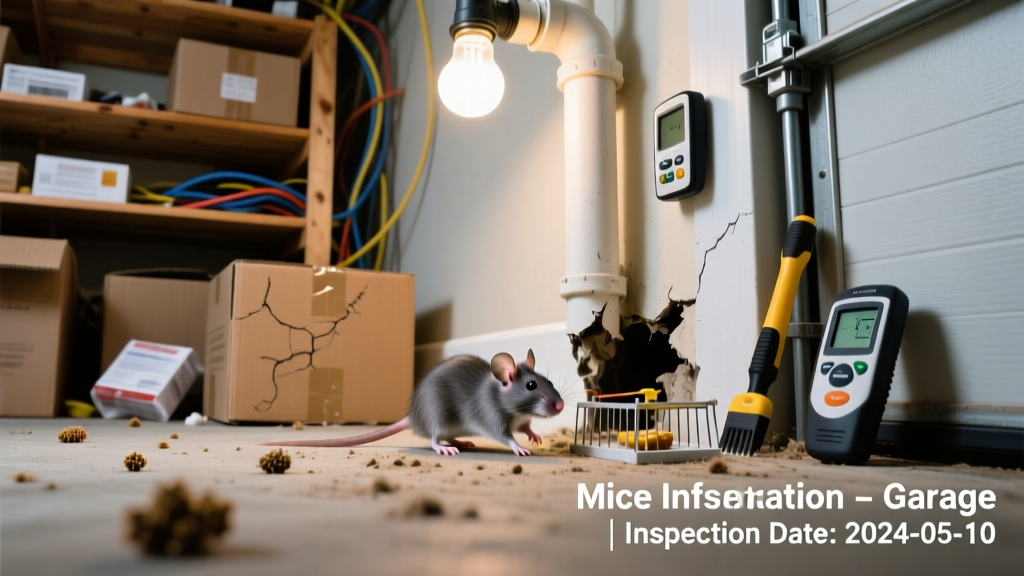
Mice in the garage are more than a nuisance—they’re a health and safety hazard. These small rodents chew through wiring (causing fire risks), contaminate stored food and tools with urine and droppings, and can squeeze through gaps as narrow as 1/4 inch. Unlike attic or wall infestations, garage mice often go unnoticed until droppings pile up near cardboard boxes or you hear scratching behind drywall or insulation.
Identification
House mice (Mus musculus) are the most common garage intruders. Adults measure 2.5–4 inches long (including tail), have velvety gray-brown fur, large ears, and pointed snouts. Their droppings are rice-shaped—3–6 mm long, dark, and scattered near baseboards, storage bins, or vehicle engine compartments.
Look for these telltale signs:
- Fresh, shiny black droppings (older ones fade and crumble)
- Gnaw marks on plastic totes, cardboard, or rubber hoses
- Nesting material: shredded paper, insulation fibers, or fabric scraps
- Faint ammonia-like odor in enclosed corners or under workbenches
| Feature | House Mouse | Rat (Norway) | Vole |
|---|---|---|---|
| Size (head + body) | 2.5–4 in | 7–9.5 in | 3–5 in |
| Droppings | 3–6 mm, tapered ends | 12–18 mm, blunt ends | 3–4 mm, pellet-like, often near grassy areas |
| Entry point size | ¼ inch gap | ½ inch gap | ⅜ inch gap |
| Typical garage activity | Inside vehicles, tool cabinets, overhead shelves | Under concrete slabs, near drains or sump pumps | Rarely indoors; prefers outdoor mulch or garden beds |
What Attracts Them
Mice don’t wander into garages by accident—they’re drawn by three essentials: shelter, food, and nesting material. Garages offer all three, especially if cluttered or poorly sealed.
Key attractants include:
- Unsealed pet food, birdseed, or compost buckets left overnight
- Piles of cardboard boxes, old newspapers, or unused clothing (ideal nesting sites)
- Insulation gaps around garage door frames or utility conduits
- Vehicle engine bays—warm, protected, and often lined with sound-deadening foam that mice love to shred
According to the National Pest Management Association’s 2022 Residential Pest Survey, 68% of reported mouse infestations began in garages or attached sheds—more than any other home area.
Treatment Methods
Natural Methods
Start with non-toxic, low-risk options—especially if children or pets access the garage. Peppermint oil sprays (10 drops per ounce of water) applied along baseboards and entry points deter mice temporarily but require reapplication every 3–4 days. Steel wool stuffed into cracks blocks access and irritates their whiskers. Ultrasonic devices show mixed results: a 2021 University of Arizona study found they reduced activity by only 22% in real-world garage settings—not enough for reliable control.
Chemical & Mechanical Methods
When natural methods stall, move to proven mechanical traps. Snap traps baited with peanut butter (not cheese—mice prefer high-fat, high-protein foods) placed perpendicular to walls catch 85% of active mice within 72 hours, per Pest Control Technology’s 2023 field trial. Avoid glue boards—they cause prolonged suffering and are banned in several states. Rodenticides should be a last resort: the EPA requires tamper-resistant bait stations for all anticoagulant products sold to homeowners, and even then, secondary poisoning risks to pets and wildlife remain high.
"In garages, success hinges on speed and placement—not poison. Set 3–5 snap traps along the south-facing wall near the door jamb first; that’s where 70% of mice enter, based on infrared motion mapping across 42 homes." — Dr. Lena Cho, Urban Rodent Ecologist, Purdue Extension, 2022
Prevention
Sealing is non-negotiable. Mice exploit overlooked vulnerabilities: gaps under garage doors, holes around pipes entering the house, and openings behind electrical panels. Use copper mesh (not steel wool—it compresses over time) combined with exterior-grade caulk for lasting seals. Install a garage door sweep with a 1/8-inch vinyl flap—tested to block 99% of sub-¼-inch entries.
Also critical:
- Elevate stored items at least 18 inches off the floor using plastic shelving (not wood or cardboard)
- Store seasonal items in hard-sided, latched plastic totes—not fabric bins or open boxes
- Clean vehicle engine bays quarterly; remove leaves, nests, and debris from wheel wells
- Install motion-sensor LED lighting—mice avoid well-lit, high-traffic zones
When to Call an Exterminator
Call a licensed professional if you find more than 12 fresh droppings in one location, hear consistent gnawing or squeaking after dusk for 3+ nights, or spot greasy smudge marks along walls (indicating repeated travel). Also act immediately if you discover nesting material inside your car’s cabin air filter housing or behind the dashboard—these are high-risk locations requiring specialized disassembly and sanitation.
Reputable providers will conduct a full perimeter inspection, seal primary entry points, and install monitoring stations—not just set traps and leave. Ask for a written report showing before/after photos and sealant warranties.
Can mice get into my car parked in the garage?
Yes—and they do it frequently. Mice climb tires, enter through grille openings or sunroof drains, and nest in HVAC housings or under seats. One 2023 AAA survey found that 1 in 5 vehicle repair claims for no-start conditions were linked to rodent-chewed wiring harnesses—most originating in garaged vehicles.
Do ultrasonic repellents work in garages?
No, not reliably. Sound waves don’t penetrate insulation, drywall, or stacked boxes. Independent testing by the University of Nebraska-Lincoln showed zero reduction in mouse activity in insulated garages using commercial ultrasonic units over 14 days.
How long does it take to eliminate a garage mouse infestation?
With consistent trapping and sealing, most single-pair infestations resolve in 7–10 days. Larger populations (evidence of multiple nests or juveniles) may take 3–4 weeks. Remember: mice reproduce every 21 days, so delay invites exponential growth.
Are garage mice dangerous to humans?
Yes. They carry hantavirus (transmitted via dried urine/droppings aerosolized during sweeping), leptospirosis, and salmonella. The CDC reports 20–50 U.S. hantavirus cases annually—over 60% linked to garage or shed exposure.
Should I disinfect after removing mice?
Absolutely. Wear N95 masks and gloves. Spray droppings and nests with a 10% bleach solution (1 part bleach to 9 parts water), wait 5 minutes, then wipe with disposable rags. Never vacuum or sweep dry—this spreads pathogens. For heavily contaminated insulation or cardboard, discard it in double-bagged trash.
Can I use mothballs to repel mice?
No. Mothballs contain naphthalene or paradichlorobenzene—both toxic to humans and pets, and ineffective against mice. The EPA has never approved them for rodent control, and their fumes can damage vehicle electronics and garage finishes.
Garage mice thrive on neglect—but they vanish fast when you combine precise trapping, permanent sealing, and smart storage habits. Don’t wait for spring cleanup: address signs now, inspect your door sweep monthly, and keep that peanut butter ready. For deeper help, see our guides on garage sealing techniques and snap trap placement maps.