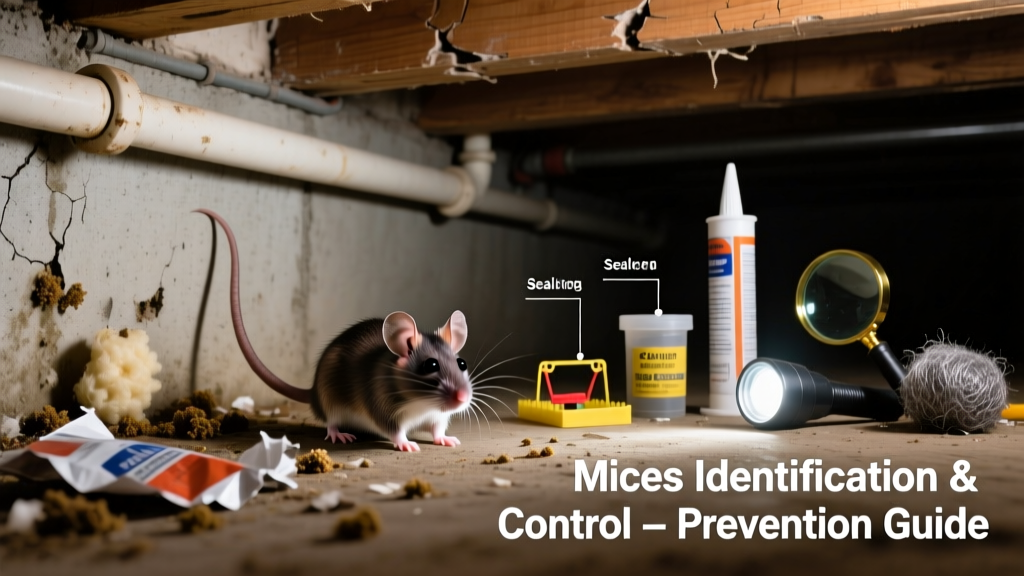
Mice in basements are more than a nuisance—they’re a health and structural risk. House mice (Mus musculus) thrive in cool, cluttered, undisturbed spaces like unfinished basements, where they chew wiring, contaminate insulation with urine and droppings, and reproduce rapidly—females can have up to 10 litters per year, each with 5–6 pups (National Pest Management Association, 2022).
Identification
Basement-dwelling mice are typically 2.5–4 inches long (including tail), with light gray to brown fur, large ears, and pointed snouts. Their droppings are 3–6 mm long, dark, and tapered at both ends—distinct from rat droppings, which are larger and blunt-ended.
- Fresh droppings feel moist and shiny; aged ones crumble easily
- Gnaw marks on wood, drywall, or plastic appear as parallel grooves ~1/8 inch wide
- You may hear scratching or scurrying at dawn or dusk—mice are most active then
- Nesting material (shredded paper, fiberglass insulation, fabric) often appears near foundation cracks or sump pump pits
| Feature | House Mouse | Norway Rat |
|---|---|---|
| Droppings | 3–6 mm, rice-shaped, scattered | 12–18 mm, banana-shaped, clustered |
| Hole Size | ¼-inch diameter (can squeeze through) | ½-inch or larger |
| Nesting Preference | Insulation, cardboard boxes, behind furnace | Soil burrows, crawlspaces under slabs |
| Odor | Faint ammonia scent near walls or ductwork | Strong, musky odor near floor drains or wall voids |
What Attracts Them
Basements check every box for mouse survival: shelter, moisture, warmth, and food access. Even if you don’t store food there, crumbs tracked down from kitchens, pet food left overnight, or birdseed spilled near basement windows provide ample nutrition. Leaky sump pumps, condensation on pipes, and poor drainage create humidity mice need to survive without open water sources.
- Unsealed utility penetrations (pipes, wires, HVAC ducts)
- Cardboard boxes stacked directly on concrete floors
- Old furniture, unused mattresses, or piles of clothing
- Cracks in foundation walls wider than 1/8 inch
- Cluttered storage—especially near exterior walls or windows
Treatment Methods
Natural Methods
Start with non-toxic, low-risk options—especially if children or pets use the basement. Steel wool stuffed into entry points (then sealed with caulk) physically blocks re-entry. Peppermint oil-soaked cotton balls placed along baseboards disrupt mouse olfaction but require weekly replacement. Ultrasonic devices show inconsistent results in real-world basements; the National Pesticide Information Center (2021) found no peer-reviewed evidence supporting their efficacy in enclosed, cluttered spaces.
Chemical & Mechanical Options
Use snap traps (not glue boards—inhumane and ineffective in damp basements) baited with peanut butter or nesting material like dental floss. Place traps perpendicular to walls, spaced 2–3 feet apart along known runways. For persistent infestations, rodenticide baits labeled for indoor basement use (e.g., bromadiolone) must be secured in tamper-resistant bait stations—never loose or exposed. The U.S. EPA requires all residential rodenticides sold after 2015 to meet strict stationing standards to protect children and pets.
Prevention
Sealing is 80% of long-term success. Inspect the entire perimeter—including where the foundation meets the sill plate—and seal gaps with copper mesh + silicone caulk (steel wool alone corrodes in damp basements). Replace torn vapor barriers under flooring and install door sweeps on basement entry doors. Store all items—including holiday decorations—in hard-sided plastic bins with gasketed lids—not cardboard or fabric bags.
"In over 12 years of inspecting flooded and high-humidity basements, I’ve never seen a mouse infestation resolved without first addressing moisture control. Dry basements don’t attract mice—they just don’t.” — Carla Mendez, Certified Wildlife Biologist & IPM Consultant, PestControlToday Magazine, 2023
When to Call an Exterminator
Call a licensed pest professional if you find more than 10 fresh droppings in one area, hear consistent activity behind walls, or spot greasy rub marks along more than two walls. Licensed exterminators use thermal imaging to locate hidden nests and apply exclusion techniques that meet state building code standards—like installing galvanized metal flashing behind brick veneer where mice commonly nest.
How fast do mice multiply in a basement?
A single pregnant female entering your basement in spring can produce 50+ descendants by fall. With no predators and stable temperatures, their gestation is just 19–21 days—and females can become pregnant again within 24 hours of giving birth.
Can mice chew through concrete?
No—but they exploit hairline cracks, expansion joints, and deteriorated mortar. They *will* chew through poured concrete’s curing compound or weak spots where it meets cinderblock, especially if moisture has softened the surface. Focus sealing efforts on junctions, not solid slab areas.
Do basement mice carry hantavirus?
Rarely—house mice (Mus musculus) are not primary carriers. However, deer mice (Peromyscus maniculatus), which sometimes occupy rural or semi-rural basements, *do* transmit hantavirus via aerosolized urine/droppings. Always wear an N95 mask and gloves when cleaning suspected nesting areas, and mist surfaces with 10% bleach solution before wiping.
Why do mice prefer unfinished basements?
Unfinished basements offer insulation voids, exposed framing, and minimal foot traffic—ideal for nesting and movement. Finished basements with drywall, carpet, and lighting reduce appeal, but mice still exploit gaps behind baseboards and under subfloors. A finished basement isn’t immune—it just hides evidence longer.
Will mice leave if there’s no food?
They’ll relocate—but not immediately. Mice can survive 2–4 days without food but need water daily. In basements with leaky pipes or condensation, they’ll linger for weeks scavenging dust, glue, or paper fibers. Removing food *and* moisture sources together forces faster departure.
Are ultrasonic repellents worth trying?
No—especially not in basements. Sound waves don’t penetrate insulation, drywall, or clutter. Independent testing by the University of Nebraska-Lincoln (2020) showed zero reduction in mouse activity in basements using commercial ultrasonic units over 8-week trials.
Basement mice won’t vanish overnight—but with methodical sealing, targeted trapping, and moisture control, most infestations drop to zero within 2–3 weeks. For ongoing protection, inspect your foundation twice yearly—once before winter and again after spring rains. Pair that with basement moisture control and foundation crack sealing, and you’ll cut reinfestation risk by over 70%. If you’re dealing with recurring issues, consider a professional basement pest inspection to uncover hidden entry routes no homeowner catches.