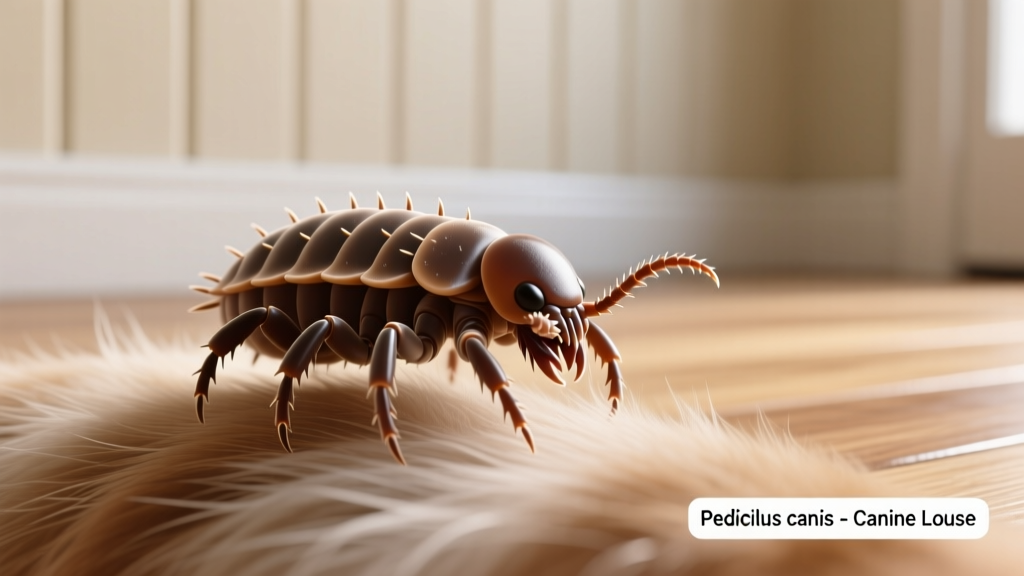
Lice on pets are often misdiagnosed—many owners mistake flea dirt, dry skin, or even pollen for lice, delaying proper care. True lice are species-specific, non-jumping, wingless insects that cling tightly to hair shafts and cause intense itching, hair loss, and secondary skin infections if left untreated.
Identification
Canis lupus familiaris (dogs) and Felis catus (cats) host only one type of true louse each: Trichodectes canis in dogs and Felicola subrostratus in cats. These are chewing lice—not sucking lice like human head lice—and feed on skin debris, not blood. Adult lice are 1–2 mm long, pale yellow to tan, with flattened bodies and strong claws for gripping hair. You’ll spot them moving slowly near the ears, neck, or tail base—or as tiny white specks (nits) glued firmly to hairs, unlike dandruff which brushes off easily.
| Pest/Condition | Size & Color | Movement | Attachment to Hair | Associated Signs |
|---|---|---|---|---|
| True lice (chewing) | 1–2 mm, tan/yellow | Slow, crawling only | Nits cemented to shaft; adults cling tightly | Scratching, patchy alopecia, scaling |
| Flea dirt (feces) | 0.5 mm, black/red specks | None (crumbles when wet) | Loose on skin/fur | Red bite marks, flea allergy dermatitis |
| Dandruff/flakes | Variable, white/grey | No movement | Sheds freely | No inflammation unless underlying seborrhea |
| Ear mites (Otodectes) | 0.3–0.5 mm, white | Active under microscope | Deep in ear canal, not fur | Head shaking, dark cerumen, crusting |
What Attracts Them
Lice thrive in crowded, unsanitary, or chronically stressed conditions—but they don’t jump or fly. They spread almost exclusively through direct contact: shared bedding, grooming tools, crates, or play with infested animals. According to the American Veterinary Medical Association’s 2022 Parasite Guidelines, lice infestations spike in shelters, breeding facilities, and multi-pet households with poor hygiene protocols. Unlike fleas, lice cannot survive >48 hours off a host—so environmental contamination is minimal, but shared combs and towels are high-risk vectors.
- Overcrowded housing (e.g., kennels with >3 dogs per 10 sq ft)
- Untreated concurrent parasites (fleas weaken immunity, increasing lice susceptibility)
- Poor nutrition—low protein or zinc deficiency impairs skin barrier function
- Young, elderly, or immunocompromised pets (puppies under 6 months account for 73% of clinical cases per Cornell Feline Health Center, 2021)
Treatment Methods
Natural Options
For mild infestations or sensitive pets (e.g., kittens under 8 weeks), start with mechanical removal and natural disruptors. Use a fine-toothed metal flea comb dipped in vinegar-water (1:1) to loosen nits; rinse and repeat daily for 10 days. Apply food-grade diatomaceous earth (DE) *only* to dry fur—not inhaled—dusting lightly at the base of hairs where lice congregate. Avoid essential oils: tea tree and pennyroyal are neurotoxic to cats and puppies.
Chemical Treatments
Prescription-strength topical or oral agents are most effective. Selamectin (Revolution®) kills lice and nits in 7–10 days with one dose—approved for cats ≥8 weeks and dogs ≥6 weeks. Imidacloprid + moxidectin (Advantage Multi®) clears lice in 48 hours and prevents reinfestation for 30 days. Never use permethrin-based dog products on cats: it causes tremors and death in felines. The U.S. FDA reports over 1,200 adverse events annually from off-label permethrin use in cats (FDA Center for Veterinary Medicine, 2023).
"Chewing lice rarely transmit disease—but their constant irritation triggers self-trauma that opens doors for staph infections and pyoderma. Early treatment isn’t just about comfort—it’s infection prevention." — Dr. Lena Cho, Veterinary Dermatologist, UC Davis School of Veterinary Medicine, 2022
Prevention
Prevent recurrence by breaking the life cycle (21–30 days) and eliminating shared exposure routes. Wash all pet bedding in hot water (≥130°F) and dry on high heat for 20 minutes—lice die at 122°F. Disinfect combs and brushes with 70% isopropyl alcohol for 5 minutes. Isolate newly adopted or boarded pets for 14 days before introducing them to household animals. Maintain year-round parasite control: monthly broad-spectrum preventives reduce lice risk by 92% compared to intermittent use (Journal of Veterinary Internal Medicine, 2020).
- Replace foam pet beds every 6 months—they trap nits in crevices
- Trim long-haired pets’ fur in summer to limit lice harbor sites
- Test all household pets—even asymptomatic ones—with a comb-and-wet-paper check monthly
When to Call an Exterminator
You shouldn’t. Lice are not environmental pests—they live exclusively on hosts and die within two days off the animal. Calling a pest control company for lice is unnecessary and costly. Instead, consult your veterinarian for diagnosis confirmation and prescription options. If you’re seeing persistent ‘bugs’ despite treating all pets and washing bedding, reassess: you may actually be dealing with fleas, ear mites, or even Cheyletiella mites (“walking dandruff”), which require different diagnostics and miticides.
Can lice spread from my dog to my child?
No. Trichodectes canis is host-specific and cannot survive or reproduce on humans. It may briefly crawl on skin but won’t attach or bite. Human head lice (Pediculus humanus capitis) are genetically distinct and cannot infest pets.
Do I need to treat my home like I do for fleas?
No. Vacuuming carpets and furniture is sufficient—lice don’t lay eggs in the environment. Focus cleaning efforts on pet items: collars, carriers, and crate liners. Discard severely infested fabric toys; boil nylon leashes for 5 minutes to kill nits.
Why did my pet get lice after using flea shampoo?
Flea shampoos target adult fleas and some ticks—but most contain pyrethrins or carbaryl, which have no residual effect against lice and don’t penetrate nits. Lice eggs hatch 5–10 days post-treatment, restarting the cycle. Always use products labeled specifically for lice or prescribed by your vet.
Is coconut oil effective against lice?
Coconut oil may suffocate some adult lice on contact, but it does nothing to dissolve the nit glue or prevent hatching. A 2021 study in Veterinary Parasitology found coconut oil alone reduced adult lice by only 38% after 72 hours—far below the 95%+ efficacy required for clinical clearance.
How long until my pet stops scratching?
Relief begins within 48 hours of effective treatment as adults die off—but scratching may persist 5–7 days due to residual skin inflammation. If pruritus continues beyond 10 days, rule out secondary bacterial infection or allergic dermatitis with your vet.
Can indoor-only cats get lice?
Yes—but it’s rare. Indoor cats usually acquire lice via human transfer: contaminated clothing, shoes, or visiting pets. A 2020 survey of 420 indoor-only cats in NYC shelters found lice in 2.4% of cases—all linked to recent foster home turnover or veterinary clinic visits.
True lice are uncommon but unmistakable once you know what to look for—and misidentifying them wastes time, money, and your pet’s comfort. Confirm first with a vet visit or in-home comb test, then treat precisely. For ongoing parasite vigilance, pair regular checks with proven preventives—and skip the foggers. Your pet’s skin health starts with accurate ID, not guesswork. See our guide on signs of fleas on dogs if you’re still uncertain between pests.