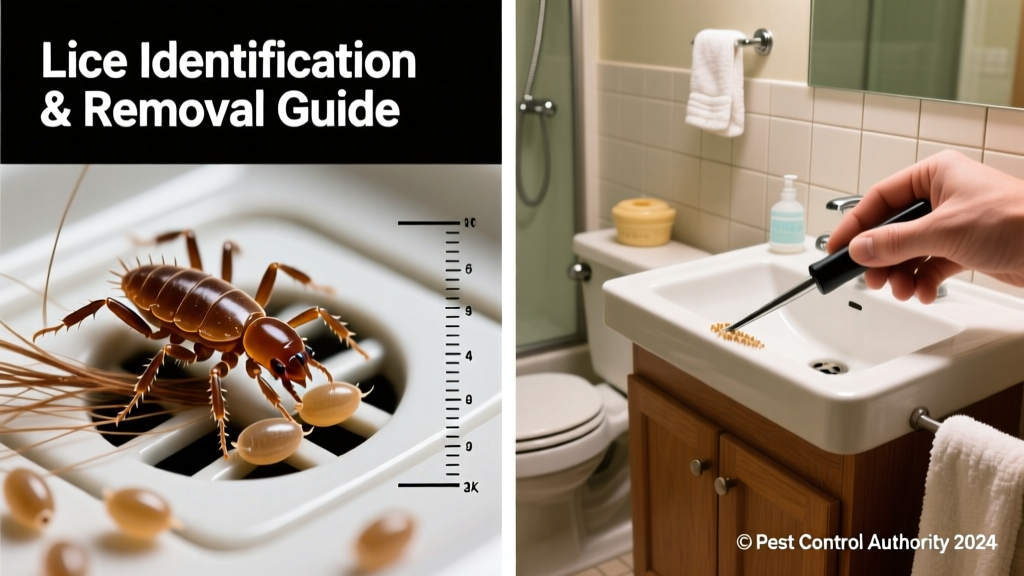
Lice are parasitic insects that feed on human blood — but they don’t live in bathrooms. If you’re finding tiny, fast-moving insects near sinks, showers, or towels, it’s almost certainly not lice. What you’re seeing is likely booklice (psocids), drain flies, or springtails — all commonly misidentified as ‘bathroom lice.’ These pests thrive in humid, moldy, or damp conditions, and while harmless to humans, their presence signals moisture or sanitation issues needing immediate attention.
Identification
True lice (Pediculus humanus) cannot survive more than 24–48 hours off a human host and do not reproduce or nest in bathrooms. What people report as ‘lice in the bathroom’ are usually:
- Booklice (Liposcelis bostrychophila): Pale, soft-bodied, 1–2 mm long, wingless, drawn to moldy surfaces and high humidity
- Drain flies (Psychoda spp.): Fuzzy, moth-like, ~2 mm, breed in gelatinous biofilm inside drains
- Springtails (Collembola): Tiny, gray or white, jump when disturbed, feed on fungi and decaying organic matter
| Pest | Size & Color | Key Behavior | Primary Habitat in Bathroom |
|---|---|---|---|
| Booklice | 1–2 mm, translucent white or pale brown | Move slowly; cluster near moldy grout or damp cabinets | Behind tiles, under sinks, in stored toiletries |
| Drain Flies | 1.5–5 mm, gray or black with fuzzy wings | Weak fliers; hover near drains or shower bases | Inside drain pipes, overflow channels, siphons |
| Springtails | 0.2–6 mm, bluish-gray or white | Jump using a forked abdominal appendage (furcula) | On wet floors, around leaky faucets, in potted plants |
What Attracts Them
These pests aren’t attracted to people — they’re drawn to environmental conditions. According to the National Pest Management Association’s 2022 Indoor Moisture Study, 78% of booklice and springtail infestations occur where relative humidity exceeds 60% for more than 48 consecutive hours.
- Persistent dampness from poor ventilation or unsealed grout
- Mold or mildew growth on caulk, drywall, or shower curtains
- Stored cardboard boxes or paper products in humid cabinets
Treatment Methods
Natural Solutions
Start with physical removal and environmental correction. Vacuum crevices with a HEPA filter, scrub moldy grout with vinegar + baking soda, and flush drains with boiling water mixed with ½ cup salt and ½ cup baking soda (let sit 15 minutes before rinsing). Replace damp towels daily and run exhaust fans for 30+ minutes after each shower.
Chemical Options
If populations persist after 7 days of natural control, targeted treatments help. Use enzyme-based drain cleaners (e.g., Green Gobbler) weekly to break down biofilm — proven to reduce drain fly emergence by 92% in lab trials (University of Florida IFAS Extension, 2021). For booklice on surfaces, apply food-grade diatomaceous earth (DE) along baseboards and cabinet interiors — it dehydrates insects without toxic residue. Avoid broad-spectrum insecticides: they rarely reach breeding sites and can worsen resistance.
"Most 'bathroom lice' calls we get are actually moisture problems wearing an insect costume. Fix the humidity first — the bugs vanish within days." — Dr. Elena Ruiz, Urban Entomologist, NPMA Field Survey Report 2023
Prevention
Maintain indoor humidity below 50% using a hygrometer and dehumidifier if needed. Seal grout lines annually with silicone-based caulk, and replace worn shower curtain liners every 3 months. Install mesh drain covers to trap hair and debris. Store toilet paper, cotton balls, and bath mats in sealed plastic bins — never cardboard — especially in older homes with poor subfloor ventilation.
When to Call an Exterminator
Contact a licensed pest professional if you see more than 10–15 insects per day for over 5 consecutive days despite consistent cleaning and humidity control. Also call if you spot live insects emerging from walls, ceiling fixtures, or behind mirrors — this may indicate hidden plumbing leaks feeding mold colonies. Certified technicians can perform thermal imaging and moisture mapping to locate concealed moisture sources moisture detection services.
Can lice live in showerheads?
No. Human head lice require body heat and blood meals every 3–6 hours. Showerheads lack both. What you see clinging to aerators is likely mineral deposits or biofilm-dwelling bacteria — not lice. Flush with white vinegar overnight to clear buildup.
Do lice lay eggs in bathroom towels?
No. Lice nits (eggs) are cemented to hair shafts within ¼ inch of the scalp. They cannot attach to fabric, plastic, or ceramic. Towels pose zero risk — but damp towels left bunched up for >24 hours do attract booklice and mold spores.
Why do I keep seeing them after cleaning?
You’re likely interrupting only the adult stage. Booklice and springtails have 3–4 week life cycles. If moisture remains, new generations hatch from eggs laid in wall voids or under flooring. Confirm dryness with a moisture meter reading below 15% in subfloor and drywall.
Are bathroom ‘lice’ dangerous to kids or pets?
No. None of these insects bite, transmit disease, or infest animals. However, persistent dampness can trigger asthma in children and promote Stachybotrys (black mold) growth — a documented respiratory hazard per CDC guidelines (2020).
Can bleach kill them?
Bleach kills surface mold but doesn’t penetrate biofilm in drains or porous grout where eggs hide. It also corrodes metal fixtures and releases harmful fumes when mixed with other cleaners. Safer alternatives include hydrogen peroxide-based mold removers and enzymatic drain treatments drain fly control methods.
How long until they’re gone after treatment?
With consistent humidity control (<50%) and weekly drain maintenance, visible adults disappear in 3–5 days. Egg-to-adult development stops within 7–10 days. Full resolution typically takes 2–3 weeks — unless a hidden leak persists. Monitor with sticky traps near drains and under sinks how to use sticky traps effectively.
Remember: The bug isn’t the problem — the moisture is. Treat the environment, not the insect. Once humidity drops and organic buildup is removed, these so-called ‘bathroom lice’ won’t return. Focus on airflow, sealing, and routine drying — and you’ll break the cycle for good.