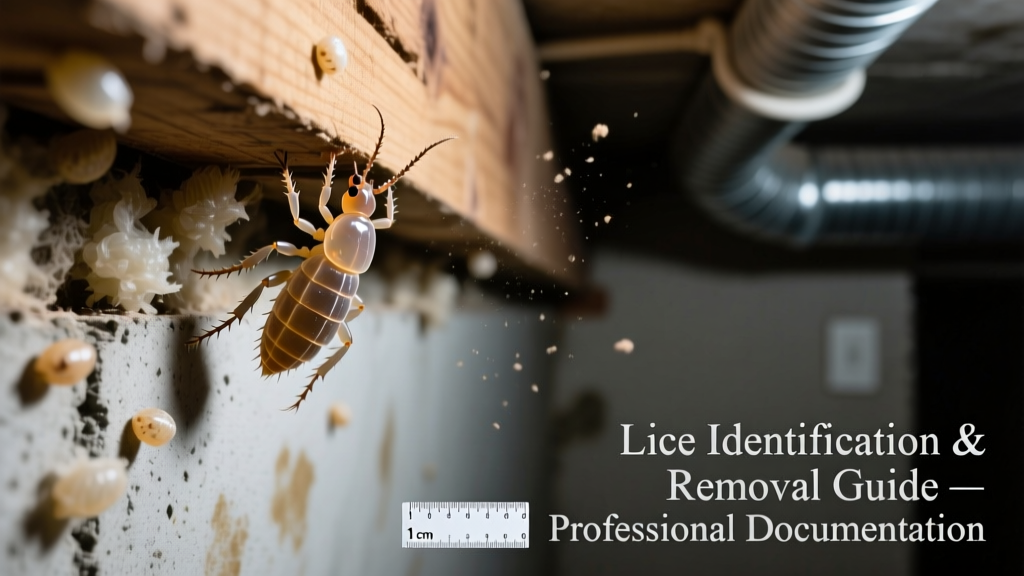
Lice are parasitic insects that feed on human blood—but they cannot survive long off a host. Finding lice in your basement is extremely rare and almost always indicates either misidentification (e.g., booklice, springtails, or carpet beetles) or a recent human infestation where items were stored post-infestation. True head or body lice won’t thrive in basements because they require consistent warmth, humidity near 70–90%, and direct access to human hosts—conditions basements rarely provide unless used as living space.
Identification
True lice (Pediculus humanus capitis or corporis) are tiny (1–3 mm), wingless, flattened insects with six legs ending in hook-like claws. They’re tan-to-gray and difficult to spot without magnification. What’s often mistaken for lice in basements includes:
- Booklice (Psocids): 1–2 mm, soft-bodied, pale brown or translucent; feed on mold, fungi, and starches—not blood.
- Springtails: Tiny (0.25–2 mm), jump when disturbed, thrive in damp concrete cracks and sump pits.
- Carpet beetle larvae: Oval, hairy, reddish-brown; feed on wool, fur, and stored fabrics—not humans.
| Pest | Size & Color | Feeds On | Found Where? | Human Health Risk? |
|---|---|---|---|---|
| Head/body lice | 1–3 mm, grayish-tan | Human blood | Scalp, seams of clothing | Itching, secondary infection |
| Booklice | 1–2 mm, pale brown/white | Mold, starchy residues | Damp cardboard, old books, insulation | None (allergen trigger for some) |
| Springtails | 0.25–2 mm, gray/black | Decaying organic matter, fungi | Moist concrete, drain tiles, sump pits | None |
| Carpet beetle larvae | 3–5 mm, bristly, rusty brown | Natural fibers, dead skin, pet hair | Stored blankets, rugs, upholstered furniture | Skin/eye irritation from hairs |
What Attracts Them
Basements attract booklice and springtails—not true lice—through three main conditions: excessive moisture (relative humidity >60%), organic debris (dust, mold, paper, fabric), and poor ventilation. According to the U.S. EPA’s 2022 Indoor Air Quality Guide, basements account for 78% of residential mold growth due to condensation and foundation seepage—creating perfect microhabitats for psocids and springtails.
- Leaky pipes or sump pump failures raising humidity above 65%
- Cardboard boxes stacked directly on concrete floors
- Old mattresses, wool blankets, or upholstered furniture stored uncovered
- Unvented laundry areas or improperly sealed HVAC ducts
Treatment Methods
Natural Approaches
Start with moisture control and physical removal. Use a dehumidifier set to ≤50% RH for at least 72 hours—booklice die within 48 hours at 45% RH (University of Kentucky Entomology, 2021). Vacuum thoroughly with a HEPA filter, focusing on baseboards, box seams, and under stored furniture. Discard infested cardboard; replace with plastic totes with tight lids.
Chemical Options
If natural methods fail after two weeks, targeted treatments may help—but avoid broad-spectrum sprays. Diatomaceous earth (food-grade) applied as a thin line along foundation walls and under storage units dehydrates booklice and springtails on contact. For severe mold-associated infestations, a borate-based solution (e.g., Tim-Bor) applied to wood framing inhibits both mold and psocid food sources. Never apply insecticides near sump pumps or floor drains—residues can contaminate groundwater.
"Most 'lice in the basement' calls we get turn out to be booklice—and 90% resolve fully within 10 days of lowering humidity and removing cardboard. No pesticide needed." — Dr. Lena Cho, Urban Pest Ecologist, Rutgers Cooperative Extension (2023)
Prevention
Long-term prevention hinges on environmental management—not insecticides. Seal foundation cracks with hydraulic cement, install vapor barriers under crawlspaces, and insulate cold water pipes to reduce condensation. Store belongings in labeled, airtight plastic bins—not cardboard or fabric bags. Run your basement dehumidifier year-round, even in winter: cold air holds less moisture, but when it warms indoors, relative humidity spikes.
- Inspect stored items every 3 months for musty odors or visible mold
- Keep basement temperature between 60–68°F to discourage mold and pest activity
- Install exhaust fans in laundry or utility zones with timers (minimum 20 min/post-use)
When to Call an Exterminator
Call a licensed pest management professional if you’ve confirmed live, moving, human-feeding lice on people (not just basement debris)—which suggests an active head or body lice infestation requiring medical coordination. Also consult one if booklice persist after 3 weeks of strict humidity control and cleanup, or if you discover mold covering >10 sq ft—especially black, fuzzy growth on insulation or drywall. These indicate structural moisture issues beyond DIY scope.
Can lice live in basement carpets?
No. Human lice die within 24–48 hours off a host. If you find crawling insects in carpet, they’re likely carpet beetle larvae or springtails—not lice. Vacuum daily for 5 days, then steam-clean at ≥200°F to eliminate both.
Do lice lay eggs in basement walls?
False. Lice glue eggs (nits) only to hair shafts or clothing fibers worn next to skin. Nits found on basement surfaces are almost certainly booklice eggs—laid in clusters on damp paper or moldy wood.
Will washing basement-stored clothes kill lice?
Yes—if those clothes were recently worn by someone with lice. Wash in hot water (≥130°F) and dry on high heat for ≥20 minutes. But if clothes sat untouched for >48 hours in the basement, lice would already be dead. Focus instead on checking wearers, not storage.
Are booklice dangerous to pets?
No. Booklice don’t bite animals or humans. However, their presence signals high mold levels—which can irritate pets’ respiratory systems. Address the moisture first.
Why do I keep seeing tiny bugs after cleaning?
You’re likely observing springtails emerging from damp concrete pores after cleaning disturbs them—or newly hatched booklice from residual mold colonies. Continue dehumidifying and inspect for hidden leaks behind stored items or under stairs.
Can lice travel from basement to upstairs bedrooms?
Only if carried by an infested person. Lice cannot jump, fly, or survive long off-host. If lice appear upstairs, the source is human-to-human transmission—not basement migration. Check household members’ scalps and launder shared hats, combs, and pillowcases immediately.
Basements aren’t lice habitats—they’re symptom locations. The real fix isn’t killing bugs; it’s drying the space, removing mold food sources, and rethinking how you store things. For persistent moisture issues, consider a whole-house dehumidifier system or consult a certified waterproofing specialist. Most cases resolve faster than you’d expect—once you stop treating the bug and start treating the environment.