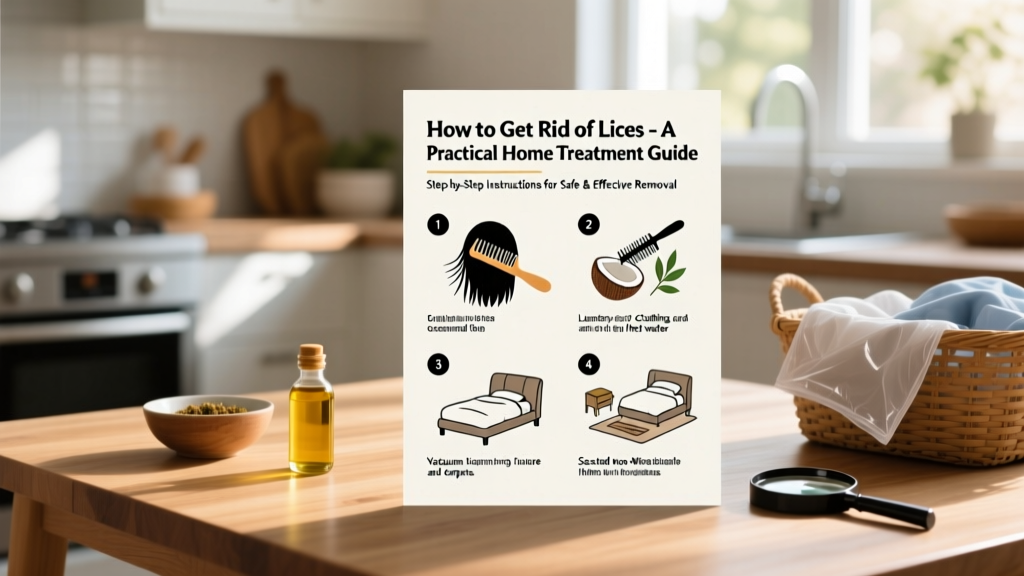
Lice are tiny, wingless parasitic insects that live on human scalps and feed on blood — causing intense itching, sleep disruption, and social stigma, especially among school-aged children. Unlike bed bugs or fleas, head lice (Pediculus humanus capitis) cannot jump or fly, but they spread rapidly through direct head-to-head contact or shared personal items like combs, hats, or headphones.
Identification
Head lice are about the size of a sesame seed (2–3 mm), tan to grayish-white, and become darker after feeding. Nits (eggs) appear as tiny yellowish-white ovals firmly cemented to hair shafts within ¼ inch of the scalp — unlike dandruff, they don’t brush off easily. Persistent scratching behind the ears and at the nape of the neck is often the first clue.
| Feature | Lice Nits | Dandruff | Hair Casts |
|---|---|---|---|
| Attachment | Cemented tightly to hair shaft | Loose, flakes off easily | Slippery, ring-like, slides along hair |
| Location | Within 6 mm of scalp | Scalp surface or shoulders | Along mid-shaft or ends |
| Color | Yellowish-white or brown | White or yellow | Translucent or whitish |
| Removal | Requires nit comb or fingernail pressure | Falls off with brushing | Slides off with finger pressure |
What Attracts Them
Lice don’t seek out dirty hair or poor hygiene — in fact, they prefer clean scalps where they can move freely. They’re drawn to warmth, humidity, and close physical proximity. Schools, daycares, sleepovers, and sports teams are high-risk environments due to frequent head-to-head contact. Shared lockers, helmets, and classroom headphones also serve as transmission vectors.
- Children aged 3–11 account for over 90% of U.S. head lice cases (CDC, 2022)
- One louse can lay 6–10 eggs per day — up to 100 in its 30-day lifespan
- Lice survive less than 48 hours off the human host, making environmental fumigation unnecessary
Treatment Methods
Natural Approaches
Wet-combing with a fine-tooth metal nit comb remains the most evidence-backed non-chemical method. Apply conditioner to dry hair, then comb section-by-section under bright light every 3–4 days for at least two weeks. Studies show consistent wet-combing achieves 57% clearance after two weeks and 95% after four (Cochrane Review, 2021). Essential oils like tea tree and anise have shown some efficacy in lab studies, but lack robust clinical proof for standalone use.
Chemical Treatments
Over-the-counter pediculicides containing permethrin 1% (e.g., Nix) or pyrethrins (e.g., Rid) remain first-line options — though resistance is widespread. The CDC recommends repeating treatment on day 9 to kill newly hatched nymphs. Prescription options like ivermectin lotion (Sklice) or spinosad (Natroba) are effective against resistant strains and require only one application. Never use pet flea products — they’re toxic to humans.
- Permethrin resistance exceeds 98% in some U.S. regions (Journal of Medical Entomology, 2020)
- Spinosad has >85% cure rate after single application (FDA prescribing data, 2023)
Prevention
Prevent reinfestation by avoiding head-to-head contact during outbreaks, storing hats and scarves separately, and washing bedding and clothing in hot water (130°F+) followed by high-heat drying for 20 minutes. Vacuum upholstered furniture and car seats — but skip pesticide sprays; they’re ineffective and hazardous. Regular weekly wet-combing helps catch early infestations before they spread.
For long-term household protection, keep hair tied back for kids in group settings and inspect for other hitchhiking pests like bed bugs that share similar transmission routes. Also review how to tell lice apart from fleas, since misidentification leads to wasted time and incorrect treatments.
When to Call an Exterminator
You shouldn’t — licensed pest control operators do not treat head lice. Lice are a medical, not structural, pest. If standard treatments fail after two full courses, consult a pediatrician or dermatologist. They may test for resistance, rule out seborrheic dermatitis or psoriasis mimicking nits, or prescribe alternative medications.
"Lice infestations are not a reflection of cleanliness or parenting — they’re a public health issue rooted in biology and behavior. The best tool isn’t a spray bottle; it’s a metal comb and consistency." — Dr. Maritza Soto, Pediatric Dermatologist, Children's Hospital Los Angeles, 2023
Can lice live on pets?
No. Head lice are obligate human parasites — they cannot survive on dogs, cats, or other animals. If your pet is scratching, check for fleas or mites instead.
Do I need to wash everything in the house?
No. Focus only on items used within the past 48 hours: pillowcases, towels, hats, brushes, and hair accessories. Lice die quickly off the scalp — vacuuming floors and furniture is sufficient for other surfaces.
Can adults get lice too?
Yes — though less common due to less head-to-head contact, adults in close-contact roles (teachers, childcare workers, parents of young kids) are at measurable risk. CDC reports rising adult cases linked to household transmission.
Are lice dangerous?
Not medically dangerous — they don’t carry disease in the U.S. But secondary skin infections from scratching (e.g., impetigo) occur in ~10% of untreated cases (American Academy of Pediatrics, 2022). Chronic infestations also impact sleep, concentration, and emotional well-being.
How long does treatment take?
Effective treatment takes minimum 14 days — longer if resistance or missed nits delay progress. The life cycle from egg to adult is 17–21 days, so follow-up combing must extend beyond visible lice to break the cycle.
What if my child keeps getting lice?
Recurrent cases usually point to either incomplete treatment (missing nits), re-exposure at school/daycare, or asymptomatic carriers in the household. Screen all family members with a magnifying glass and bright light — especially behind ears and at the crown — even without symptoms.
Staying calm and systematic beats panic every time. Lice are stubborn but beatable with the right tools, timing, and patience — no magic potions required. For related concerns, see our guides on scabies vs. lice and how ticks differ from lice.