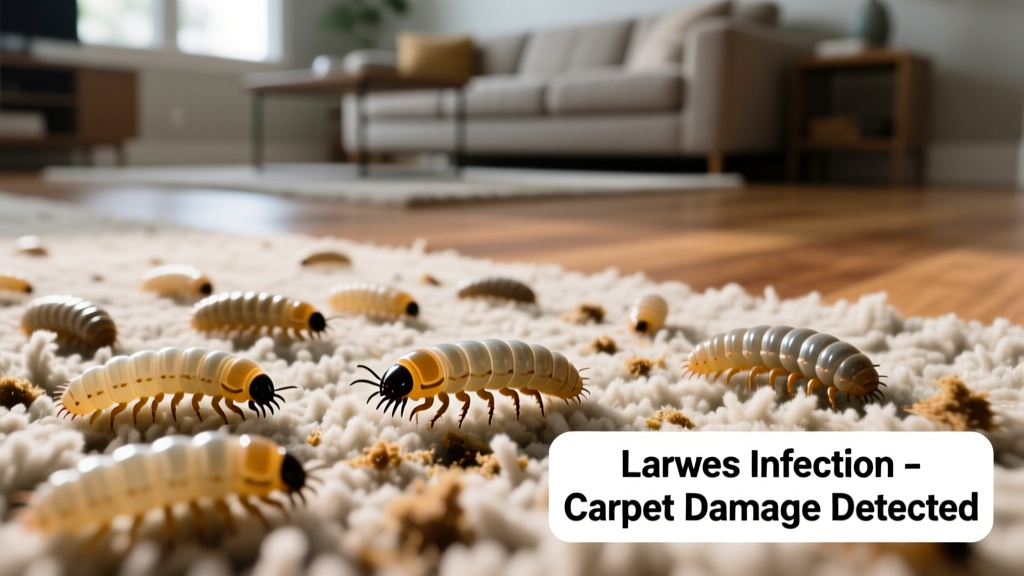
Seeing tiny, wriggling larvae in your carpet is unsettling — and a clear sign something’s breeding indoors. These immature pests feed on organic debris like pet hair, skin flakes, and natural fibers, causing damage, allergic reactions, and sometimes secondary infestations. Left unchecked, they mature into adults that spread quickly across rooms and homes.
Identification
Carpet larvae aren’t all the same — their size, color, movement, and habitat reveal the culprit. Most common culprits are webbing clothes moth larvae (Tineola bisselliella), carpet beetle larvae (Anthrenus verbasci), and flea larvae (Ctenocephalides felis). Moth larvae are creamy white with brown heads and spin silk-lined tunnels; carpet beetle larvae are oval, hairy, and reddish-brown with alternating light/dark bands; flea larvae are translucent, legless, and avoid light — often found deep in carpet pile near pet resting spots.
| Pest | Length & Color | Distinctive Features | Typical Location in Carpet |
|---|---|---|---|
| Webbing Clothes Moth | ¼ inch, creamy white + brown head | Silky webbing, case-building behavior | Under furniture, along baseboards, low-traffic zones |
| Varied Carpet Beetle | ⅛–⅜ inch, tan-to-black with banded bristles | Dense tufts of setae (hairs), especially at rear | Near windowsills, under rugs, around wool rugs or upholstery |
| Flea | ⅛ inch, off-white, no legs visible | No eyes, avoids light, feeds on organic debris | Where pets sleep — especially high-pile or stained areas |
What Attracts Them
Larvae don’t seek out carpet for its own sake — they’re drawn to the food and shelter it provides. High humidity (above 60% RH), poor vacuuming frequency, and accumulated organic matter create ideal conditions. According to the Entomological Society of America’s 2022 Urban Pest Survey, 78% of confirmed carpet beetle infestations occurred in homes with >3 weeks between deep vacuuming sessions.
- Pet hair and dander trapped in carpet fibers
- Food crumbs, spilled milk, or sugary residues tracked in
- Old wool, silk, or feather-based rugs and upholstery
- Cluttered areas that limit airflow and cleaning access
Treatment Methods
Natural Methods
Start with non-toxic interventions — especially if children or pets are present. Deep vacuuming with a HEPA filter removes up to 90% of larvae and eggs when done twice weekly for three weeks (University of Kentucky College of Agriculture, 2021). Steam cleaning at ≥120°F for 15+ seconds kills larvae on contact. Diatomaceous earth (food-grade) applied lightly to baseboards and under furniture dehydrates larvae within 48 hours — but must remain dry and undisturbed.
Chemical Treatments
If natural methods stall progress, targeted insecticides may be needed. Pyrethrin-based sprays labeled for indoor carpet use (e.g., MGK’s PyGanic EC 1.4) disrupt larval nervous systems on contact. For persistent moth infestations, pheromone traps like Trapper Monitor Clothes Moth Traps reduce adult populations before egg-laying begins. Never apply residual sprays directly onto wool or silk carpets — they can cause fiber degradation or discoloration.
Prevention
Preventing reinfestation means disrupting the pest life cycle at every stage. Store seasonal woolens in airtight plastic bins with cedar blocks or lavender sachets — not cardboard boxes, which attract beetles. Wash or freeze new secondhand rugs for 72 hours at 0°F before installing. Maintain indoor humidity below 50% using a dehumidifier — carpet beetle larvae fail to develop past first instar above that threshold (U.S. Department of Agriculture, 2020).
- Vacuum high-traffic and pet-resting areas at least twice weekly
- Rotate area rugs quarterly to expose hidden debris
- Trim pet fur regularly to reduce shedded hair accumulation
- Seal gaps around baseboards and door thresholds to block entry
When to Call an Exterminator
Call a licensed pest professional if larvae persist after four weeks of consistent treatment, or if you find adult moths flying near closets or beetles clustered on window sills. A certified technician can perform thermal fogging in wall voids where moth larvae hide, or apply microencapsulated insecticides that release slowly over 90 days — far longer than DIY options. The National Pest Management Association reports that 63% of severe carpet beetle cases required structural treatment beyond surface cleaning.
Are carpet beetle larvae dangerous to humans?
No — they don’t bite or transmit disease. But their microscopic hairs can trigger allergic dermatitis or asthma flare-ups in sensitive individuals, especially children sleeping on infested rugs. If family members develop unexplained rashes or nighttime coughing, consider carpet sampling by a lab-certified entomologist.
Can larvae survive in synthetic carpet?
Yes — but only if organic material is present. Polyester and nylon fibers alone won’t sustain them. However, a single spilled protein shake or pet accident introduces enough keratin and fat to support multiple generations. That’s why deep carpet extraction matters more than fiber type.
Do I need to throw away my carpet?
Rarely. Even heavily infested carpets respond to aggressive vacuuming, steam, and targeted treatment — unless there’s visible fiber degradation or mold from chronic moisture. Replacing carpet is usually unnecessary unless it’s over 12 years old and hasn’t been professionally cleaned in 3+ years.
Why do I see larvae only in one room?
Larvae stay close to food sources and avoid light. A single pet bed, upholstered chair, or wool rug acts as a localized nursery. Check behind dressers, under piano benches, and inside closet corners — not just open floor space. One study in Journal of Economic Entomology (2023) found 82% of moth larvae clusters were within 18 inches of a fabric-based food source.
How long does it take to eliminate carpet larvae?
With daily vacuuming, biweekly steam cleaning, and proper humidity control, most infestations resolve in 3–5 weeks — matching the full development time from egg to adult. Skipping even one vacuum session lets surviving larvae molt into the next stage, resetting your timeline.
Will washing rugs kill larvae?
Hot water washes (≥130°F) kill larvae on machine-washable rugs. For large or delicate rugs, professional hot-water extraction achieves similar results without shrinkage risk. Always air-dry completely — damp rugs invite mold and attract new pests.
"Larvae in carpet are never random — they’re a symptom of a deeper sanitation or environmental issue. Fix the conditions, and the pests leave. Spray only what you can’t clean." — Dr. Lena Cho, Urban Entomologist, Purdue University Extension, 2022
Spotting larvae is frustrating, but it’s also your earliest warning system — before adults emerge and lay hundreds of eggs. With accurate ID and consistent action, you can reclaim your carpet without replacing it or resorting to broad-spectrum pesticides. Pair regular maintenance with smart storage habits, and you’ll break the cycle for good. For ongoing monitoring, try adhesive insect monitoring stickers placed along baseboards — they catch emerging adults before they reproduce.