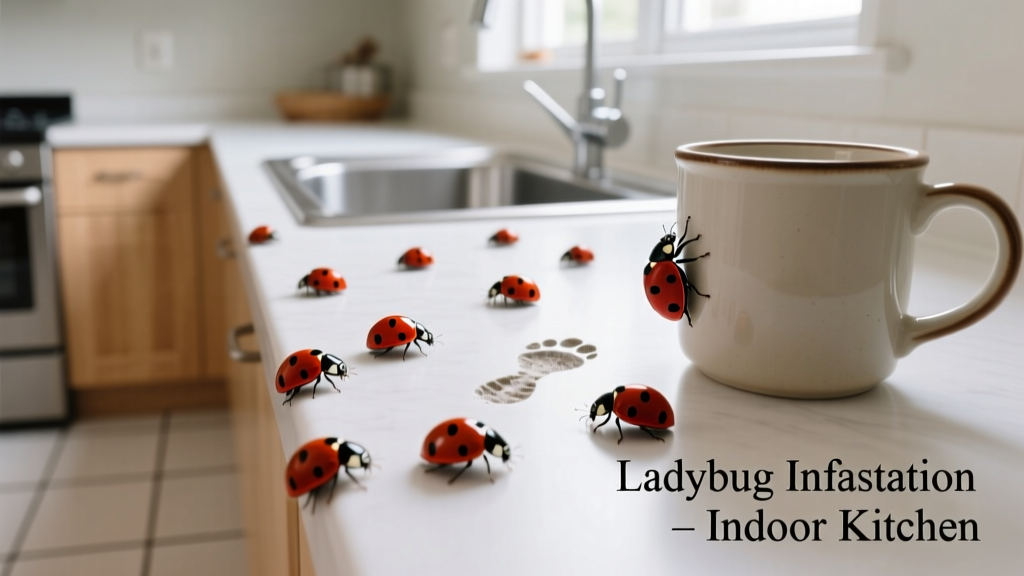
Ladybugs—especially the invasive multicolored Asian lady beetle (Harmonia axyridis)—often invade kitchens in fall seeking warmth and shelter. While beneficial outdoors, indoors they’re a nuisance: they secrete foul-smelling yellow fluid when disturbed, stain countertops and cabinets, and may trigger allergic reactions in sensitive individuals (University of Kentucky Entomology, 2022).
Identification
Not all red-and-black spotted beetles are harmless garden allies. The Asian lady beetle is larger (5–8 mm), more variable in color (tan to orange to red), and has an unmistakable black 'M' or 'W' marking on the pronotum (the shield behind the head). Native ladybugs are typically smaller (4–6 mm), uniformly round, and lack that marking.
| Feature | Asian Lady Beetle | Native Ladybug (e.g., Hippodamia convergens) |
|---|---|---|
| Size | 5–8 mm | 4–6 mm |
| Pronotum Marking | Distinct black 'M' or 'W' | No 'M'; often plain or with faint spots |
| Behavior Indoors | Clusters on sunny windows, walls, and kitchen cabinets | Rarely found indoors; not prone to overwintering inside |
| Odor When Disturbed | Strong, acrid, coriander-like scent | Mild or undetectable |
Look for clusters near window frames, light fixtures, or pantry shelves—especially in October through December. You might also spot tiny yellow stains on cabinets or countertops: that’s reflex bleeding, a defense mechanism.
What Attracts Them
Kitchens offer three key draws: heat gradients, light, and entry points. Ladybugs detect infrared radiation and follow warm air currents—leaky door sweeps, gaps around pipes under sinks, and cracks near stove vents become highways. South- and west-facing windows amplify solar gain, turning kitchen nooks into thermal magnets. They’re also drawn to the faint scent of fermented fruit residues, spilled sugar, or even vinegar left on countertops.
- Unsealed gaps around refrigerator kickplates and dishwasher access panels
- Cracks along baseboards near pantry flooring (especially over heated crawlspaces)
- Light-colored kitchen cabinets—studies show they prefer landing on pale surfaces (Ohio State Extension, 2021)
Treatment Methods
Natural Removal
Vacuuming is the safest first step—but use a shop vac with a cloth filter bag or insert a knee-high stocking over the hose end to trap and release them unharmed outdoors. Avoid standard vacuums: crushed beetles stain filters and emit odor. For small numbers, gently scoop onto stiff paper and carry outside during midday (they fly best above 55°F).
A 1:10 solution of white vinegar and water sprayed lightly on windowsills deters landing—ladybugs dislike its acidity and evaporative cooling effect. Test on a discreet cabinet area first; prolonged exposure can dull laminate finishes.
Chemical Options
Residual pyrethroid sprays (e.g., deltamethrin) applied to exterior foundation cracks and window frames *before* peak migration (late September) reduce indoor entry by up to 70% (Penn State Extension, 2023). Indoors, avoid broad-spectrum aerosols—they kill beneficial insects like spiders that prey on ladybugs and worsen infestations long-term.
- Do NOT use foggers—ineffective and hazardous in food prep areas
- Never spray directly on countertops, stovetops, or near open food
- If using insecticidal dust (e.g., diatomaceous earth), apply only in wall voids or behind appliances—not on surfaces
Prevention
Seal entry points *before* October. Focus on kitchen-specific vulnerabilities: replace worn refrigerator door gaskets, caulk gaps where plumbing enters cabinets, and install fine-mesh (16-mesh or finer) vent covers over range hood exhausts. Install LED bulbs with a color temperature below 3000K—warmer-toned lights attract fewer insects than cool-white or daylight bulbs.
Keep pantry items tightly sealed—even dried herbs and grains emit volatile compounds ladybugs detect. Wipe down countertops daily with diluted vinegar (1 tsp per quart water) to neutralize residual sugars and pheromone trails.
"Most kitchen ladybug sightings occur within 3 feet of a thermal leak or light source—check your stove hood damper and pantry door sweep first." — Dr. Elena Ruiz, Urban Entomologist, Rutgers Cooperative Extension (2023)
When to Call an Exterminator
Call a licensed pest professional if you find >50 live beetles daily for three consecutive days—or if you notice them emerging from ceiling tiles, light fixtures, or behind built-in appliances. That signals established harborage in wall voids or attic spaces, requiring targeted dusting or aerosol treatments inaccessible to DIYers.
Also consult an exterminator if beetles appear year-round (not just fall/winter), which may indicate a hidden colony feeding on aphids in potted herbs on your kitchen windowsill—or worse, a structural moisture issue attracting both pests and fungi.
Can ladybugs contaminate food?
No documented cases of foodborne illness from ladybugs exist. However, their reflex bleeding fluid contains alkaloids that may taint flavor and cause mild gastric upset in sensitive individuals. Discard any uncovered food they contact—and wash utensils with hot soapy water.
Why do they gather on my microwave?
Modern microwaves emit low-level heat and electromagnetic fields that mimic ideal overwintering microclimates. Their internal vents also draw warm air from nearby cabinets, creating a convection loop. Clean the external vent grille monthly and ensure the unit isn’t pushed flush against the wall—leave 2 inches for airflow.
Are they laying eggs in my kitchen?
Extremely unlikely. Ladybugs require live aphids or scale insects to lay viable eggs. If you see tiny yellow ovals on pantry shelves, it’s likely grain moth eggs—not ladybugs. Check flour, oats, and birdseed for webbing and larvae instead.
Will bug zappers work?
No—zappers attract and kill moths and flies but rarely catch ladybugs. Worse, they scatter fragmented bodies across kitchen surfaces, worsening staining and odor. Skip them entirely.
Do ultrasonic repellents work?
Controlled trials at Iowa State University (2022) found zero statistically significant reduction in ladybug activity using ultrasonic devices—neither in labs nor real kitchens. Save your money and focus on sealing and light management.
Can I release them in my garden?
Yes—but only if they’re native species. Asian lady beetles outcompete and cannibalize native ladybugs, disrupting local ecology. If unsure, release them >1 mile from natural habitat—or better yet, contact your local extension office for ID help. For confirmed Asian beetles, humanely dispose of them via freezing (15 minutes at 0°F) before discarding.
Consistent prevention beats reactive removal every time. Start sealing, cleaning, and adjusting lighting now—and your kitchen will stay ladybug-free through winter and beyond. For related strategies, see our guides on aphids on kitchen herbs and pantry pest identification.