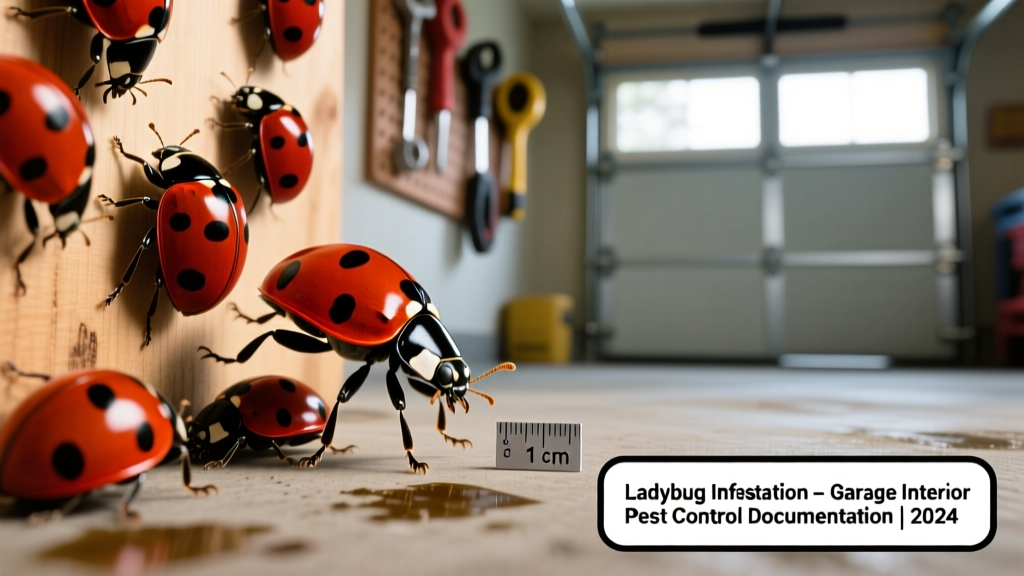
Ladybugs—especially the invasive multicolored Asian lady beetle (Harmonia axyridis)—flock to garages in fall seeking warmth and shelter for overwintering. While beneficial outdoors, they become a nuisance indoors: they secrete foul-smelling yellow fluid when disturbed, stain surfaces, and may trigger allergic reactions in sensitive individuals.
Identification
Not all red-and-black spotted beetles are the same. The Asian lady beetle is often mistaken for native ladybugs but differs in key ways. Look for a distinctive black 'M'-shaped mark behind the head (on the pronotum), variable spot count (0–22), and orange-to-red wing covers that range from pale salmon to deep crimson. They’re slightly larger (5–8 mm) and more oval than native species.
| Feature | Asian Lady Beetle | Native Ladybug (e.g., Hippodamia convergens) |
|---|---|---|
| Size | 5–8 mm | 4–6 mm |
| Pronotum marking | Black 'M' or 'W' shape | Plain or faint light spots |
| Spot variability | 0–22 spots; some entirely black or orange | Consistent 7–9 spots; rarely absent |
| Behavior indoors | Aggregates in large numbers; seeks cracks near windows/doors | Rarely enters structures; stays outdoors |
Signs of infestation include clusters on south-facing garage walls, window frames, or overhead door seals—especially on warm autumn days. You may also notice tiny yellow stains (reflex bleeding) on concrete floors or stored boxes.
What Attracts Them
Garages are ideal overwintering sites because they offer thermal mass, minimal disturbance, and entry points most homeowners overlook. Key attractants include:
- South- or west-facing exterior walls that absorb afternoon sun and radiate heat into wall voids
- Gaps around overhead garage door seals (even 1/16" openings suffice)
- Cracks in foundation walls, utility conduit entries, or soffit vents
- Warm air currents rising from attached homes into the garage attic space
According to the University of Kentucky Entomology Department’s 2022 field survey, 68% of garage ladybug aggregations occurred within 3 feet of the overhead door track or adjacent wall seams—highlighting how precise their entry targeting really is.
Treatment Methods
Natural Removal
Vacuuming with a shop vac (using a clean bag or cloth filter) is the fastest, safest method—just empty the bag outside immediately to avoid reinfestation. For live removal, use a soft brush and wide-mouth jar to gently scoop them into a ventilated container, then release outdoors on a sunny, sheltered tree trunk at least 100 yards from your home. Avoid crushing them: reflex bleeding can stain drywall, carpet, or car interiors.
- Cool garage temps below 55°F overnight slow movement and make vacuuming easier
- Use a flashlight at dusk—they’re attracted to light and gather near windows
- Place damp paper towels near clusters to encourage grouping before vacuuming
Chemical Options
Residual pyrethroid sprays (e.g., deltamethrin or bifenthrin) applied to entry points *outside* the garage can deter new arrivals—but only as a last resort and never inside where pets or vehicles are stored. The U.S. EPA warns that indoor pesticide use against ladybugs carries unnecessary risk: they’re not disease vectors and pose no structural threat. If spraying is unavoidable, follow label instructions precisely and ventilate thoroughly.
"Vacuuming beats spraying every time for garage ladybugs—no residue, no risk, and it works even on cold mornings when they’re sluggish." — Dr. Ric Bessin, UK Entomology Extension, 2023
Prevention
Sealing is 90% of the solution—and it’s doable in under a weekend. Focus first on the overhead door: replace worn rubber seals, install weatherstripping along the top and side tracks, and caulk gaps where the door meets the frame. Then inspect the garage’s perimeter:
- Fill cracks >1/8" in concrete floors and foundation walls with hydraulic cement or polyurethane caulk
- Install fine-mesh (16-mesh) screening over soffit and gable vents
- Seal utility penetrations (electrical conduits, plumbing lines) with expanding foam or copper mesh + caulk
- Add a threshold sweep to any walk-in garage door
For long-term success, combine sealing with seasonal monitoring: check south-facing walls weekly in September and October. Early detection means fewer beetles—and less cleanup later.
When to Call an Exterminator
Call a licensed pest professional if you find more than 1,000 ladybugs inside your garage over two weeks—or if they’re consistently returning despite sealing efforts. A reputable technician will inspect for hidden voids (e.g., between garage wall sheathing and insulation) and apply targeted exterior barrier treatments. Avoid companies offering “whole-garage fogging”: it’s ineffective and violates EPA guidelines for non-target pests.
Why do ladybugs gather on my garage door?
They’re drawn to the thermal gradient—the warm surface of sun-heated metal or wood absorbs infrared radiation, mimicking the sun-warmed rock faces they use in nature. Their compound eyes detect subtle heat signatures, guiding them to the warmest seam or gap. This is why clusters appear on the top third of doors, especially near hinges or weatherstrip edges.
Can ladybugs damage my car or tools?
No—they don’t chew wiring, rubber, or metal. But their reflex bleeding fluid contains alkaloids that can etch painted surfaces over time. Wipe stains quickly with a damp microfiber cloth; avoid ammonia-based cleaners, which react with the secretion and worsen discoloration.
Are ladybugs harmful to pets?
Rarely—but dogs or cats may vomit or drool after chewing one due to its bitter alkaloid defense chemicals. According to the ASPCA Animal Poison Control Center’s 2021 case log, fewer than 12 incidents were reported nationwide—none required hospitalization. Still, vacuum up visible beetles before letting pets roam the garage freely.
Do ultrasonic devices work against ladybugs?
No. Independent testing by the Ohio State University Extension (2022) found zero reduction in ladybug aggregation near ultrasonic emitters—even at full power and multiple units per garage. These devices rely on sound frequencies insects don’t use for navigation or communication.
Will cold weather kill them in my garage?
Not reliably. Asian lady beetles tolerate temperatures down to 20°F for weeks and enter diapause (a hibernation-like state) at 45–55°F. Garages often stay above freezing—especially if attached to heated homes—so they survive winter and emerge in spring. That’s why prevention must happen *before* temperatures drop.
Can I use essential oils to repel them?
Peppermint and clove oil sprays show mild short-term repellency in lab trials (University of Nebraska-Lincoln, 2020), but field effectiveness in garages is negligible. Oils evaporate quickly in drafty spaces and require reapplication every 2–3 days—making them impractical compared to physical exclusion. Save your money and focus on sealing instead.
If you’ve dealt with ladybugs in the garage before, you know how fast they multiply—and how stubborn they are once settled. Prevention isn’t glamorous, but caulking those tiny gaps now saves hours of vacuuming next October. For more seasonal strategies, see our guides on overwintering pests and garage pest-proofing. And remember: a well-sealed garage keeps out more than just ladybugs—it blocks mice, box elder bugs, and stink bugs too.