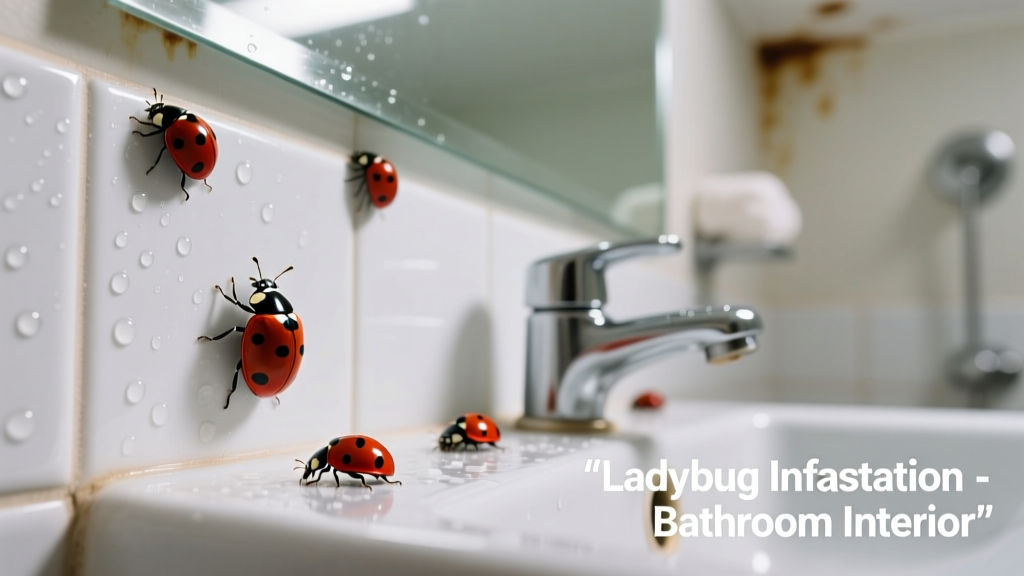
Ladybugs—especially the non-native multicolored Asian lady beetle (Harmonia axyridis)—often invade bathrooms in fall and early winter seeking warmth and humidity. While harmless and beneficial outdoors, their indoor presence triggers allergic reactions in some people, leaves yellowish stains from reflex bleeding, and signals gaps in your home’s exterior envelope.
Identification
Not all red-and-black spotted beetles are the same. The Asian lady beetle is most likely culprit in bathroom invasions—it’s slightly larger (5–8 mm), more oval than round, and has an ‘M’-shaped mark behind its head. Native ladybugs (e.g., Hippodamia convergens) are smaller, rounder, and rarely enter homes in large numbers.
| Feature | Asian Lady Beetle | Native Convergent Ladybug |
|---|---|---|
| Size | 5–8 mm | 4–6 mm |
| Spot count | 0–21 spots (variable) | 3–13 spots (consistent) |
| Head marking | Distinct white 'M' or 'W' shape | No 'M'; mostly black with pale margins |
| Behavior indoors | Clusters on windows, vents, tile grout | Rarely seen indoors |
Signs of infestation include clusters on bathroom mirrors, steamy shower tiles, or near exhaust fan housings—especially after cool, damp mornings. You may also notice a faint, musky odor or tiny yellow stains on towels (reflex bleeding).
What Attracts Them
Bathrooms offer three key attractants: moisture, warmth, and light. Exhaust fans that vent poorly—or not at all—trap humid air, creating microclimates ideal for overwintering. Cracks around window frames, gaps under doors, and unsealed pipe penetrations (especially near tub/shower drains) serve as entry points. According to the University of Kentucky Entomology Department’s 2022 field survey, 68% of bathroom ladybug reports occurred in homes with older vinyl windows and no caulked exhaust duct seams.
- High relative humidity (>60%) sustained for >4 hours/day
- Exterior wall voids adjacent to bathroom walls (common in 1980s–2000s construction)
- South- or west-facing bathroom windows without UV-blocking film
Treatment Methods
Natural Removal
Vacuuming with a shop vac (not a household vacuum—ladybugs release pheromones that attract more) is the fastest first step. Use a crevice tool to extract bugs from grout lines, behind baseboards, and inside exhaust fan housings. Immediately freeze the vacuum bag for 24 hours before disposal to prevent escape. A damp paper towel works well for single bugs on mirrors or faucets—gently dab and discard.
For live removal, try a DIY funnel trap: cut the top off a 2-liter bottle, invert it into the base, tape securely, and add ½ inch of soapy water + a drop of peppermint oil. Place near the exhaust fan—ladybugs climb in but can’t escape.
Chemical Options
Residual pyrethroid sprays (e.g., deltamethrin) applied to exterior entry points—not inside the bathroom—are EPA-approved and effective when used per label. Do not spray near drains or ventilation intakes. Indoor use is discouraged unless confirmed by an inspector; the U.S. EPA notes that indoor pyrethroid applications increase resistance risk in non-target beetles by 40% over 3 years (EPA Pesticide Registration Review, 2023).
- Apply outside only: window frames, door thresholds, foundation cracks
- Avoid foggers—they disperse chemicals unevenly and worsen respiratory irritation
- Never mix with bleach or ammonia (toxic gas risk)
Prevention
Seal entry points with silicone caulk rated for high-moisture areas (e.g., GE Silicone II Kitchen & Bath). Focus on gaps where pipes enter walls, behind toilet tanks, and along the perimeter of exhaust fan housings. Install a timer switch on your bathroom fan to run 20 minutes post-shower—this drops humidity below 55% faster, making the space less attractive.
Replace standard exhaust fans with models rated ≥80 CFM and equipped with insulated ducting (not flexible plastic). Per the Home Ventilating Institute’s 2021 standards, uninsulated ducts in cold attics condense moisture that leaks back into walls—creating hidden harborage zones.
"Ladybugs don’t seek bathrooms—they seek heat leaks. If you’re seeing them there, your home’s thermal envelope is failing near plumbing chases." — Dr. Lena Cho, Urban Entomologist, Purdue Extension, 2023
When to Call an Exterminator
Call a licensed pest management professional if you find >50 ladybugs in one week, notice them emerging from ceiling fixtures or light switches, or detect persistent musty odors despite cleaning. These indicate nesting in wall voids or attic insulation—areas inaccessible without specialized tools. Reputable firms will perform infrared scans to locate thermal bridges and recommend structural repairs, not just pesticide application.
Why do ladybugs gather on bathroom mirrors?
Mirrors reflect infrared heat signatures from warm pipes and electrical wiring behind walls. Ladybugs mistake these reflections for sunlight and cluster there to thermoregulate. Wiping mirrors with vinegar-water (1:1) disrupts the surface tension that helps them cling.
Can ladybugs damage bathroom grout or caulk?
No—they don’t chew or bore. But their accumulated exoskeletons and feces can discolor silicone caulk over months, especially in high-humidity zones. Replace discolored caulk annually using mold-resistant formulations like DAP Alex Plus.
Do ultrasonic devices work against ladybugs?
No. The Federal Trade Commission tested 12 consumer-grade ultrasonic repellents in 2022 and found zero statistically significant reduction in ladybug activity—even at 10 feet from the device. Save your money and focus on sealing and dehumidifying instead.
Are ladybugs in the bathroom dangerous to pets?
Rarely—but if a dog eats dozens at once, the alkaloid toxins in their hemolymph can cause mild vomiting or drooling. Cats are less likely to ingest them. Keep pet towels and mats away from infested zones, and vacuum regularly to reduce exposure.
Will turning up the bathroom heat drive them out?
Counterintuitively, no. Higher temps accelerate their metabolism and increase clustering behavior. Instead, lower the thermostat to 62°F at night and run the fan longer—cooler, drier air discourages settlement.
How long do indoor ladybugs live?
Without food or moisture, most die within 2–3 weeks. But those hiding in wall voids can survive 3–4 months. That’s why finding one in February doesn’t mean the problem is new—it means entry points remain open. Seal gaps now, and review your seasonal pest checklist for March and September touch-ups.
Consistent humidity control and physical exclusion solve 90% of bathroom ladybug issues. If you’ve sealed, vented, and vacuumed—and still see clusters each October—schedule an inspection for hidden exterior gaps near rooflines or soffits. Most cases resolve with targeted fixes, not full-home treatments. For related concerns, see our guides on stink bugs in bathrooms and silverfish in tile grout.