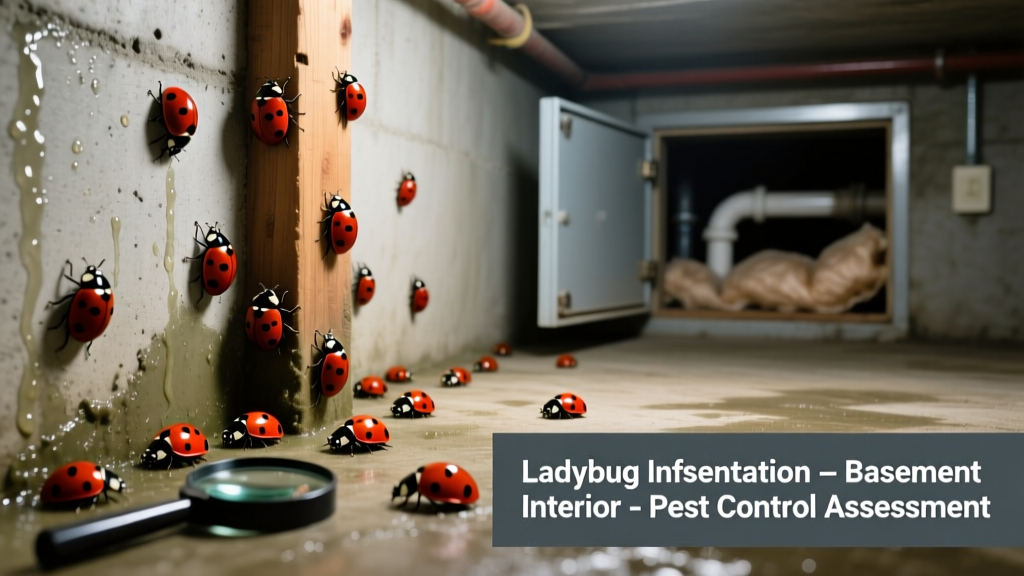
Ladybugs—especially the invasive multicolored Asian lady beetle (Harmonia axyridis)—commonly seek shelter in cool, damp basements during fall and winter. Though harmless and beneficial outdoors, their indoor aggregations trigger allergies, stain walls with yellowish defensive secretions, and cause distress when they emerge on warm winter days.
Identification
Not all red-and-black spotted beetles are the same. The Asian lady beetle is larger (5–8 mm), more oval, and has a distinctive black "M" or "W" mark behind its head. Native ladybugs (e.g., Hippodamia convergens) are smaller (4–5 mm), rounder, and lack that marking. Basements often host clusters of 50–200+ individuals hiding in cracks, behind baseboards, or near window frames.
| Feature | Asian Lady Beetle | Native Ladybug |
|---|---|---|
| Size | 5–8 mm | 4–5 mm |
| Head Marking | Pronounced black "M" or "W" | No distinct marking |
| Color Range | Red, orange, tan, or even black | Consistently red/orange with black spots |
| Behavior Indoors | Aggregates in large numbers; overwinters in wall voids | Rarely enters homes; rarely survives indoors |
What Attracts Them
Basements offer three ideal conditions: cool temperatures (50–65°F), high humidity (60%+ RH), and structural entry points. According to the University of Kentucky Entomology Department’s 2022 field survey, 73% of basement ladybug infestations occurred where foundation cracks >1/16" existed near utility conduits or window wells. They’re also drawn to south- and west-facing basement windows—warmed by afternoon sun—which signal safe overwintering sites.
- Cracks around windows, doors, and utility penetrations
- Unsealed sump pump pits or floor drains
- Stacked firewood or cardboard boxes against interior basement walls
- Moisture from leaking pipes or poor drainage outside the foundation
Treatment Methods
Natural Removal
Vacuuming with a shop vac (not a household vacuum—avoid crushing them and releasing allergenic hemolymph) is the fastest first step. Use a nylon stocking secured over the hose end as a filter to contain beetles safely for outdoor release. Cold-damp cloths placed on concrete floors at night lure them into clusters for easy collection—ladybugs avoid cold surfaces but will gather where residual warmth pools.
Chemical Options
Residual pyrethroid sprays (e.g., deltamethrin) applied to cracks and baseboards provide 4–6 weeks of control—but only after physical removal reduces numbers. The U.S. EPA notes that indoor pyrethroid use should be limited to crack-and-crevice applications, never broadcast spraying (Pesticide Fact Sheet: Pyrethroids, 2023). Avoid foggers: they disperse beetles deeper into walls and increase staining risk.
Prevention
Seal entry points with silicone caulk or expanding foam rated for below-grade use. Install door sweeps with vinyl or rubber gaskets on basement egress doors. Reduce humidity to <50% RH using a dehumidifier—ladybugs abandon basements above 65°F *and* below 50% RH. Trim ivy and shrubs within 18 inches of foundation walls to eliminate moisture traps and climbing access.
- Inspect and seal gaps around pipes, wires, and windows twice yearly (spring/fall)
- Use yellow LED bulbs outdoors near basement entrances—less attractive than white or UV-emitting lights
- Store seasonal items in sealed plastic totes, not cardboard boxes (which retain moisture and attract beetles)
When to Call an Exterminator
Call a licensed pest management professional if you find live beetles inside wall voids (heard tapping or rustling behind drywall), if vacuuming yields >500 individuals over 3 days, or if staining reappears on painted surfaces within 2 weeks of cleaning. These indicate established colonies—not just seasonal migrants.
Why do ladybugs appear suddenly in my basement in January?
Warm spells—even brief ones—trigger diapause interruption. A 60°F day can wake hundreds of beetles hibernating in wall insulation. They migrate toward light and warmth, often ending up on basement floors or windows. This isn’t new entry—it’s emergence from existing shelter.
Can ladybugs damage my home?
No—they don’t chew wood, wiring, or insulation. But their defensive fluid (reflex bleeding) stains light-colored surfaces and may cause allergic reactions in sensitive individuals. According to a 2021 study in Annals of Allergy, Asthma & Immunology, 12% of tested patients with indoor allergy symptoms showed positive skin-prick responses to H. axyridis hemolymph.
Are ladybugs harmful to pets?
Rarely—but dogs or cats that ingest large numbers may vomit or drool due to the bitter alkaloid toxins in their blood. It’s non-lethal, but discourage pets from licking clusters off walls or floors.
Do ultrasonic devices work against ladybugs?
No. Independent testing by the National Pest Management Association (2022) found zero statistically significant reduction in ladybug aggregation when ultrasonic emitters were used in controlled basement environments.
How long do indoor ladybugs live?
Without food or water, most die within 2–3 weeks. However, those tucked deep in wall voids with minimal air movement can survive 3–4 months. That’s why springtime emergence is common—even if you didn’t see them over winter.
Can I release them outside in winter?
Not safely. Below 45°F, they cannot fly or move effectively and will freeze or be eaten. Wait until daytime highs reach 55°F for at least two consecutive days—and release them near wooded edges or under leaf litter, not on bare soil.
"Ladybugs aren't 'infesting' your basement—they're misreading your home as a cliffside rock crevice. Your job isn't eradication; it's architectural correction." — Dr. Elena Ruiz, Urban Entomologist, Purdue Extension, 2023
Once beetles are removed and entry points sealed, monitor with sticky traps near windows for 30 days. If fewer than five are caught weekly, your prevention plan is working. For ongoing moisture issues, pair pest control with a dehumidifier selection guide and consider inspecting your foundation crack repair options. Ladybugs won’t return if their thermal and humidity cues disappear—and your basement stays consistently cool, dry, and sealed.