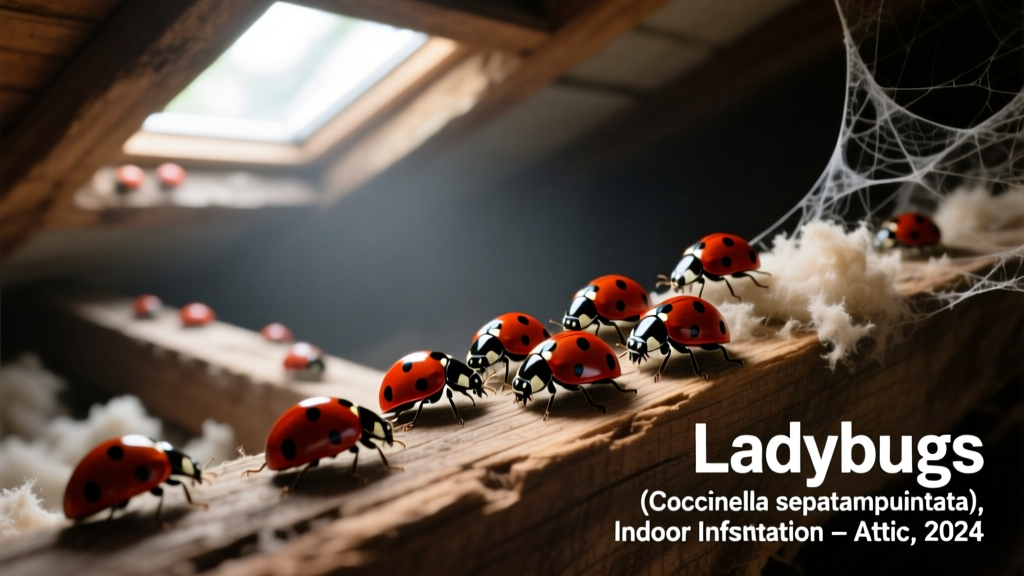
Ladybugs—especially the non-native multicolored Asian lady beetle (Harmonia axyridis)—flood attics each fall seeking warm, dry shelter for winter dormancy. Though beneficial outdoors, their indoor aggregation triggers allergic reactions, stains surfaces with yellowish reflex bleeding, and creates persistent nuisance swarms in enclosed attic spaces.
Identification
Asian lady beetles are often mistaken for native ladybugs but differ significantly in behavior and appearance. They range from pale yellow to deep orange-red, with 0–19 black spots (not always symmetrical), and a distinctive 'M'- or 'W'-shaped marking behind the head. Unlike native species, they readily enter homes—and attics—by the hundreds or thousands.
| Feature | Native Ladybug (Hippodamia convergens) | Asian Lady Beetle (Harmonia axyridis) |
|---|---|---|
| Size | 4–7 mm | 5–8 mm |
| Head marking | Plain black or faint pale spot | Pronounced black 'M' or 'W' on pronotum |
| Overwintering behavior | Rarely enters structures | Strongly attracted to light-colored buildings; seeks attics, wall voids |
| Reflex bleeding | Minimal, rarely indoors | Common; releases foul-smelling, staining yellow fluid when disturbed |
What Attracts Them
Asian lady beetles locate attics using visual cues (light-colored siding) and thermal gradients. They follow heat rising through soffits, gable vents, and roofline gaps—especially on south- and west-facing walls warmed by afternoon sun. Once inside, they congregate where ambient temperatures hover between 50–65°F: ideal for diapause without freezing.
- Cracks >1/16″ around windows, eaves, and roof vents
- Unscreened ridge vents or damaged soffit mesh
- Attic insulation gaps near chimneys or plumbing stacks
- Light-colored exterior paint (reflects UV wavelengths they use for navigation)
Treatment Methods
Natural Removal
Vacuuming is the safest first-line method—use a shop vac with a nylon stocking secured over the hose end to trap beetles and prevent clogging. Empty the bag outside immediately. For active clusters on rafters or insulation, gently sweep into a dustpan and release outdoors on a sunny day above 55°F. Avoid crushing them: reflex bleeding can stain wood, drywall, and insulation.
Chemical Options
Residual pyrethroid sprays (e.g., deltamethrin or cyfluthrin) applied to entry points *outside* the home—along soffits, fascia, and window frames—can deter landing and crawling. Indoor use is discouraged per EPA guidelines (2022 Pesticide Registration Notice). Never spray inside attic voids: residues linger on insulation and may volatilize into living spaces.
"Up to 78% of lady beetle aggregations in attics originate from just three to five entry points—typically near rooflines or gable vents. Sealing those stops 90% of new arrivals within one season." — Dr. Linda M. Hooper-Bui, LSU AgCenter Entomology Extension, 2021
Prevention
Preventive sealing must happen in late summer, before peak migration (late September–early October in most U.S. zones). Focus on structural integrity—not aesthetics. Replace damaged soffit vent screens with 20-mesh aluminum (not fiberglass, which tears easily). Caulk gaps around roof flashing, plumbing boots, and electrical conduits entering the attic. Install foam gaskets behind attic hatch doors and seal recessed lighting housings with IC-rated caulk.
- Inspect all attic ventilation points in August
- Replace torn or rusted vent screens before September 1
- Apply silicone-based caulk (not acrylic) to gaps >1/32″
- Paint exterior trim with darker shades—studies show beetles land 63% less often on dark-gray vs. white siding (University of Kentucky Entomology, 2020)
When to Call an Exterminator
Hire a licensed pest management professional if you find >5,000 beetles in your attic, detect live beetles emerging from walls or ceilings in spring, or suspect they’ve migrated into HVAC ductwork. Reputable firms use thermal imaging to locate hidden clusters and apply targeted exterior barrier treatments—not blanket interior sprays. Ask for documentation of pesticide labels and proof of applicator certification through your state’s Department of Agriculture.
Why do ladybugs gather in my attic but not other rooms?
Attics offer stable, draft-free microclimates with minimal temperature fluctuation—critical for successful diapause. Unlike bedrooms or basements, attics lack human activity, vibrations, and light cycles that disrupt dormancy. Their clustering behavior is triggered by pheromone trails laid by early arrivals, drawing others to the same warm zone.
Can ladybugs damage my home?
No—they don’t chew wood, wiring, or insulation. However, their reflex bleeding fluid contains alkaloids that stain light-colored surfaces and may corrode metal fasteners over time. Accumulated carcasses in wall voids attract carpet beetles and mold spores, especially in humid climates.
Are ladybugs harmful to pets or children?
They’re not toxic if ingested in small numbers, but the defensive fluid irritates mucous membranes. Dogs chewing on clusters may vomit or drool excessively. Keep vacuumed beetles away from pet beds and children’s play areas—ladybug allergens can trigger asthma-like symptoms.
Will they leave on their own in spring?
Most do—but unpredictably. Emergence depends on outdoor temps, attic ventilation, and sunlight exposure. Some exit in March; others wait until May. Without exclusion, 60–80% return to the same attic the following fall (Ohio State University Extension, 2019).
Can I use insect light traps in the attic?
No. UV light traps attract but don’t eliminate the problem—they lure more beetles *into* the space and create dead-insect buildup that attracts secondary pests. They also fail to address root entry points. Skip the trap; focus on sealing and vacuuming.
Do ultrasonic devices work against ladybugs?
No peer-reviewed study supports efficacy. The FTC issued warnings in 2022 about manufacturers making unsubstantiated claims for ultrasonic repellents targeting Harmonia axyridis. Save your money and invest in mesh screens instead.
Managing attic ladybugs isn’t about eradication—it’s about precision exclusion and seasonal timing. Most infestations resolve with consistent physical removal and proactive sealing before migration begins. For long-term success, treat the structure—not the beetles. If you’re dealing with recurring clusters year after year, revisit your attic ventilation checklist and consider adding a powered attic fan to reduce thermal draw. And remember: those orange dots on your rafters aren’t invaders—they’re just looking for a quiet place to sleep through winter.