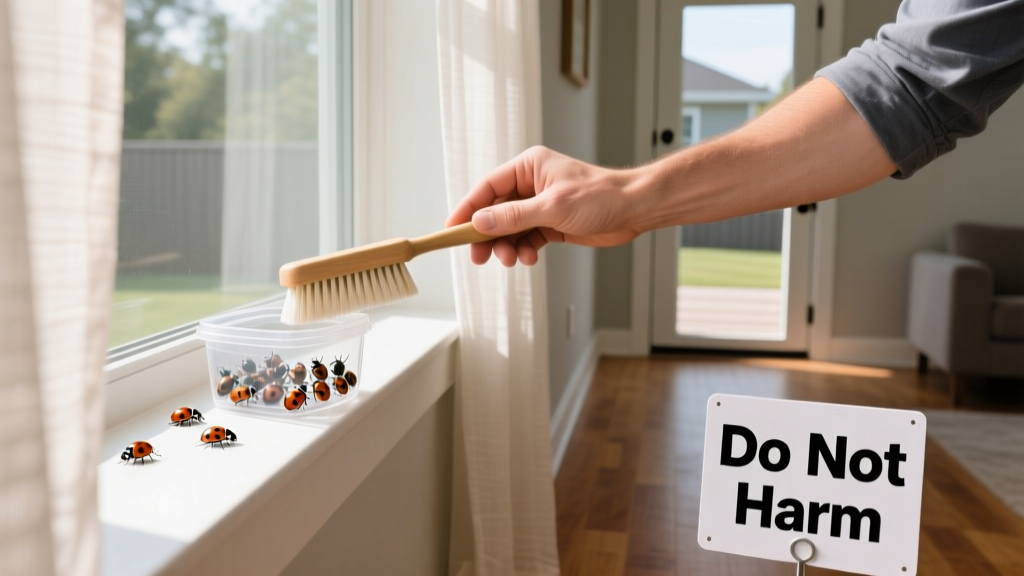
Ladybugs—especially the non-native multicolored Asian lady beetle (Harmonia axyridis)—swarm homes each fall seeking warm shelter for winter hibernation. Though beneficial outdoors, indoors they become a nuisance: they stain walls and curtains with yellowish defensive secretions, emit a foul odor when disturbed, and can trigger allergic reactions in sensitive individuals (University of Kentucky Entomology, 2022).
Identification
Ladybugs found indoors are most often the multicolored Asian lady beetle—not the native red-and-black species. Adults range from 0.17 to 0.25 inches long, with variable coloration (orange, tan, or red) and 0–19 black spots. A key identifier is the distinctive 'M'-shaped marking behind the head on the pronotum.
| Species | Size | Color & Spots | Key ID Feature | Indoor Risk Level |
|---|---|---|---|---|
| Multicolored Asian lady beetle | 4–6 mm | Orange to red; 0–19 black spots | Black 'M' on white pronotum | High |
| Native convergent lady beetle | 4–5 mm | Red with 6–13 black spots | No 'M'; black legs | Low (rare indoors) |
| Twelve-spotted lady beetle | 4–5 mm | Yellow-orange with 12 black spots | Uniform spot size; pale legs | Very low |
Signs of infestation include clusters on sunny windowsills, attic eaves, or interior walls—especially in October through March—and tiny yellow stains on curtains or baseboards.
What Attracts Them
These beetles are phototactic and thermotactic: they seek south- or west-facing sun-warmed surfaces in autumn. Cracks around windows, gaps under doors, unsealed soffits, and openings near utility lines serve as entry points. Homes with light-colored exteriors, especially stucco or vinyl siding, attract more beetles than darker structures (Penn State Extension, 2021).
- South- or west-facing exterior walls with direct afternoon sun
- Gaps >1/8 inch wide around windows, doors, and foundation vents
- Unscreened attic vents or missing chimney caps
- Decaying wood or loose caulk near rooflines
Treatment Methods
Natural Removal
Vacuuming with a shop vac (not a household vacuum—beetles release odors and fluids that clog filters) is the fastest non-toxic method. Use a clean, detachable hose attachment and empty the canister outside immediately. For small numbers, a damp paper towel works well—gently scoop and release outdoors away from the house.
Cool temperatures slow their movement: lowering indoor temps to 60°F for several hours makes them easier to collect. Some homeowners use pheromone traps like the Spectracide Asian Lady Beetle Trap, which lures beetles with a synthetic aggregation pheromone.
Chemical Options
Residual insecticides should be used only as a last resort and strictly outdoors—never inside living areas. Perimeter sprays containing bifenthrin or deltamethrin applied in late September to early October reduce entry by up to 70% (University of Nebraska-Lincoln Extension, 2020). Indoor pesticide use is discouraged: it doesn’t eliminate overwintering adults already inside and poses health risks to pets and children.
- Avoid foggers or space sprays—they disperse chemicals widely and don’t target entry points
- If treating exterior cracks, use microencapsulated formulations for longer residual effect
- Always follow EPA label instructions and wear gloves/mask during application
Prevention
Sealing is 90% of long-term control. Focus on the upper third of your home—their preferred entry zone. Replace worn weatherstripping, install door sweeps with rubber bristles, and caulk gaps around window frames, pipes, and electrical conduits using silicone-based sealant (which remains flexible in cold temps).
Install 20-mesh aluminum screening over attic vents and soffit openings. Trim tree branches and vines within 2 feet of the house—these provide landing pads before beetles crawl into crevices.
"Most homeowners spend hours vacuuming ladybugs in January—but if they’d spent two hours caulking in October, they’d avoid 95% of the problem." — Dr. Ric Bessin, University of Kentucky Entomology, 2022
When to Call an Exterminator
Call a licensed pest management professional if you’re finding >500 beetles indoors over a 48-hour period, notice beetles emerging from wall voids or ceiling fixtures, or suspect they’re accessing your HVAC system. Reputable companies use targeted exclusion techniques—not blanket spraying—and can inspect hard-to-reach areas like ridge vents and gable ends.
Ask for a written inspection report and verify they’re certified by the National Pest Management Association. Avoid services that promise 'ladybug extermination'—they can’t be eradicated indoors without sealing first.
Why do ladybugs gather on my windows?
They mistake glass reflections for open sky and fly toward light—a behavior called positive phototaxis. Once trapped, they cluster where warmth radiates (e.g., sunlit sills). Installing sheer curtains or applying temporary UV-reflective film cuts attraction by ~60% (Ohio State Extension, 2023).
Are ladybugs harmful to pets?
Rarely—but if a dog or cat eats dozens at once, the defensive alkaloids can cause mild gastrointestinal upset or mouth irritation. There’s no documented case of serious toxicity in pets, but keep vacuumed beetles away from curious animals.
Do ladybugs lay eggs inside homes?
No. They enter homes solely to overwinter—not to breed. All egg-laying occurs outdoors in spring on aphid-infested plants. Any larvae you see indoors are almost certainly carpet beetles or another species.
Can I release them outside in winter?
Not safely. Below 45°F, they become immobile and die if exposed. If collected in cold months, store them in a ventilated container in an unheated garage (35–45°F) until consistent 50°F+ days return—then release at dawn near shrubs or trees.
Will vinegar kill ladybugs?
Vinegar spray may deter them temporarily due to its acidity and smell, but it’s not lethal and evaporates quickly. It won’t affect eggs or hidden adults. Skip DIY sprays and focus instead on physical removal and exclusion—sealing cracks delivers real results.
Consistent prevention starts in late summer: inspect your home’s envelope, replace damaged screens, and schedule a professional exterior sealant touch-up every 2–3 years. Most infestations drop sharply after year two of diligent exclusion—even in heavily affected neighborhoods.