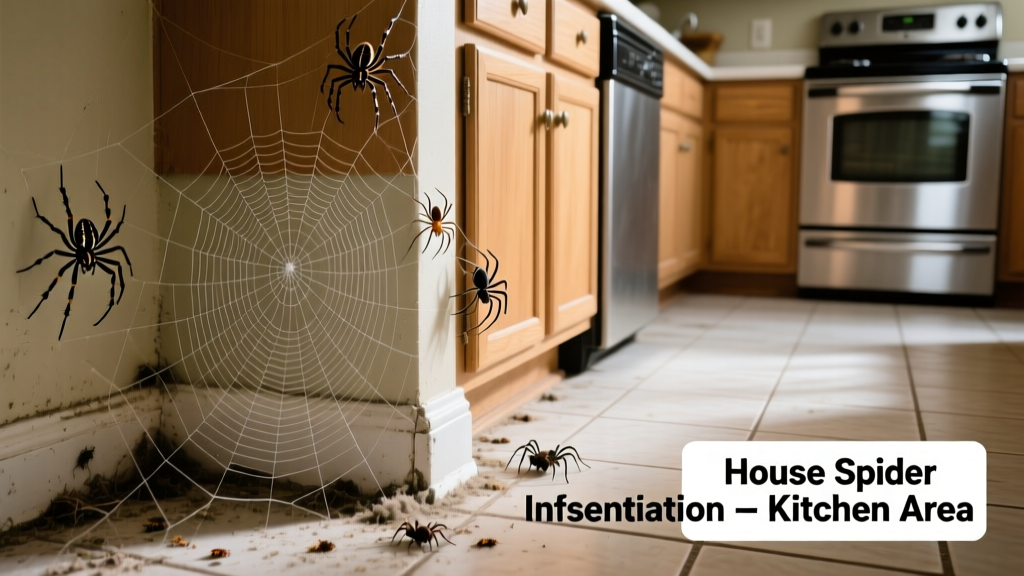
House spiders—especially Parasteatoda tepidariorum (common house spider) and Tegenaria domestica (barn funnel weaver)—frequently settle in kitchens because of warmth, moisture, and insect prey. While harmless to humans, their webs near food prep areas, egg sacs in cabinet hinges, and sudden appearances at night trigger discomfort and hygiene concerns.
Identification
House spiders in kitchens are typically 3–8 mm long, brown or gray with chevron-shaped markings on the abdomen. Legs are long and thin; most build irregular, tangled webs—not symmetrical orbs—in corners, behind appliances, or inside pantry shelves. Unlike dangerous species like black widows or brown recluses, they lack distinct hourglass markings or violin-shaped patterns.
| Species | Size | Web Type | Risk Level | Typical Kitchen Spot |
|---|---|---|---|---|
| Common House Spider (P. tepidariorum) | 4–8 mm | Loose, sticky, three-dimensional tangles | None — non-venomous to humans | Under sink, behind fridge, ceiling corners |
| Barn Funnel Weaver (T. domestica) | 7–12 mm | Sheet-like with funnel retreat | None — bites rare and mild | Baseboards, pantry floor gaps, behind stove |
| Jumping Spider (Phidippus spp.) | 2–7 mm | No web — hunts actively | None — curious but non-aggressive | Countertops, windowsills, toaster slots |
Key signs include: dusty silk strands across upper cabinets, small white oval egg sacs (about 1/8″ wide) tucked in crevices, and live spiders scurrying when opening rarely used drawers.
What Attracts Them
Kitchens offer three critical resources: shelter, water, and food. Leaky faucets or damp dish racks create micro-humidity. Crumbs, unsealed pet food, and open cereal boxes attract ants, flies, and silverfish—spider prey. Cluttered cabinets and stacked boxes provide undisturbed nesting zones. According to the National Pest Management Association’s 2022 Residential Pest Survey, 68% of homes reporting spider activity had at least one persistent moisture source in the kitchen.
- Standing water from leaky pipes or condensation under the sink
- Unsealed dry goods (flour, rice, oats) that draw pantry pests
- Cardboard boxes stored under counters or in pantries (spiders hide in corrugated layers)
- Gap-filled baseboards and cracked caulk around windows and plumbing
Treatment Methods
Natural Methods
Vinegar-water spray (1:1 ratio) disrupts pheromone trails and deters spiders on contact. Spray along baseboards, cabinet edges, and behind appliances weekly. Diatomaceous earth (food-grade) applied as a fine line along entry points dehydrates spiders within 24–48 hours—but avoid using near open food or where children/pets may inhale dust. Vacuuming webs and spiders with a HEPA-filter vacuum removes both adults and egg sacs effectively—dispose of the bag or canister contents outdoors immediately.
Chemical Options
Pyrethroid-based aerosol sprays (e.g., those containing bifenthrin or cypermethrin) work well for spot treatment in low-traffic zones like behind the refrigerator or under the sink. Apply only in cracks and crevices—not on countertops or food prep surfaces. The U.S. EPA notes that overuse of these products indoors can increase resistance in spider populations within 18–24 months (EPA Pesticide Registration Review, 2023). Always follow label instructions and ventilate the area for 30 minutes post-application.
Prevention
Long-term control means making your kitchen less hospitable—not just removing spiders. Seal gaps larger than 1/16″ with silicone caulk or copper mesh. Store flour, cereal, and pet food in rigid, lidded containers—glass or thick plastic, not zip-top bags. Wipe down countertops nightly and sweep floors at least every other day to eliminate insect prey. Install door sweeps on pantry and exterior kitchen doors, and replace torn window screens immediately.
"Spiders don’t invade kitchens for shelter alone—they’re following the food chain. Cut off their prey, and you’ll see 70% fewer spiders within three weeks." — Dr. Lena Cho, Urban Entomologist, Cornell Cooperative Extension (2021)
- Clean behind and under appliances monthly (fridge, dishwasher, microwave)
- Run exhaust fans during and after cooking to reduce humidity
- Replace cardboard packaging with sealed containers within 48 hours of opening
- Inspect and re-caulk around sink drains and pipe entries every 6 months
When to Call an Exterminator
Call a licensed pest professional if you find more than 10 adult spiders per week despite consistent cleaning and sealing, or if you spot egg sacs in multiple locations (e.g., inside cabinets, behind wall tiles, and in light fixtures). Infestations exceeding 50+ visible spiders suggest a nearby colony—and possibly entry via structural gaps that require specialized inspection. Most reputable companies offer free visual assessments before quoting treatment; ask if they use integrated pest management (IPM) protocols focused on exclusion first.
Why do I keep finding spiders near my coffee maker?
Heat and residual moisture make coffee makers ideal microhabitats. Wipe the warming plate and drip tray daily, and unplug the unit weekly to vacuum crumbs and silk buildup underneath. Check the cord wrap area—spiders often nest where cords coil against warm surfaces.
Can house spiders get into sealed food packages?
Yes—especially thin plastic bags or cardboard boxes with tiny tears. They won’t chew through thick plastic or glass, but they’ll exploit existing openings. Transfer opened pasta, rice, or nuts to airtight food storage containers within 24 hours of opening.
Are cobwebs in my kitchen dangerous?
No. Cobwebs are abandoned silk, not active nests. But their presence signals recent spider activity—and possibly unnoticed entry points. Remove them with a microfiber duster, then inspect the area for gaps or moisture.
Do spiders lay eggs in kitchen cabinets?
Frequently. Egg sacs are often wedged into hinge recesses, screw holes, or behind drawer slides. Use a flashlight and dental mirror to check tight spaces. Remove sacs with tape or tweezers—never crush them indoors, as hundreds of spiderlings may hatch and scatter.
Will keeping lights on deter spiders?
No. Most house spiders are nocturnal but aren’t repelled by light. In fact, lights attract flying insects—which in turn attract spiders. Instead, reduce outdoor lighting near kitchen windows or switch to yellow sodium-vapor bulbs to cut down on moth and fly traffic.
Can I use peppermint oil to repel spiders permanently?
Peppermint oil (10–15 drops per cup of water) offers short-term deterrence—up to 3–4 days—when sprayed on baseboards or window frames. However, it evaporates quickly and has no residual effect. It’s best used as a supplemental tool alongside sealing and sanitation, not a standalone solution. For longer-lasting natural repellency, combine it with regular vacuuming and diatomaceous earth application.
House spiders in the kitchen are rarely a sign of neglect—they’re opportunistic responders to conditions we often overlook. Fix the moisture, block the gaps, and break the food chain, and you’ll see real results in under a month. Consistency beats intensity: 10 minutes of targeted cleanup twice a week outperforms one deep-clean marathon every season.