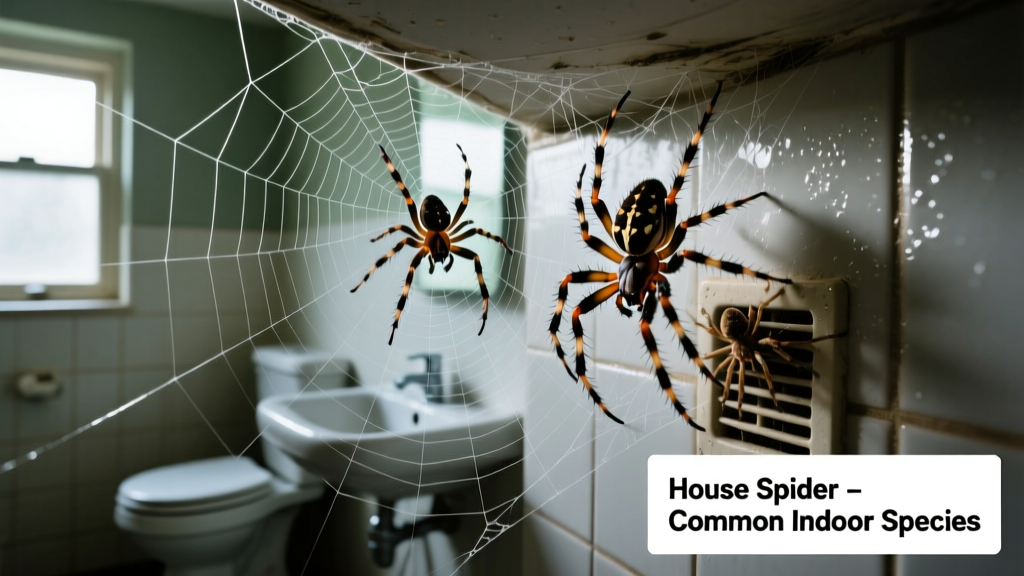
House spiders—especially Parasteatoda tepidariorum (common house spider) and Tegenaria domestica (barn funnel weaver)—frequently settle in bathrooms because of consistent humidity, infrequent disturbance, and abundant insect prey like drain flies and silverfish. While harmless to humans, their webs in corners, behind toilets, and above shower stalls trigger discomfort and signal underlying moisture or entry-point issues.
Identification
House spiders in bathrooms are typically small (3–8 mm body length), brown or gray, with long, slender legs and no distinct markings. They build irregular, tangled cobwebs—not symmetrical orbs—often in high, dry corners or behind fixtures where airflow is low. Unlike dangerous spiders such as black widows or brown recluses, house spiders rarely bite, and their venom causes only mild, localized redness if provoked.
| Species | Size & Color | Web Location | Risk Level |
|---|---|---|---|
| Common House Spider (Parasteatoda tepidariorum) | 4–6 mm; light to dark brown, bulbous abdomen | Upper corners, behind mirrors, under sinks | None — non-aggressive, non-venomous to humans |
| Barn Funnel Weaver (Tegenaria domestica) | 7–10 mm; pale brown with chevron patterns on abdomen | Floor-level crevices, baseboards, towel racks | None — fast-moving but shy; bites extremely rare |
| Long-Bodied Cellar Spider (Pholcus phalangioides) | 5–7 mm; pale yellow-gray, extremely long legs | Showerheads, ceiling corners, light fixtures | None — often mistaken for daddy longlegs; cannot bite human skin |
- Webs appear overnight in undisturbed zones (e.g., behind toilet tank, inside cabinet hinges)
- Small, fast-moving spiders dropping from ceilings or scurrying along grout lines
- Clusters of tiny white egg sacs (pea-sized, silken) tucked in wall cracks or pipe insulation
What Attracts Them
Bathrooms offer three critical resources: moisture, shelter, and food. Relative humidity above 60% supports both spiders and their prey—especially fungus gnats, drain flies, and springtails that breed in damp grout, overflow pans, and leaky faucets. Poor ventilation (e.g., no working exhaust fan or windows that don’t open) traps steam and condensation. Cracks around pipes, gaps under doors, and unsealed vent covers provide easy entry from walls or crawlspaces.
According to the National Pest Management Association’s 2022 Residential Pest Survey, 68% of homes reporting spider activity had at least one documented moisture issue—most commonly in bathrooms with missing caulk, cracked grout, or slow-draining sinks.
Treatment Methods
Natural Removal
Start with physical removal and habitat disruption. Vacuum webs and spiders using a crevice tool—immediately dispose of the vacuum bag outdoors. Wipe down surfaces with a 1:1 vinegar-water solution to eliminate silk pheromone trails. Place sticky traps (spider-specific glue boards) behind toilets and under sinks—not near water sources—to monitor activity and reduce populations without chemicals.
- Spray peppermint oil (10 drops per cup of water) along baseboards and pipe entries—spiders avoid its scent
- Replace damp bath mats daily and store towels off the floor to reduce microhabitats
- Use a dehumidifier set to 45–55% RH during humid months—test with a hygrometer near the shower
Chemical Options
Only consider residual sprays if natural methods fail after 2–3 weeks and webbing persists in multiple locations. Use EPA-registered pyrethroid-based aerosols (e.g., Suspend SC or Tempo SC Ultra) applied as a 6-inch band along baseboards, behind toilets, and around pipe penetrations—not directly into drains or on countertops. Avoid foggers: they disperse ineffectively in small, tiled spaces and pose inhalation risk in poorly ventilated bathrooms.
"Most bathroom spider infestations resolve within 10 days of fixing the moisture source—not the spider. If you’re spraying weekly and still seeing webs, check your exhaust fan’s CFM rating and clean the duct interior." — Dr. Lena Cho, Urban Entomologist, Purdue Extension, 2023
Prevention
Long-term prevention targets the root cause: moisture + access. Re-caulk all tub/shower edges and sink perimeters every 12–18 months—silicone sealant lasts longer than acrylic in wet areas. Install an exhaust fan rated for at least 50 CFM (per Home Ventilating Institute standards) and run it for 20 minutes post-shower. Seal pipe gaps with copper mesh and expandable foam—spiders can’t chew through metal mesh, unlike caulk alone.
- Inspect and replace worn shower door seals monthly—they trap moisture and harbor springtails
- Keep bathroom doors closed when not in use to limit movement between rooms
- Store toiletries in sealed containers; open bottles attract fungus gnats, which attract spiders
- Check under the vanity for standing water or leaking supply lines—32% of bathroom spider hotspots originate from hidden leaks (IBHS 2023 Moisture Audit)
When to Call an Exterminator
Call a licensed pest professional if you find more than 10 live spiders in a single week across multiple bathrooms—or if you spot webs in adjacent rooms (hallways, bedrooms, basements). This suggests a colony nesting in wall voids or crawlspaces, not just incidental bathroom visitors. Also consult an exterminator if you’ve addressed moisture, sealed entries, and removed webs for 3+ weeks with no reduction.
Why do I only see spiders in my bathroom at night?
House spiders are nocturnal and avoid light and vibration. Bathrooms are quieter at night, and residual warmth from daytime showers creates thermal pockets that draw them out. They also hunt nighttime-active insects like drain flies, which emerge after lights go off.
Can house spiders come up through the drain?
No—they lack the anatomy to climb smooth PVC or metal drain pipes against gravity or water flow. What you’re seeing likely entered via gaps around the drain flange, overflow tube, or wall vents—not the pipe itself. A properly installed drain cover with fine mesh prevents entry at the source.
Are bathroom spider webs dangerous to breathe?
No. Spider silk is inert protein and poses no respiratory hazard—even for people with asthma or allergies. However, dusty, abandoned webs can trap mold spores or dust mites; removing them improves indoor air quality regardless.
Do ultrasonic pest repellers work on spiders?
No. Independent testing by the University of Nebraska-Lincoln (2021) found zero statistically significant reduction in spider activity when ultrasonic devices were used in controlled bathroom environments. These units emit frequencies spiders neither hear nor respond to.
Will killing one spider bring more?
No—and this is a persistent myth. Spiders are solitary and don’t communicate chemically to summon others. Removing one doesn’t increase activity; ignoring moisture and food sources does.
Can I use bleach to kill spider eggs?
Bleach may dissolve silk but won’t reliably penetrate egg sacs. Physical removal with a toothbrush and tissue—followed by disposal in outdoor trash—is safer and more effective. Bleach fumes also corrode grout and metal fixtures over time.
House spiders in bathrooms aren’t an infestation warning—they’re a moisture meter with eight legs. Fix the humidity, seal the gaps, and sweep the webs, and you’ll rarely need to reach for anything stronger than a broom. For persistent cases, pair a bathroom moisture audit with targeted sealing—most problems resolve before pesticides ever enter the picture.