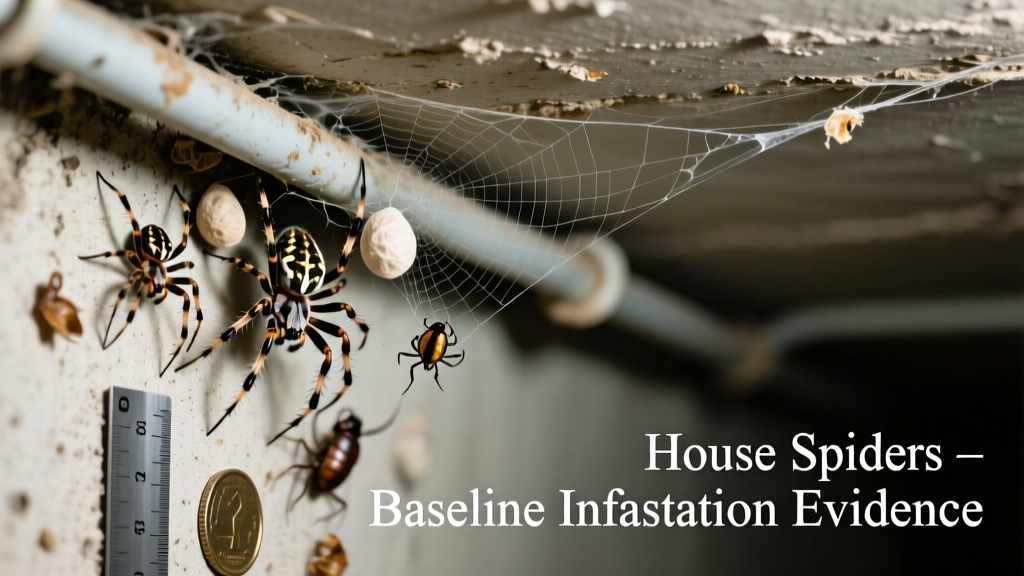
House spiders (Tegenaria domestica and Parasteatoda tepidariorum) commonly settle in basements because of the cool, humid, undisturbed environment—ideal for web-building and hunting insects. While they rarely bite and pose no serious health risk, their webs, egg sacs, and sheer numbers trigger anxiety and signal underlying moisture or entry-point issues.
Identification
Basement-dwelling house spiders are typically 1/4 to 3/8 inch long with long, slender legs and brownish-gray bodies. They build irregular, tangled, non-sticky webs in corners, behind pipes, under stairs, and near sump pumps. Unlike black widows or brown recluses, they lack distinctive markings—but misidentification is common, especially with juvenile spiders.
| Species | Web Type | Body Markings | Typical Location |
|---|---|---|---|
| Domestic House Spider | Loose, messy, funnel-like | Light brown with chevron patterns on abdomen | Corner joists, storage boxes, furnace rooms |
| Cellar Spider (Daddy Longlegs) | Thin, wispy, vertical strands | Pale tan, extremely long thin legs | Ceiling beams, window wells, light fixtures |
| Yellow Sac Spider | Small silken retreats (not full webs) | Yellowish-green, darker cephalothorax | Cracks in foundation, behind baseboards |
Signs you’re dealing with house spiders—not pests like silverfish or centipedes—include:
- Clusters of small, cream-colored, papery egg sacs (each holds 100–250 eggs)
- Frequent sightings at dusk or dawn, especially near moisture sources
- Webbing that reappears within 48 hours after cleaning
What Attracts Them
Spiders don’t seek humans—they follow food and shelter. Basements provide both when conditions go unchecked. According to the National Pest Management Association’s 2022 Residential Pest Survey, 68% of homes with recurring spider activity had documented moisture issues in crawlspaces or basements.
- High relative humidity (>60%) supports mold, which attracts springtails and fungus gnats—their primary prey
- Cluttered storage (cardboard boxes, stacked lumber, old furniture) offers nesting sites and thermal cover
- Unsealed cracks >1/16 inch around windows, floor drains, and utility penetrations serve as entry highways
- Exterior lighting draws flying insects indoors, creating a feeding corridor into basement stairwells
Treatment Methods
Natural Methods
Vinegar-water spray (1:1 ratio) disrupts spider pheromone trails and deters web-building—apply weekly along baseboards and pipe chases. Diatomaceous earth (food-grade) dusted in dry, inaccessible crevices dehydrates spiders on contact; reapply after any humidity spike. Vacuuming webs and egg sacs with a HEPA-filter vacuum removes up to 90% of active populations in one pass—immediately dispose of the bag outside.
Chemical Options
For persistent infestations, use pyrethroid-based sprays (e.g., bifenthrin or cypermethrin) only as spot treatments—not broadcast applications. The U.S. EPA advises limiting indoor use to cracks, voids, and perimeter zones to reduce exposure risk. Always follow label instructions: apply in ventilated areas, avoid carpeted surfaces, and keep children/pets away for 24 hours. Note: Most over-the-counter “spider killer” aerosols have <10% active ingredient—less effective than professional-grade formulations.
Prevention
Long-term control means making your basement uninviting—not just killing spiders. Start with moisture control: install a dehumidifier set to 45–50% RH and fix leaks within 24 hours. Seal all gaps with copper mesh + silicone caulk—especially where plumbing enters concrete walls. Replace white LED bulbs with yellow sodium-vapor lights outdoors to cut insect attraction by up to 70%, per a 2021 University of Florida Entomology study.
- Store items in sealed plastic bins—not cardboard (which retains moisture and harbors prey)
- Inspect and clean sump pump pits monthly; algae buildup attracts springtails
- Trim shrubs and vines 18+ inches from foundation walls to eliminate bridge access
When to Call an Exterminator
Call a licensed pest management professional if you see more than 15 adult spiders in a single week—or if you find egg sacs in multiple rooms beyond the basement. Also consider professional help if DIY efforts fail after 3 consecutive weeks, or if you suspect structural entry points (e.g., crumbling mortar, cracked block foundations). Reputable firms conduct moisture mapping and offer 6-month warranties on spider exclusion services.
Do house spiders bite?
They can, but almost never do. House spiders bite only when trapped against skin—like inside a shoe or folded towel. Their venom is not medically significant to humans. Bites resemble mild mosquito welts and resolve in 1–2 days. If swelling or redness spreads beyond 2 inches, consult a physician to rule out infection or misidentified species.
Are cobwebs the same as spider webs?
No. Cobwebs are abandoned, dusty webs left by spiders that have moved on—or died. Fresh, taut, sticky, or multi-layered webs indicate current activity. Finding three or more fresh webs in one zone suggests localized breeding, not just wandering individuals.
Can I use foggers for basement spiders?
Avoid total-release foggers (“bug bombs”). They’re ineffective against spiders hiding in cracks and voids—and may disperse them deeper into walls. The CDC reports fogger misuse causes 20,000+ annual poison exposures, mostly from inhalation in poorly ventilated basements.
Why do I see more spiders after rain?
Heavy rain saturates soil and floods burrows, forcing ground-dwelling insects—and the spiders that hunt them—upward. Basements become temporary refuge. This surge usually lasts 2–4 days post-rainfall and drops sharply once interior humidity stabilizes.
Does bleach kill spider eggs?
Bleach can dissolve egg sacs on hard, non-porous surfaces—but it won’t penetrate fabric, cardboard, or wood grain where most sacs hide. Worse, bleach fumes irritate respiratory tracts and degrade rubber gaskets on sump pumps. Use a stiff brush and vacuum instead.
Will sealing my basement windows stop spiders?
It helps—but isn’t enough alone. Spiders enter through weep holes, conduit sleeves, and expansion joints. A complete seal requires inspecting the entire perimeter, including the cinderblock mortar joints below grade. For guidance, see our basement moisture seal checklist and whole-home spider-proofing guide.
House spiders in basements are less about infestation and more about environmental cues gone uncorrected. Fix the moisture, remove the clutter, seal the gaps—and you’ll break the cycle without reaching for chemicals. As entomologist Dr. Linda Rayner notes in her 2023 field manual Urban Arachnid Management: “You don’t control spiders. You control what they eat and where they hide.”
“You don’t control spiders. You control what they eat and where they hide.” — Dr. Linda Rayner, Urban Arachnid Management, 2023