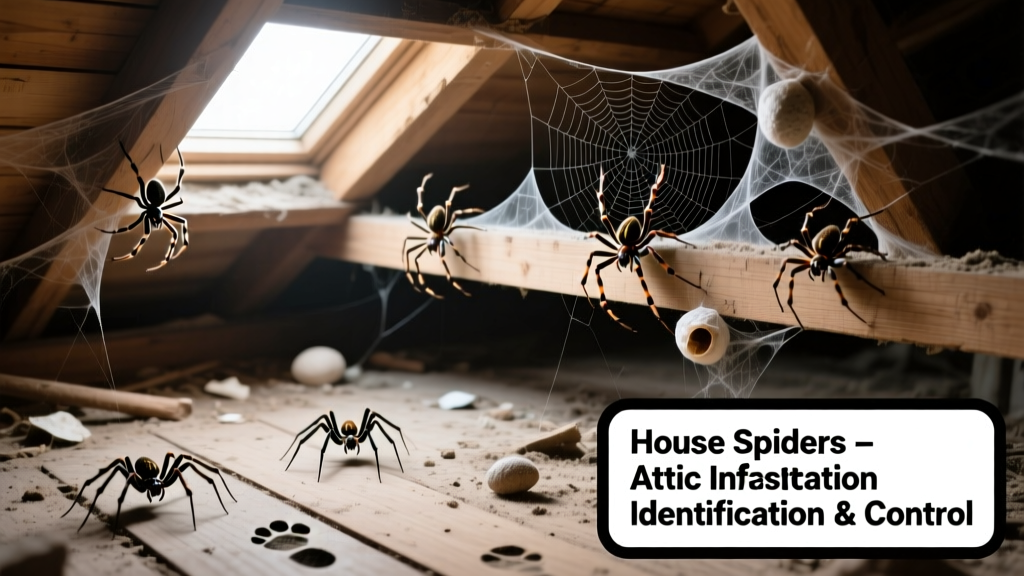
House spiders (Tegenaria domestica and related species) commonly colonize attics because they offer quiet, undisturbed spaces with abundant insect prey. While not dangerous — they rarely bite and pose no health threat — their webs, egg sacs, and sheer numbers can trigger anxiety, reduce air quality near insulation, and signal larger pest entry issues.
Identification
House spiders in attics are typically brown or gray, with long, slender legs (leg span up to 1.5 inches) and a body length of 3–6 mm. They build irregular, tangled, non-sticky webs in corners, along rafters, and behind stored boxes. Unlike black widows or brown recluses, they lack distinct markings — but their web placement and behavior are telltale signs.
| Species | Web Type | Body Markings | Risk Level |
|---|---|---|---|
| House spider (Tegenaria) | Loose, three-dimensional tangle | Uniform tan/brown, no stripes or hourglass | Low — bites rare and medically insignificant |
| Cellar spider (Pholcus) | Thin, messy, often near vents or light fixtures | Extremely long, fragile legs; small pale body | None — harmless, eats other spiders |
| Black widow (Latrodectus) | Tight, asymmetrical, low to ground | Glossy black with red hourglass underside | High — venomous; seek immediate ID if suspected |
- Look for papery, off-white egg sacs (about the size of a pea) tucked into crevices or under insulation batts
- Check for molted exoskeletons clinging to webs — a sign of active, growing populations
- Shine a flashlight across rafters at night: live spiders often freeze mid-web, reflecting greenish eye-shine
What Attracts Them
Attics become spider magnets when three conditions align: consistent food supply, shelter from disturbance, and access points. House spiders feed on flies, moths, silverfish, and other attic-dwelling insects — so an existing insect problem directly fuels spider colonization. Poor ventilation creates humidity pockets that attract both prey and spiders. And gaps around plumbing stacks, roof vents, and eaves give them easy entry from outdoors or lower floors.
According to the National Pest Management Association’s 2022 Residential Pest Survey, 68% of homes with documented attic spider activity also had unsealed soffit vents or missing gable screen mesh.
Treatment Methods
Natural Methods
Start with physical removal and habitat disruption. Vacuum webs, egg sacs, and adults using a shop vac with a hose extension — immediately seal and discard the bag outdoors. Wipe down rafter beams and joists with a 5% vinegar-water solution: acetic acid disrupts pheromone trails and deters re-webbing. Introduce natural predators like jumping spiders or centipedes — though avoid this if you’re already managing a centipede infestation.
- Install LED motion-sensor lights in attic access points — spiders avoid bright, sudden light
- Place sticky traps (not baited) along baseboards and near insulation seams — monitor weekly for activity spikes
- Use diatomaceous earth (food-grade) in 1/8-inch bands along framing joints — dehydrates spiders on contact
Chemical Methods
Reserve chemical options for persistent, high-density infestations. Pyrethroid-based aerosols (like those containing deltamethrin) work best when applied as a crack-and-crevice treatment — never broadcast-spray insulation. Always wear an N95 mask and gloves: disturbing fiberglass insulation while spraying risks respiratory exposure. The U.S. EPA notes that pyrethroids break down within 7–14 days indoors, minimizing long-term residue risk when used as directed.
"Most attic spider problems aren’t solved with sprays — they’re solved by cutting off their food chain. If you eliminate the moths and silverfish first, the spiders leave or starve within 3 weeks." — Dr. Lena Cho, Urban Entomologist, Purdue Extension, 2023
Prevention
Long-term prevention hinges on sealing, drying, and monitoring. Seal all gaps >1/8 inch with copper mesh and silicone caulk — especially where electrical conduits enter, around attic hatches, and at chimney flashing. Install passive ridge vents and soffit vent baffles to maintain airflow below 55% relative humidity — spiders avoid dry, well-ventilated spaces. Store holiday decorations and boxes in sealed plastic totes (not cardboard), and inspect items before bringing them into the attic.
For ongoing maintenance, schedule biannual attic sweeps: one in early spring (before egg sacs hatch) and another in late fall (before overwintering begins). Pair each sweep with a quick inspection of silverfish in attic and attic moth infestations, since both are primary spider food sources.
When to Call an Exterminator
Call a licensed pest professional if you find more than 20 active webs in a single 10' x 10' zone, discover egg sacs in multiple locations (especially behind insulation), or suspect misidentified venomous species. Also consider professional help if you’ve treated twice with appropriate methods and seen zero reduction after four weeks — this usually signals hidden entry routes or an adjacent colony in wall voids.
Can house spiders damage insulation?
No — they don’t chew or nest in insulation like rodents. But heavy webbing can trap dust and moisture, reducing R-value over time and creating micro-habitats for mold spores. A 2021 study in Journal of Structural Pest Management found attic web density correlated with 7–12% localized thermal inefficiency in fiberglass batts.
Do attic spiders come down into living areas?
Sporadically — especially during mating season (late summer) or when attic conditions shift (e.g., post-rain humidity spikes). Most sightings downstairs are lone males searching for mates, not signs of full-house infestation.
Are spider sprays safe near HVAC ductwork?
No. Avoid aerosol or liquid insecticides within 3 feet of duct registers, furnace intakes, or attic-mounted air handlers. Residue can volatilize and recirculate. Use only non-aerosol, low-VOC residual dusts (e.g., boric acid blends) applied strictly to framing, not duct surfaces.
How long do house spider egg sacs take to hatch?
Typically 2–3 weeks in warm attics (70°F+), but up to 6 weeks in cooler zones. Each sac holds 25–60 spiderlings. Removing sacs before hatching prevents exponential growth — and it’s safer than trying to kill hundreds of dispersing juveniles.
Will cold winter temperatures kill attic spiders?
Not reliably. House spiders are cold-tolerant and often cluster in insulated wall voids or under roofing felt where temps stay above freezing. They become sluggish below 45°F but survive months of dormancy — which is why spring is the most effective treatment window.
Can I use essential oils to repel attic spiders?
Peppermint oil solutions show limited short-term repellency in lab trials (University of Nebraska-Lincoln, 2020), but field effectiveness in dusty, ventilated attics is negligible. Oil residues also attract dust and degrade insulation paper facing. Skip it — focus on exclusion and moisture control instead.
Attics are ecosystems — not just storage spaces. Managing house spiders there means treating the environment, not just the bugs. Fix the gaps, dry the air, and disrupt the food chain, and you’ll see fewer webs, calmer inspections, and less need for repeat interventions. For deeper structural fixes, see our guide on attic ventilation repair.