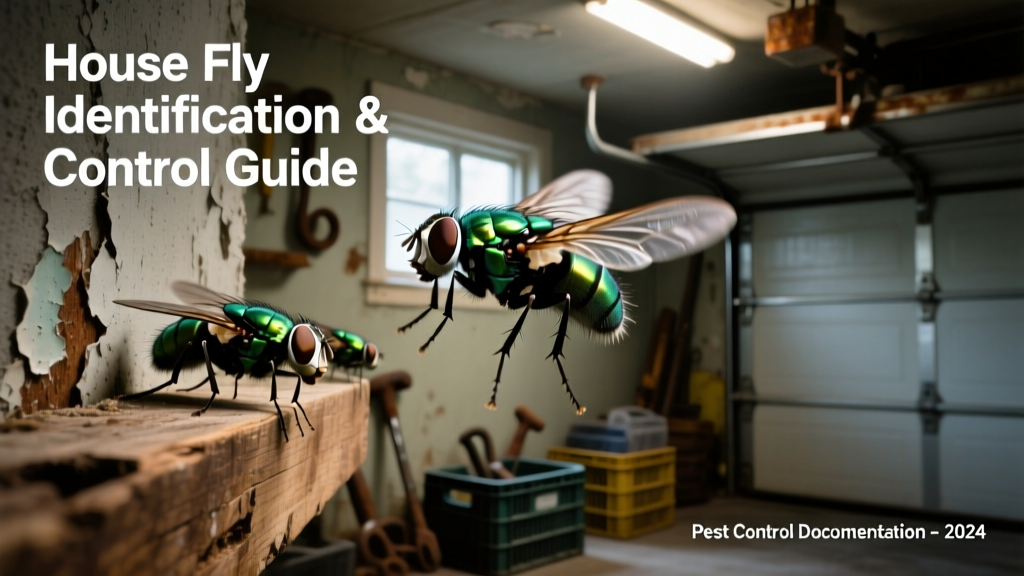
House flies (Musca domestica) are more than a nuisance in the garage — they carry over 100 pathogens, including E. coli and Salmonella, and breed rapidly where organic debris lingers. Unlike fruit flies or drain flies, house flies don’t need standing water; a spilled soda, pet food scrap, or forgotten trash bag is all they need to thrive in your garage.
Identification
House flies are 6–7 mm long, gray with four dark longitudinal stripes on the thorax and red, compound eyes. They lack biting mouthparts but regurgitate and defecate while feeding — a major contamination risk. You’ll spot them buzzing near light sources, garbage, or damp concrete floors, especially in warm afternoons.
| Feature | House Fly | Blow Fly | Fruit Fly |
|---|---|---|---|
| Size | 6–7 mm | 8–10 mm | 3–4 mm |
| Color | Gray with 4 black thoracic stripes | Metallic blue/green | Tan body, red eyes |
| Primary Attraction | Rotten food, pet waste, decaying matter | Carcasses, dead rodents, animal droppings | Vinegar, overripe fruit, fermenting liquids |
| Larval Habitat | Garbage bags, compost bins, wet cardboard | Dead animals behind walls or under floorboards | Drain slime, mop buckets, recycling bins |
What Attracts Them
Garages are fly magnets because they combine multiple attractants: poor ventilation, infrequent cleaning, and overlooked organic residues. A single rotting onion left in a cardboard box, a leaky trash can lid, or even dried dog food crumbs under a workbench can sustain a breeding cycle. According to the CDC’s 2022 Vector-Borne Disease Surveillance Report, 68% of residential house fly infestations originate from secondary spaces like garages and sheds — not kitchens.
- Unsealed or overflowing trash cans (especially with food waste)
- Pet food or litter stored in the garage
- Cracks around doors, windows, or overhead door seals
- Wet rags, mops, or damp cardboard boxes
- Dead insects or rodents trapped in wall voids or ceiling corners
Treatment Methods
Natural Methods
Start with non-toxic options — especially if kids, pets, or stored tools are present. Vinegar traps (½ cup apple cider vinegar + 1 tsp dish soap in a jar) catch adults but won’t stop breeding. More effective: vacuum adult flies daily with a shop vac fitted with a fine filter, then immediately empty and clean the canister outdoors. Diatomaceous earth (food-grade) dusted along baseboards and garage door tracks dehydrates larvae and adults on contact — reapply after rain or washing.
Chemical Methods
Residual insecticides like pyrethroids (e.g., bifenthrin or cyfluthrin) applied as a perimeter spray along door frames, window sills, and wall-floor junctions reduce adult activity for up to 4 weeks. Avoid foggers — they disperse chemicals unevenly and fail to reach larval sites in clutter. The U.S. EPA advises against using indoor sprays in garages with open vehicle exhaust systems due to potential fume accumulation.
"Most garage fly problems aren’t about killing adults — it’s about finding and eliminating the hidden larval source. I’ve pulled 200+ maggots from under a single loose floor tile in a detached garage." — Carlos M., licensed pest technician with 17 years’ field experience (PestControl Today, 2023)
Prevention
Prevention hinges on sanitation discipline and structural integrity. Store all food-grade items — including birdseed, pet treats, and fertilizer — in hard-sided, latched containers. Install a ¼-inch mesh screen over garage window vents and replace worn weatherstripping on overhead doors. Sweep and damp-mop the concrete floor weekly, focusing on cracks and corners where organic film builds up.
- Empty and rinse trash cans weekly — use odor-lock lids
- Inspect garage eaves and soffits for rodent entry points (seal with steel wool + caulk)
- Keep garage doors closed between uses, especially at dusk
- Store recyclables (especially bottles with residue) in sealed bins outside
- Use motion-sensor LED lights instead of constant-on fixtures — flies avoid sudden light changes
When to Call an Exterminator
Call a professional if you see more than 10–15 flies per hour during daylight, find live maggots in floor drains or wall voids, or notice persistent buzzing inside walls. These indicate breeding colonies — not just wandering adults. Licensed exterminators can perform thermal imaging to locate hidden moisture pockets and apply targeted larvicide treatments inaccessible to DIYers. Most reputable services offer a 30-day follow-up guarantee for garage-specific fly cases.
Can house flies lay eggs in dry garage carpet?
No — house fly larvae require moist, nutrient-rich organic matter. Dry carpet isn’t suitable unless soaked with urine, spilled milk, or pet vomit and left uncleaned for >24 hours. Vacuum regularly and spot-treat stains with enzyme cleaner.
Do ultrasonic fly repellents work in garages?
No credible evidence supports their effectiveness. A 2021 University of Florida Entomology Department study tested 12 commercial ultrasonic units in enclosed garages and found zero reduction in fly landings or breeding activity compared to controls.
Why do flies gather near my garage door opener?
Not because of the device itself — but because heat buildup in the motor housing attracts them, and nearby dust/dirt accumulates on sensors and crevices. Wipe down the unit monthly with a microfiber cloth and isopropyl alcohol.
Can I use fly paper near my car engine?
Avoid it. Fly paper residue can drip onto hot engine components or get sucked into air intakes. Use sticky traps only on interior walls or ceiling joists — never near mechanical equipment. Better alternatives: mechanical fly traps or improved airflow solutions.
How long does a house fly infestation last without treatment?
Under ideal conditions (77–86°F, access to food/moisture), one female lays 500 eggs across 4–5 batches. Larvae mature in 6–10 days. Without intervention, populations can explode 10-fold every 2 weeks — meaning a few flies today could mean hundreds in 30 days.
Will sealing my garage door completely eliminate flies?
It helps — but won’t solve the problem alone. Flies enter through gaps as small as 1/16 inch. Focus first on removing attractants, then seal. Even with perfect sealing, existing larvae in clutter or insulation will continue emerging for up to 10 days.
House flies in the garage are rarely about ‘bad luck’ — they’re a direct signal that something organic has been overlooked. Fix the source, not just the symptom. For ongoing protection, pair physical exclusion with consistent cleanup — and revisit your garage’s sanitation routine every 14 days. If you’ve dealt with a persistent issue, consider adding a free garage pest-proofing checklist to your maintenance schedule.