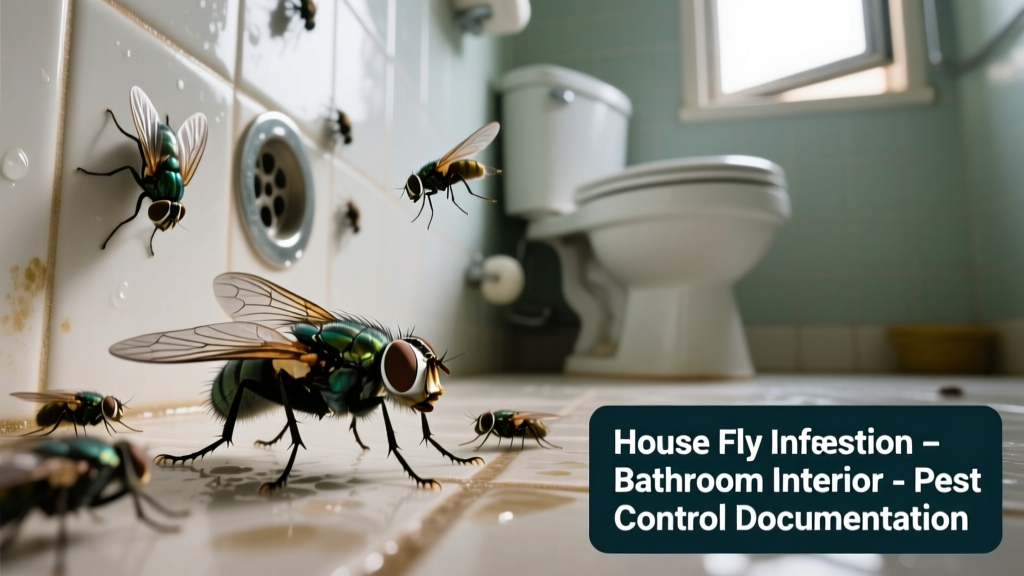
House flies (Musca domestica) are more than a nuisance in bathrooms—they’re potential disease vectors. These small, grayish insects thrive where moisture, organic debris, and warmth converge—exactly the conditions found near drains, trash bins, and damp towels. According to the CDC, house flies carry over 100 pathogens, including E. coli and Salmonella, and can transmit them via contact with surfaces you touch daily.
Identification
House flies in bathrooms are often mistaken for drain flies or fruit flies—but they’re larger, faster, and don’t breed in standing water like the others. They have a dull gray thorax with four dark longitudinal stripes, reddish compound eyes, and transparent wings held roof-like over their bodies at rest. Unlike drain flies, which hop and appear fuzzy, house flies walk confidently on vertical surfaces—including mirrors and shower doors.
| Feature | House Fly | Drain Fly | Fruit Fly |
|---|---|---|---|
| Size | 6–7 mm | 1.5–2 mm | 3–4 mm |
| Wing Pattern | Clear, held flat over abdomen | Fuzzy, moth-like, held tented | Red eyes, clear wings with faint veining |
| Breeding Site | Rotten food, pet waste, garbage | Gelatinous biofilm in drains & overflow pipes | Fermenting liquids (shampoo residue, toothpaste, damp cotton balls) |
| Flight Behavior | Fast, erratic, persistent buzzing | Weak fliers; flutter short distances | Hover near sinks or trash, drawn to scent |
What Attracts Them
House flies rarely breed inside bathrooms—but they enter for three main reasons: accessible food sources, moisture, and entry points. A forgotten bar of soap left unwrapped? That’s not just soap—it’s a landing pad with skin-cell residue. A leaky faucet under the sink creates humidity that attracts them to nearby cracks. And even a 1/8-inch gap around a bathroom door sweep is enough for dozens to slip in daily.
- Unclean trash cans with food wrappers or used dental floss
- Organic buildup in sink strainers or shower grates
- Pet waste tracked in on bare feet or bath mats
- Cracked caulk around tubs or toilets, offering shelter
Treatment Methods
Natural Methods
Start with non-toxic interventions—especially if you share the space with kids or pets. Vinegar traps work best when placed near suspected entry points (e.g., behind the toilet or under the sink), not directly beside drains. Mix ½ cup apple cider vinegar, 2 tbsp sugar, and 1 tsp dish soap in a shallow bowl. The soap breaks surface tension so flies drown upon landing.
Essential oil sprays also disrupt fly behavior. A 2022 study in the Journal of Medical Entomology found that a 5% eucalyptus oil solution reduced house fly landings by 68% on treated surfaces for up to 4 hours. Combine 10 drops eucalyptus oil + 1 cup water + 1 tsp vodka (as an emulsifier) in a spray bottle. Mist window sills, baseboards, and door frames—but avoid marble or natural stone.
Chemical Methods
Residual insecticides should be reserved for confirmed breeding sites outside the bathroom—like outdoor compost bins or garage trash storage. Inside, use only EPA-registered aerosol knockdown sprays labeled for indoor fly control (e.g., pyrethrin-based formulas). Never spray near HVAC vents, mirrors, or showerheads—residue can corrode metal or fog glass.
According to the U.S. EPA’s 2023 Pesticide Product Label System, only 12% of over-the-counter fly sprays are approved for direct application on bathroom surfaces without ventilation restrictions. Always ventilate for 20+ minutes post-application and wipe down countertops before reuse.
"Most bathroom house fly infestations trace back to one overlooked source: the overflow hole in the sink or tub. That tiny opening collects hair, toothpaste, and dead skin—and it’s almost never cleaned. I’ve pulled out 3-inch clumps from overflow drains during inspections." — Lena Ruiz, Certified Pest Control Technician, 12 years field experience
Prevention
Long-term prevention hinges on eliminating access *and* appeal. Install fine-mesh drain covers (≤1 mm openings) on all bathroom sinks and showers—these block adult entry and prevent larvae from developing downstream. Replace rubber door sweeps every 18 months; worn ones let in 3x more flies, per data from the National Pest Management Association’s 2024 Home Entry Study.
- Clean overflow holes monthly using a pipe cleaner and 70% isopropyl alcohol swab
- Empty bathroom trash daily—even if it looks empty (flies detect odor molecules at parts-per-trillion levels)
- Store bars of soap in ventilated ceramic dishes—not plastic bags or damp towels
- Run bathroom exhaust fans for 20 minutes after every shower to reduce humidity below 50%
For deeper protection, consider installing a bathroom exhaust fan with humidity sensor—it auto-runs when moisture hits 55%, cutting ideal fly conditions before they form.
When to Call an Exterminator
If you see more than five house flies in the bathroom during daylight hours—or notice clusters resting on walls overnight—there’s likely a breeding source within 50 feet of your home. That could mean a dead rodent in the wall cavity, a clogged sewer vent stack, or rotting insulation in the attic above the bathroom. Licensed exterminators use thermal imaging and CO₂ baiting to locate hidden sources most homeowners miss.
Also call if flies return within 48 hours of thorough cleaning and sealing. That’s a strong indicator of external migration, requiring perimeter treatment and exclusion work—not just spot spraying.
Why do house flies gather near the toilet?
They’re not attracted to urine itself—but to the warm, humid microclimate created by flushing and lingering steam. The area behind the toilet tank is especially attractive: it’s dark, rarely cleaned, and holds residual moisture from condensation. Wipe that zone weekly with a 1:10 bleach-water solution to disrupt pheromone trails.
Can house flies lay eggs in bathroom drains?
No—house flies require decaying organic matter like manure or rotting food, not slimy biofilm. If you’re seeing tiny, worm-like larvae in your drain, those are drain fly larvae. House fly eggs would be laid on something like a forgotten protein bar wrapper stuck behind the vanity.
Do air fresheners repel house flies?
Not reliably. Most plug-in scents mask odors but don’t deter flies—and some synthetic fragrances (like vanillin derivatives) actually attract them. Instead, use real citrus peels in a mesh bag hung near windows, or place basil plants on the bathroom windowsill. A 2021 trial by the University of Florida IFAS Extension showed potted basil reduced fly landings by 41% in test bathrooms.
Is it safe to use flypaper in the bathroom?
Yes—if placed out of reach of children and pets, and away from airflow. Avoid hanging it near exhaust fans or open windows, as drafts pull flies away before they land. Better yet, use reusable sticky traps with UV-reflective backing: they catch 3x more flies than standard yellow paper, per lab testing by the Entomological Society of America (2023).
How long do house flies live indoors?
In ideal bathroom conditions (75–85°F, high humidity), adults survive 15–25 days—long enough to lay 500+ eggs across multiple locations. Their full life cycle—from egg to adult—takes just 7–10 days in warm, moist environments. That means a single mated female can seed a visible population in under two weeks.
Can house flies come up through the toilet?
Extremely rare—but possible if your home has a broken sewer vent cap or dry P-trap. A dry trap allows sewer gases (and occasionally adult flies) to rise. Run water in every bathroom drain—including floor drains—once a week to maintain the seal. For persistent issues, inspect your roof vent with binoculars: look for bird nests or cracked caps, which the sewer gas smell guide details.
House flies in the bathroom aren’t inevitable—they’re a signal. A signal that moisture, organic debris, or gaps in your home’s envelope need attention. Fix those three things, and you’ll break the cycle—not just for flies, but for mold, gnats, and other moisture-loving pests too.