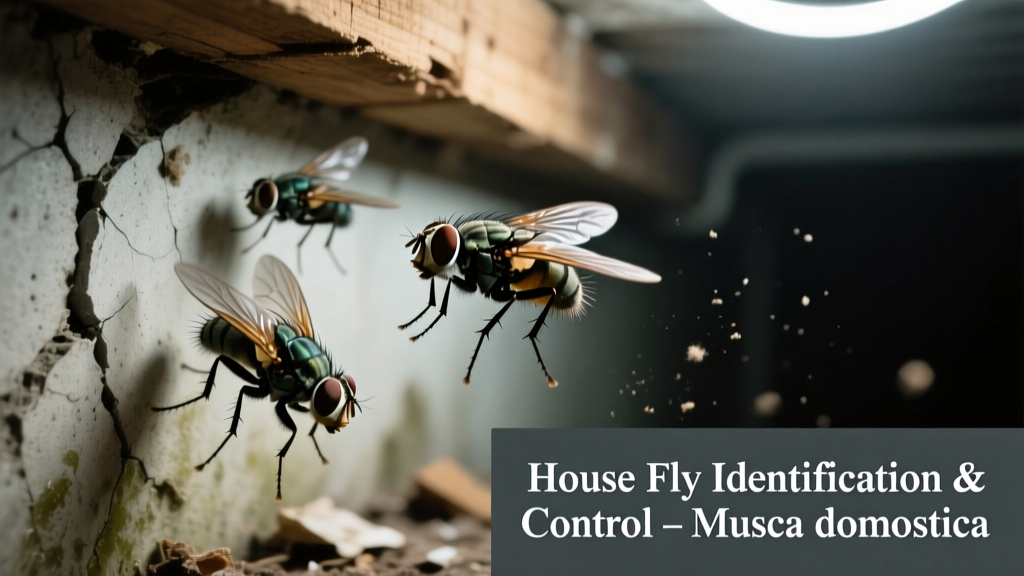
House flies (Musca domestica) are more than just a nuisance in basements — they’re a health hazard. These insects carry over 100 pathogens, including Salmonella and E. coli, and thrive where moisture, organic debris, and poor ventilation converge. Unlike outdoor fly activity, basement infestations often signal hidden decay, plumbing leaks, or long-term sanitation issues that go unnoticed until numbers spike.
Identification
House flies are 6–7 mm long, gray with four dark longitudinal stripes on the thorax and large red compound eyes. Their wings make a distinct low buzz, especially near drains or sump pits. You’ll spot them walking upside-down on walls or hovering near damp concrete floors — not typically resting on windows like cluster flies.
| Pest | Size & Color | Key Behavior | Basement Clue |
|---|---|---|---|
| House Fly | 6–7 mm, gray with 4 black thoracic stripes | Walks rapidly; avoids light; breeds in moist organic matter | Fly swarms near floor drains or trash bins — no breeding site visible above ground |
| Drain Fly | 1.5–5 mm, fuzzy gray/black moth-like | Weak fliers; hovers near sinks or floor drains | Found crawling on drain pipes or inside overflow pans — larvae in gelatinous biofilm |
| Fungus Gnat | 2–3 mm, slender black with long legs | Flits erratically; attracted to damp soil or potted plants | Emerges from houseplant pots stored in basement or near leaky water heaters |
What Attracts Them
Basements lure house flies because of three consistent conditions: moisture, decaying organics, and warmth. A cracked sewer line under the slab can release methane and organic vapors that draw adults underground. Overflowing sump pump pits, forgotten pet food in storage bins, and compost buckets left for weeks all serve as breeding sites — even if you don’t see maggots, eggs hatch in under 8 hours in warm, humid air.
- Standing water in French drains or behind foundation walls (relative humidity >60%)
- Rotted wood framing or insulation soaked by undetected leaks
- Unsealed garbage bags, rodent carcasses in wall voids, or old carpet padding harboring food crumbs
Treatment Methods
Natural Methods
Start with non-toxic options — especially if you have pets, children, or HVAC intakes in the basement. Vinegar traps work best when placed near floor drains: mix ½ cup apple cider vinegar, 2 tbsp sugar, and 1 tsp dish soap in a mason jar. The scent lures adults; the soap breaks surface tension so they drown. Replace every 48 hours.
Vacuuming is surprisingly effective: use a shop vac with a crevice tool along baseboards, behind water heaters, and under storage shelves. Empty the canister outside immediately — adult flies can survive brief suction and escape indoors.
Chemical Methods
Residual insecticides like pyrethroids (e.g., D-Force HPX or Suspend SC) applied to baseboards and around pipe penetrations provide 2–4 weeks of control — but only after eliminating breeding sources. Never spray directly into drains; instead, use an enzyme-based drain gel first to dissolve organic film, then apply residual spray to adjacent surfaces.
According to the National Pest Management Association’s 2022 Field Survey, 68% of successful basement fly eliminations involved combined drain cleaning + targeted residual treatment — not fogging or broad-spectrum sprays.
"If you’re still seeing house flies 72 hours after cleaning all visible organic matter, assume there’s a hidden source — check behind drywall near laundry hookups or under concrete steps where soil may have washed in." — Dr. Lena Cho, Entomologist, Purdue Extension (2023)
Prevention
Long-term prevention hinges on moisture control and exclusion. Install a dehumidifier set to 50% RH — house fly egg development slows sharply below that threshold. Seal gaps around utility lines with expanding foam or copper mesh, and replace cracked window wells with screened versions.
- Inspect sump pump discharge lines quarterly for cracks or pooling at the foundation base
- Store recyclables in sealed, lidded bins — especially cardboard, which absorbs moisture and attracts egg-laying females
- Replace fiberglass insulation soaked by leaks with closed-cell spray foam to eliminate hidden harborage
When to Call an Exterminator
Call a licensed pest professional if you find live maggots in wall voids, hear buzzing inside walls, or see >10 adult flies daily for three consecutive days despite cleaning and trapping. These indicate structural-level infestation — not just surface activity. Licensed technicians can use borescopes to inspect behind walls and apply dust formulations into inaccessible cavities where standard sprays won’t reach.
Why do house flies gather near my basement floor drain?
They’re likely breeding in the organic sludge coating the interior of the pipe — not the drain itself. Biofilm buildup from soap scum, hair, and food particles creates perfect larval habitat. Enzyme cleaners used weekly reduce this layer significantly more than bleach, which only disinfects the surface.
Can house flies lay eggs in dry basement carpet?
Rarely — but yes, if the carpet padding has absorbed moisture from a past leak and now holds mold or mildew. Larvae need moisture content >30% to survive. Pull back carpet edges near exterior walls and sniff for musty odors; if present, test with a moisture meter before assuming it’s clean.
Do house flies survive winter in basements?
Absolutely. Basements averaging 55–65°F year-round allow continuous breeding cycles. Unlike outdoors, where cold halts development, indoor basements support up to five generations per year — especially near furnaces or water heaters.
Is a UV fly light effective in basements?
Only if placed away from competing light sources and within 5 feet of fly pathways. In unfinished basements with exposed wiring, ensure fixtures are rated for damp locations. Note: UV lights kill adults but do nothing for eggs or larvae — always pair with sanitation.
Can I use fly paper in a finished basement?
Yes — but avoid hanging near HVAC returns or ceiling fans. Flies drawn to the glue will die mid-air and drop onto furniture or rugs. Instead, mount vertically behind doors or along cold exterior walls where flies naturally congregate during cooler hours.
Will sealing my basement windows stop house flies?
Partially — but most enter through utility penetrations (pipes, wires, sump pits) rather than windows. Focus on sealing gaps ≥1/8″ with silicone caulk or steel wool. Also inspect dryer vent flaps for warping; 23% of basement fly entries traced to faulty exterior vents (IBHS 2023 Residential Entry Point Study).
House flies in basements rarely appear out of nowhere — they follow opportunity. Fix the moisture, remove the food, seal the entry points, and monitor with simple traps. For persistent cases, drain flies and fungus gnats often co-occur, so confirm species before treating. And remember: no amount of spraying replaces finding and eliminating the source.