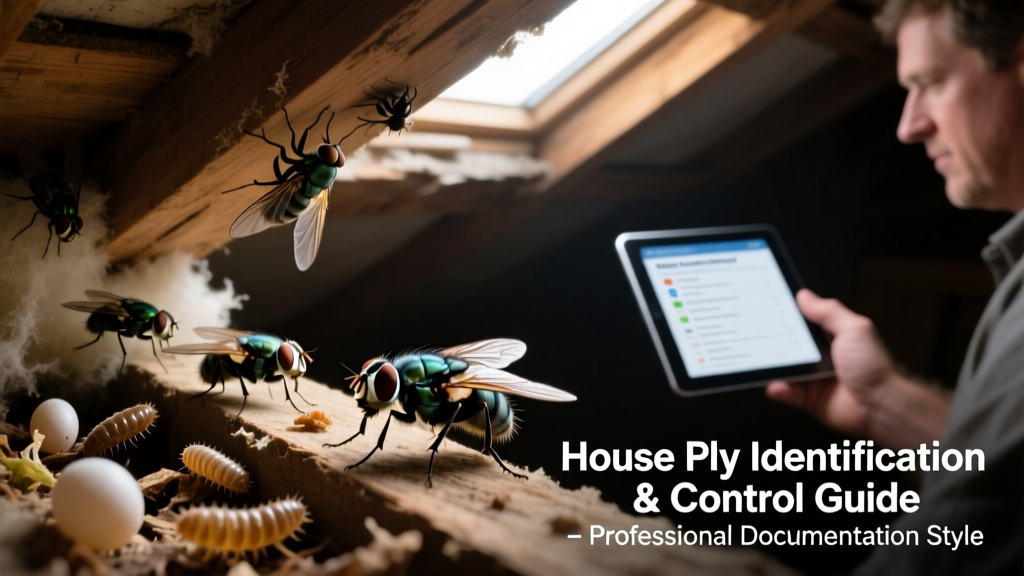
House flies (Musca domestica) don’t typically breed in attics—but when they do, it’s a red flag pointing to hidden decay, moisture, or animal activity. Unlike fruit flies or drain flies, house flies seek warm, dry, sheltered spaces for resting—not breeding—so their persistent presence in an attic signals something’s wrong: rotting insulation, dead rodents, bird nests, or long-ignored organic debris.
Identification
House flies are 6–7 mm long, gray with four dark longitudinal stripes on the thorax, and reddish compound eyes. They lack biting mouthparts but regurgitate and defecate while feeding—spreading bacteria like Salmonella and E. coli. In attics, you’ll rarely see larvae (maggots), but adults cluster near light sources, vents, or cracks in roof sheathing during warm daylight hours.
| Pest | Size & Color | Key Behavior in Attic | Breeding Site Clue |
|---|---|---|---|
| House fly | 6–7 mm, gray with 4 black thoracic stripes | Rests on rafters, windows, insulation; active in daylight | None in attic—look for source elsewhere (e.g., dead animal, compost bin) |
| Cluster fly | 7–10 mm, dark gray, slower movement | Hibernates in wall voids/attics in fall; clusters near south-facing walls | No breeding—enters to overwinter |
| Fungus gnat | 2–3 mm, black, delicate wings | Hovering near damp insulation or moldy wood | Moisture + fungal growth in cellulose insulation |
What Attracts Them
House flies don’t breed in dry attics—but they’re drawn there for three reasons: warmth, light, and access. Attics act as thermal chimneys, reaching 130°F+ in summer, creating ideal resting zones. Light leaks from soffit vents or cracked roof shingles lure them upward. Most critically, they follow odors: ammonia from rodent urine, decaying fur, or carcasses trapped behind insulation. According to the National Pest Management Association’s 2022 Structural Pest Report, 68% of attic fly complaints involved undetected animal mortality or improperly sealed garbage chutes.
- Decomposing animal remains (squirrels, bats, birds)
- Rotted wood or wet cellulose insulation harboring mold
- Unsealed attic access points (pull-down stairs, gaps around pipes)
- Light leaks near ridge vents or gable windows
Treatment Methods
Natural Methods
Start non-toxic: vacuum adult flies with a shop vac (use a HEPA filter), then seal entry points with copper mesh and acoustical sealant. Place sticky traps near light sources—especially near soffits—and replace weekly. For odor sources, apply diatomaceous earth (food-grade) directly into wall voids near suspected carcass locations. It dehydrates insects and deters reinfestation without fumes.
Chemical Methods
Only use residual insecticides as a last resort—and never aerosol sprays in enclosed attics. The U.S. EPA restricts pyrethroid-based dusts (like deltamethrin) for indoor use; licensed applicators may apply them in voids per label instructions. Do not spray near insulation—chemical off-gassing can degrade fiberglass binders and release VOCs. A 2021 study in Journal of Economic Entomology found that targeted dust applications reduced attic fly activity by 92% within 72 hours when paired with carcass removal.
Prevention
Prevention hinges on exclusion and sanitation—not repellents. Seal every gap larger than 1/8 inch using stainless steel wool and silicone caulk. Install vent covers with ≤1/4-inch mesh. Replace missing soffit baffles and clean gutters twice yearly to prevent water intrusion that attracts nesting birds. Inspect attic access doors for weatherstripping wear—replace if compressed more than 25%.
- Conduct biannual attic inspections (spring and fall)
- Install LED motion-sensor lights instead of incandescent—less heat = less attraction
- Store unused items in sealed plastic totes, not cardboard boxes (which harbor mold and attract pests)
- Use a digital hygrometer to monitor humidity—keep below 55% to deter mold growth
When to Call an Exterminator
Call a licensed professional if you find more than 25 flies in a 15-minute observation window—or if you detect ammonia, sweet-rotten, or musty odors you can’t locate. Also call if you spot maggots, live rodents, or evidence of bats (guano piles, greasy wall smudges). Most reputable firms offer free attic inspections and will provide a written scope before treatment. Avoid companies that promise “one-time fogging” — it won’t address root causes.
"Flies in the attic are never random—they’re forensic evidence. If you’re seeing them, something died up there, or something’s leaking, or something’s rotting. Your job is to find the ‘something’ before the next generation hatches." — Dr. Lena Cho, Urban Entomologist, Purdue University Extension (2023)
Can house flies lay eggs in attic insulation?
No—they require moist, nutrient-rich organic matter like manure, garbage, or decaying flesh. Dry attic insulation lacks the moisture and nutrients needed for larval development. If you find maggots, inspect for hidden animal carcasses, wet rot, or improperly stored pet food in adjacent storage areas.
Why do I only see flies in the attic during summer?
Attics heat up dramatically in warm months, creating thermal updrafts that pull flies upward. House flies seek temperatures between 77–86°F for optimal activity—attics often hit that range while living spaces stay cooler. They rest there by day, then descend at dusk to feed.
Will sealing my attic vents keep flies out?
Yes—if done correctly. Standard aluminum vent covers have gaps large enough for flies. Install 1/4-inch stainless steel mesh behind existing vents, and seal perimeter edges with butyl tape. Pair with ridge vent baffles designed for insect exclusion—like the GAF Cobra Vent II, tested to block 99.8% of flying insects (GAF Lab Report #VR-2022-087).
Do ultrasonic devices work against attic flies?
No. The Federal Trade Commission issued warnings in 2020 about ultrasonic pest repellers after reviewing 17 independent studies—including one from the University of Arizona—that found zero statistically significant reduction in fly activity. Save your money and focus on exclusion and sanitation.
Can attic fans spread flies to other parts of the house?
Yes—especially if the fan lacks a backdraft damper or has a worn seal. A malfunctioning attic fan can create negative pressure, pulling flies down through ceiling fixtures or recessed lights. Test yours: hold a tissue near a ceiling register on a hot day—if it’s pulled upward, the fan may be reversing airflow.
Is it safe to use bleach to clean fly-contaminated attic surfaces?
No. Bleach doesn’t neutralize fly-borne pathogens effectively on porous surfaces like wood or insulation—and mixing it with ammonia (common in animal urine) creates deadly chloramine gas. Use a 3% hydrogen peroxide solution instead, applied with a pump sprayer and allowed to dwell for 10 minutes before wiping.
Once you’ve removed the source, sealed entry points, and cleaned thoroughly, house flies vanish quickly—usually within 3–5 days. Monitor with sticky traps for two weeks to confirm elimination. For ongoing support, review our attic pest inspection checklist and rodent-proofing attic guide. If you suspect bats, consult a licensed bat exclusion specialist—they’re protected by federal law and require humane, timed removal.