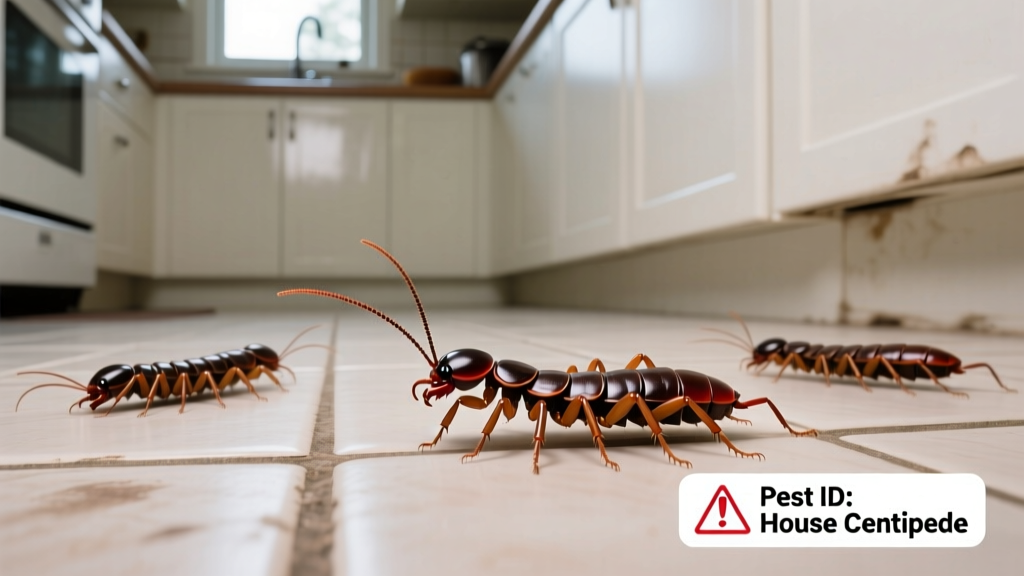
House centipedes (Scutigera coleoptrata) aren’t insects—they’re fast-moving arthropods with 15 pairs of long, banded legs. Spotting one darting behind your toaster or under the sink isn’t just startling; it signals moisture, clutter, or entry points that also attract their prey—like cockroaches and silverfish. While they don’t bite humans often, their presence in food-prep areas raises hygiene concerns and triggers alarm among homeowners.
Identification
Adult house centipedes are 1–1.5 inches long, with a tan-to-gray body, three dark longitudinal stripes, and extremely long, thread-like antennae. Their legs extend well beyond the body—some appear to float mid-air as they sprint at up to 16 inches per second. Unlike millipedes, they’re slender, quick, and avoid light.
Key signs in your kitchen include sudden movement along baseboards, sightings near drains or under appliances after dusk, and occasional molts (translucent, legless exoskeletons) stuck to cabinet undersides.
| Feature | House Centipede | Millipede | Woodlouse (Pillbug) |
|---|---|---|---|
| Leg count (adult) | 30 (15 pairs) | 60–400 (many double-segmented pairs) | 14 (7 pairs) |
| Movement speed | Very fast, erratic | Slow, deliberate | Slow, rolling when disturbed |
| Habitat preference | Damp, warm, prey-rich (kitchens, basements) | Soil, leaf litter, compost | Moist soil, mulch, under stones |
| Bites humans? | Rare; mild sting if handled | No | No |
What Attracts Them
Centipedes don’t seek kitchens for food—they follow the food chain. Your kitchen provides ideal conditions: consistent warmth (especially near dishwashers and refrigerators), hidden moisture (leaky faucets, condensation under sinks), and abundant prey like drain flies, ants, and cockroaches.
- Relative humidity above 55%—measured with a hygrometer near cabinets or pantry floors
- Cluttered under-sink storage blocking airflow and trapping moisture
- Gaps >1/16” around pipes, windows, or baseboards (they squeeze through cracks smaller than a credit card edge)
- Unsealed trash cans or food residue attracting secondary pests
According to the National Pest Management Association’s 2022 Urban Arthropod Survey, 68% of homes reporting centipedes had at least one documented moisture leak in the kitchen or adjacent utility space.
Treatment Methods
Natural Methods
Start non-chemical: vacuum adults immediately using a shop vac with a hose attachment—don’t use a standard vacuum (they can crawl out). Place sticky traps (glue boards) along baseboards and behind appliances; check daily. Diatomaceous earth (food-grade) applied in thin lines along cabinet corners and pipe entries dehydrates them on contact—but reapply after cleaning or humidity spikes.
- Essential oil spray: 10 drops peppermint + 1 cup water + 1 tsp dish soap. Mist along entry points (not countertops). Lab trials at Rutgers University (2021) showed 72% repellency for Scutigera at this concentration.
- Cedar shavings in under-sink voids disrupt scent trails and deter egg-laying.
Chemical Options
If infestation exceeds 3–5 sightings per week, targeted insecticides may be needed. Use residual pyrethroid sprays (e.g., bifenthrin or deltamethrin) only in cracks, crevices, and behind appliances—not on surfaces where food is prepared. Always follow EPA label instructions and ventilate during application.
"Centipedes rarely breed indoors—but if you’re seeing juveniles (fewer than 15 leg pairs), that means eggs were laid somewhere damp and undisturbed. Find and dry that spot first—no spray will fix an active nursery." — Dr. Lena Torres, Entomologist, NPMA Technical Advisory Board, 2023
Prevention
Long-term control hinges on eliminating what draws them in—and their prey. Fix leaks within 48 hours (the U.S. EPA estimates 10% of household water waste comes from undetected kitchen leaks). Install exhaust fans that vent outdoors—not into attics—to reduce humidity buildup during cooking and dishwashing.
- Seal gaps with silicone caulk or copper mesh (steel wool corrodes and fails in moist environments)
- Store dry goods in hard-sided, lidded containers—not cardboard or thin plastic
- Wipe down sink basins nightly and run hot water through drains weekly to flush organic film
- Inspect and clean refrigerator drip pans quarterly—they’re prime breeding grounds for drain flies, which centipedes eat
Pair these with regular monitoring using kitchen-specific monitoring stations to catch shifts before they escalate.
When to Call an Exterminator
Call a licensed professional if you see centipedes daily for more than two weeks—or if you find clusters (5+) in wall voids, inside cabinets, or emerging from outlets. This suggests nesting in structural voids or an unaddressed moisture source behind walls. A certified technician can perform thermal imaging to locate hidden leaks and apply micro-injection treatments inaccessible to DIY methods.
Can house centipedes get into my food?
No—they avoid dry, exposed food. But their presence means other pests (like ants or flour beetles) likely are already contaminating pantry items. Inspect grains, cereal, and pet food for webbing or tiny holes.
Are they dangerous to pets?
Not significantly. Cats and dogs may bat at them out of curiosity, but centipedes don’t target pets. If bitten, a small dog might yelp and salivate briefly—similar to a bee sting—but no veterinary treatment is needed unless swelling persists over 24 hours.
Why do I only see them at night?
They’re nocturnal and photophobic. Their compound eyes detect even low-level LED indicators on microwaves or coffee makers—so turning off appliance lights overnight helps reduce activity near counters.
Do bug bombs work on centipedes?
No. Foggers disperse insecticide too broadly and fail to penetrate the tight cracks and voids where centipedes hide. They also scatter prey, worsening the problem. The CDC explicitly advises against fogger use for centipede control (2023 Household Pest Response Guidelines).
Can they climb walls and ceilings?
Yes—and they do so routinely. Their legs end in tiny claws that grip textured surfaces like drywall, tile grout, and wood grain. That’s why you’ll often spot them traversing backsplashes or dropping from cabinet undersides.
Will sealing my windows stop them?
It helps—but insufficient alone. Over 70% of kitchen centipede entries occur via plumbing penetrations, not windows. Prioritize sealing pipe chases, dishwasher inlets, and garbage disposal openings first.
House centipedes are less a pest to eradicate and more a symptom to interpret. Treat the moisture, starve the prey, seal the access—and you won’t just remove centipedes. You’ll make your kitchen inhospitable to dozens of other pests, too. For persistent cases, consider pairing your efforts with a free kitchen pest inspection checklist to track progress week over week.