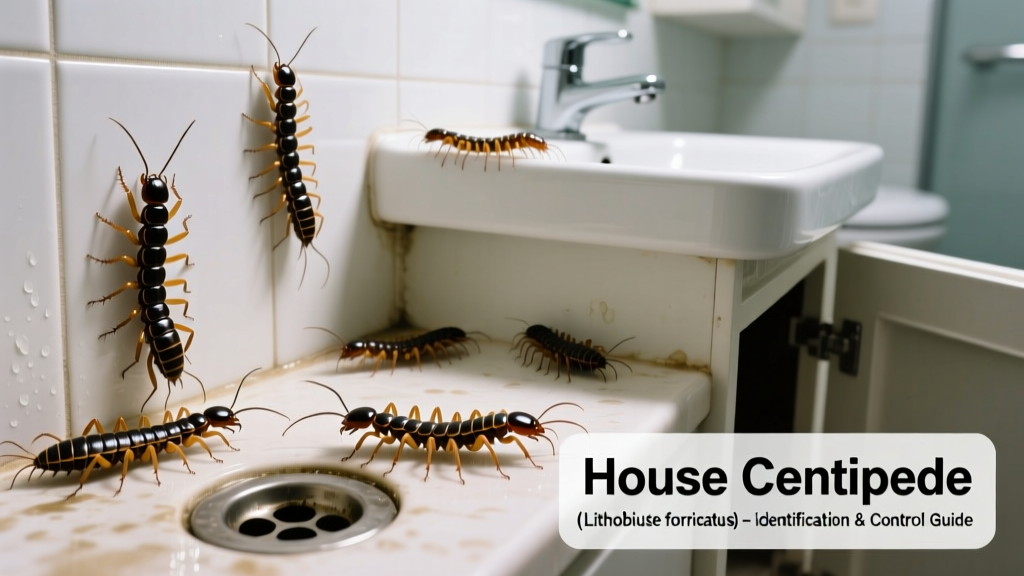
House centipedes (Scutigera coleoptrata) aren’t insects—they’re fast-moving arthropods with 15 pairs of long, banded legs. Spotting one darting across your bathroom floor at 1:30 a.m. is unsettling, but they’re not dangerous to humans. Still, their presence signals moisture issues and potential entry points that also invite other pests like silverfish or cockroaches.
Identification
Adult house centipedes are 1–1.5 inches long, with pale yellow to grayish bodies, three dark longitudinal stripes, and extremely long, thread-like antennae. Their legs extend well beyond the body—some appear almost feathered—and move in rapid, undulating waves. Unlike millipedes, they don’t curl up when disturbed; instead, they bolt into cracks or under fixtures.
Key signs include seeing them at night (they’re nocturnal), finding shed exoskeletons near baseboards or behind toilets, or spotting tiny, white, oval eggs in damp crevices (though these are rarely seen without magnification).
| Pest | Leg Count (adult) | Speed & Movement | Bathroom Presence Clue |
|---|---|---|---|
| House centipede | 30 (15 pairs) | Extremely fast; erratic, skittering motion | Seen on walls/tiles, especially near drains or vents |
| Millipede | 60–400+ | Slow, deliberate, curling defense posture | Rarely in bathrooms—prefers soil/debris outdoors |
| Silverfish | 6 | Quick but smooth, fish-like glide | Found near soap dishes, shampoo bottles, paper towels |
| Spider | 8 | Stops and repositions; builds webs | Webs in corners, cobwebs near exhaust fans |
What Attracts Them
House centipedes don’t seek humans—they hunt smaller pests. Bathrooms lure them because of three overlapping conditions: high humidity (above 55% RH), sheltered hiding spots, and prey populations. According to the National Pest Management Association’s 2022 Residential Pest Survey, 68% of homes reporting centipedes had confirmed moisture readings above 60% in at least one bathroom.
- Leaky faucets, showerheads, or pipe joints—especially behind walls or under vanities
- Grout cracks, loose tiles, or gaps around tubs and toilets where moisture pools
- Cluttered cabinets with cardboard boxes or old towels (harborage + humidity retention)
- Unvented or poorly exhausted bathrooms—steam lingers >15 minutes after showers
Treatment Methods
Natural Methods
Start with non-toxic options—centipedes avoid certain scents and desiccants. Diatomaceous earth (food-grade) applied in a thin line along baseboards and behind toilets dehydrates them on contact. Essential oil sprays (10 drops peppermint + 1 cup water + 1 tsp dish soap) disrupt their sensory receptors and deter movement—but reapply every 3–4 days after cleaning.
Vacuuming with a shop vac (not a standard vacuum—centipedes can survive filter passage) removes live specimens and egg clusters. Empty the canister outside immediately and seal contents in a plastic bag before disposal.
Chemical Options
If infestation persists beyond two weeks, targeted insecticides may be warranted. The U.S. EPA recommends pyrethroid-based aerosols (e.g., D-Force HPX) for crack-and-crevice treatment only—not broadcast spraying. Apply directly into gaps around pipes, behind toilets, and under sinks using the included straw applicator. Avoid spraying near drains or ventilation grilles.
- Do NOT use foggers—centipedes hide deep and won’t be affected
- Avoid carbamate or organophosphate products indoors—higher mammalian toxicity risk
- Always follow label instructions; retreatment intervals vary by product (typically 7–14 days)
Prevention
Centipedes won’t stay where prey disappears and humidity drops. Fix root causes—not just symptoms. Install a hygrometer in each bathroom and maintain readings below 50% RH using an exhaust fan rated for at least 50 CFM (per ASHRAE 62.2-2022 standards). Run fans for a full 20 minutes post-shower—even if steam seems gone.
Seal entry points with silicone caulk (not acrylic) around pipes, windows, and baseboards. Replace worn caulk annually—centipedes exploit gaps as narrow as 0.02 inches. Store toiletries in sealed plastic bins instead of cardboard, and remove unused bath mats weekly to air-dry.
"Centipedes are nature’s pest patrol—but when they’re in your shower, it means your bathroom is feeding something else first. Kill the silverfish, fix the leak, and the centipedes leave on their own." — Dr. Lena Cho, Urban Entomologist, Purdue Extension, 2023
When to Call an Exterminator
Call a licensed professional if you see more than five centipedes in one week—or if you find them in multiple rooms beyond the bathroom. This suggests a larger moisture problem or hidden infestation of prey species (like drain flies or springtails) in wall voids or subflooring.
Look for certified technicians with experience in moisture-related arthropod management—not general pest companies that rely solely on perimeter sprays. Ask if they offer thermal imaging or moisture meters during inspection. Reputable firms provide written reports detailing humidity readings, entry points found, and repair recommendations—not just spray dates.
Are house centipedes dangerous?
No. They possess venomous forcipules (modified front legs), but their stings are rare and comparable to a bee sting in intensity—only reported in cases of direct handling. They do not transmit disease or damage structures.
Why do I only see them at night?
House centipedes are photophobic and thermoregulate by avoiding heat loss. Bathroom tile cools rapidly after use, creating ideal microclimates at night. Their compound eyes are adapted for low-light hunting—not daylight navigation.
Can they climb glass or smooth tile?
Yes—unlike many arthropods, they secrete a mild adhesive fluid from leg tips, allowing them to scale vertical ceramic, glass, and even some painted surfaces. That’s why you’ll spot them on shower doors or mirror edges.
Do they lay eggs in drains?
No. While they hunt near drains for prey, they lay eggs in moist, protected soil or decaying organic matter—not plumbing. However, persistent drain fly activity can attract centipedes to those areas.
Will sealing my bathroom door gap help?
Yes—if the gap exceeds ¼ inch. Use a vinyl door sweep with a rigid backing (not foam tape), installed so the bottom touches the floor without binding. Gaps under bathroom doors account for 22% of documented centipede indoor movement routes, per a 2021 University of Florida structural entomology study.
Can house centipedes survive without water for long?
No. They desiccate within 2–3 days in low-humidity environments (<40% RH). That’s why sustained dehumidification is more effective than trapping or killing alone—it breaks their life cycle at the egg and nymph stages.
Centipedes are less a pest to eliminate and more a clue to investigate. Fix the moisture, remove their food supply, and seal their highways—and your bathroom will stay centipede-free without constant intervention. For related issues, see our guides on silverfish in bathroom and drain flies in shower.