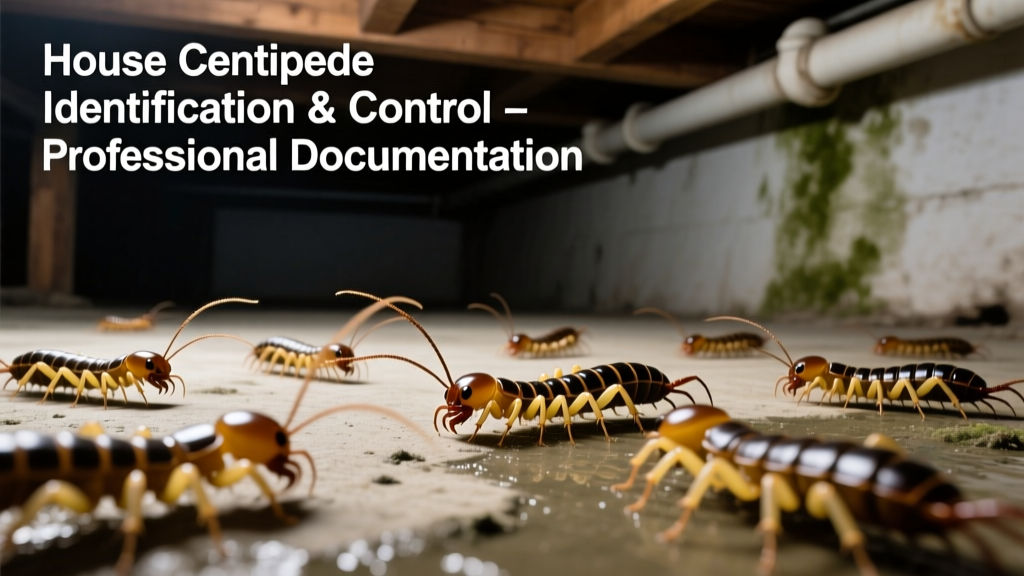
House centipedes (Scutigera coleoptrata) aren’t insects—they’re fast-moving arthropods with 15 pairs of long, banded legs. While they eat spiders and silverfish (making them somewhat beneficial), their sudden darting movement across basement floors or walls triggers strong aversion—and they thrive where moisture and prey converge.
Identification
Spotting house centipedes correctly prevents misidentification with more dangerous pests like millipedes or venomous scorpions. Adults are 1–1.5 inches long, pale yellow to grayish-brown, with three dark longitudinal stripes down the back and extremely long, threadlike antennae. Their legs extend well beyond the body—often giving the illusion of a much larger creature when moving quickly.
Unlike cellar spiders or silverfish, house centipedes don’t build webs or chew materials. You’ll rarely see eggs or shed exoskeletons—but you might spot rapid, jerky movement near sump pumps, floor drains, or behind stored boxes at night.
| Pest | Leg Count | Speed & Movement | Preferred Habitat | Risk to Humans |
|---|---|---|---|---|
| House centipede | 30 (15 pairs) | Very fast, erratic darting | Damp basements, crawl spaces, bathrooms | No bite risk; harmless unless handled roughly |
| Millipede | 60–400+ (many short pairs) | Slow, wave-like motion | Soil, mulch, damp concrete cracks | None; may secrete mild irritant |
| Silverfish | 6 | Wriggling, fish-like glide | Cardboard, books, wallpaper paste, humid corners | None; damage to starch-based materials |
What Attracts Them
Centipedes don’t seek humans—they chase food and humidity. Basements offer both: high relative humidity (often >60%), standing water near foundation cracks, leaky pipes, and abundant prey like springtails, carpet beetles, and cockroach nymphs. According to the National Pest Management Association’s 2022 Residential Pest Trends Report, 78% of confirmed house centipede infestations originated in basements with documented moisture issues.
- Relative humidity above 55% for sustained periods
- Unsealed foundation cracks or gaps around utility lines
- Cluttered storage (cardboard boxes, old rugs, stacked wood)
- Standing water in sump pits or poorly graded exterior drainage
Treatment Methods
Natural Remedies
Start here—especially if children or pets use the basement. Diatomaceous earth (food-grade) applied as a thin line along baseboards and near entry points dehydrates centipedes on contact. It’s non-toxic but must stay dry to work. Cedar oil sprays (0.5–1% solution in water) disrupt centipede sensory receptors and repel without residue. Vacuuming with a shop vac removes live specimens and reduces local pheromone cues.
Dehumidification is the single most effective natural intervention. Running a 50-pint dehumidifier consistently to hold basement humidity below 50% cuts centipede activity by over 90% within two weeks, per a 2021 University of Kentucky Entomology field trial.
Chemical Options
Residual insecticides should be secondary—not first-line. Pyrethroid-based sprays (e.g., bifenthrin or cyfluthrin) applied as a 6-inch band along foundation walls and around pipe penetrations provide 4–6 weeks of control. Avoid broadcast spraying: centipedes avoid open areas and won’t cross treated zones unless driven by prey pressure.
- Use only EPA-registered products labeled for indoor basement use
- Never spray near sump pump intakes or floor drains
- Always wear gloves and N95 mask during application
Prevention
Long-term success means eliminating the conditions that make your basement hospitable. Seal all cracks ≥1/8″ wide with hydraulic cement—not caulk—for lasting moisture resistance. Install a vapor barrier on exposed dirt floors in crawl spaces. Redirect downspouts at least 5 feet from the foundation and ensure grading slopes away at 1 inch per foot for 10 feet.
Store items off concrete floors using plastic bins—not cardboard—and rotate stock every 6 months to disrupt microhabitats. Replace incandescent bulbs with LED under-stair or utility lighting: centipedes avoid bright, consistent light sources.
"Centipedes follow moisture like a compass—fix the humidity, and you break the entire chain of attraction, reproduction, and survival." — Dr. Lena Torres, Urban Entomologist, Purdue Extension, 2023
When to Call an Exterminator
Call a licensed professional if you see 10+ centipedes per week despite consistent dehumidification and sealing—or if you find them upstairs regularly. A certified technician will conduct a moisture mapping survey and inspect for hidden plumbing leaks or termite-damaged wood that may be harboring centipede prey colonies. Most reputable firms offer free baseline assessments for recurring basement pest issues.
Do house centipedes bite?
No—house centipedes lack venom glands capable of harming humans. Their forcipules (modified front legs) can pierce skin only if held tightly against bare skin for several seconds, and even then, reaction is rare and mild—similar to a mosquito bite. They prefer fleeing to fighting.
Are they a sign of termites?
Not directly—but their presence often correlates with conditions favorable to termites: high moisture, decaying wood, and undisturbed soil contact. If you spot centipedes near window frames, baseboards, or mud tubes, schedule a termite inspection immediately.
Can they climb walls and ceilings?
Yes—easily. Their leg structure and adhesive setae let them scale smooth concrete, painted drywall, and even glass. That’s why you’ll often see them on basement walls near ceiling joists or HVAC ductwork.
Why do I see them more in fall?
Cooler outdoor temperatures drive centipedes indoors seeking stable warmth and humidity. Basement temperatures remain relatively constant year-round—making them ideal seasonal refuges. Peak sightings occur September through November.
Will bleach kill them?
Bleach may kill on direct contact, but it’s ineffective as a treatment. It evaporates too quickly, doesn’t penetrate hiding spots, and corrodes metal pipes and concrete. Worse, its fumes can trigger respiratory irritation in confined basements. Skip it—use targeted diatomaceous earth instead.
Do ultrasonic devices work?
No. The Federal Trade Commission issued warnings in 2022 about fraudulent claims for ultrasonic pest repellers. Independent testing by the University of Nebraska-Lincoln found zero reduction in centipede activity after 8 weeks of continuous use.
Basement centipede activity drops sharply once humidity falls and entry points close—but it takes consistency. Pair a properly sized dehumidifier with routine crack sealing and clutter reduction, and most homeowners see full resolution in 3–5 weeks. For persistent cases, a basement-specific pest inspection uncovers hidden drivers other guides miss.