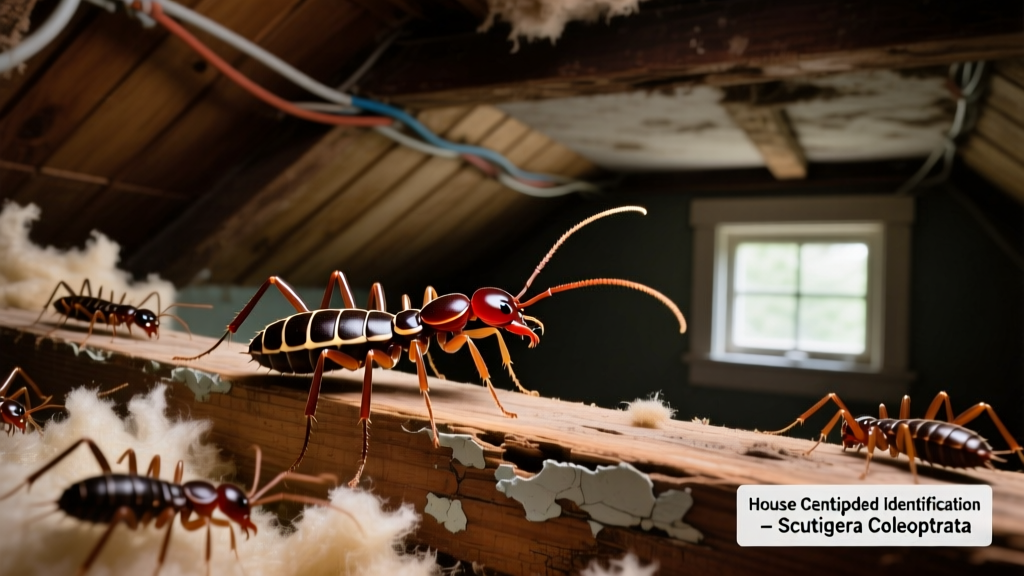
House centipedes (Scutigera coleoptrata) aren’t insects—they’re fast-moving arthropods with up to 15 pairs of long, thread-like legs. While they don’t bite humans often and pose no structural threat, their sudden darting movement across attic insulation or rafters triggers alarm—and signals underlying moisture or pest issues.
Identification
Adult house centipedes are 1–1.5 inches long, pale yellow to grayish-brown, with banded legs and prominent antennae. They’re most active at night and freeze when exposed to light—making attic inspections with a flashlight especially revealing.
Unlike silverfish or spiders, house centipedes have a distinctive undulating gait and can scale vertical surfaces effortlessly thanks to tiny hooked claws on each leg segment. Their presence almost always means other pests—like springtails, carpet beetle larvae, or spiders—are already established as food sources.
| Feature | House Centipede | Silverfish | Spider | Millipede |
|---|---|---|---|---|
| Leg count (adult) | 30–34 (15–17 pairs) | 6 | 8 | 60–400+ |
| Movement speed | Up to 1.3 ft/sec (fastest arthropod relative to size) | Slow, jerky | Variable, often deliberate | Very slow, rolling motion |
| Habitat preference | Damp, cluttered attics with prey | Humid, dark corners near paper or glue | Web-building in eaves, soffits, rafters | Moist soil or decaying wood—rare indoors |
| Bite risk | Negligible (venom not medically significant to humans) | None | Most harmless; rare medically relevant bites | None |
What Attracts Them
Centipedes don’t seek out homes—they follow conditions that support their survival and reproduction. In attics, three factors dominate: moisture, shelter, and prey.
- Relative humidity above 55% (common near roof leaks, poor ventilation, or uninsulated ductwork)
- Loose fiberglass insulation piles or cardboard boxes acting as nesting cover
- Existing populations of spiders, silverfish, cockroach nymphs, or springtails—centipedes’ primary food sources
According to the National Pest Management Association’s 2022 Field Survey, 68% of attic centipede infestations were linked to documented roof leaks or condensation buildup behind soffit vents.
Treatment Methods
Natural Methods
Start with non-chemical tactics—especially important in enclosed attic spaces where fumes linger. Diatomaceous earth (food-grade) applied along rafter edges and insulation seams dehydrates centipedes on contact. It remains effective for 3–6 months unless disturbed or wetted.
- Dehumidify: Use a portable 30-pint dehumidifier set to 45–50% RH for 72 hours, then maintain at ≤50%
- Vacuum thoroughly—including cobwebs, dust bunnies, and loose insulation fibers—using a HEPA-filter vacuum
- Remove cardboard boxes and old papers; replace with sealed plastic totes labeled and elevated off floor joists
Chemical Options
When natural methods stall, targeted insecticides help—but avoid broadcast sprays in attics. The U.S. EPA advises against pyrethroid foggers due to inhalation risk and ineffectiveness against cryptic centipede harborages.
"Centipedes hide in micro-cracks—not open spaces. Residual dusts like deltamethrin applied with a hand duster into rafter voids and insulation gaps yield 3x longer control than liquid sprays," says Dr. Lena Torres, Urban Entomologist at Purdue Extension (2023).
Approved attic-safe options include:
- Boric acid dust (applied sparingly in inaccessible voids only)
- DeltaDust® (deltamethrin-based dust) in labeled cracks and along top plates
- Cy-Kick CS (cyfluthrin microencapsulated suspension) spot-treated on wood framing—never on insulation
Prevention
Long-term success hinges on making the attic inhospitable—not just killing individuals. Centipedes reproduce year-round in warm attics; females lay 15–60 eggs in damp crevices every 2–3 weeks.
Key structural fixes include sealing soffit and ridge vent gaps with stainless steel mesh (not foam), installing vapor barriers under insulation, and insulating HVAC ducts to prevent condensation. Ventilation upgrades—like adding two balanced passive vents per 300 sq ft—cut attic humidity by up to 32%, per the Florida Solar Energy Center’s 2021 attic moisture study.
- Inspect and repair roof flashing annually—especially around chimneys and dormers
- Install LED motion-sensor lights in attic entries to disrupt nocturnal activity cycles
- Trim tree branches ≥3 feet from roofline to limit bridge access for prey insects
When to Call an Exterminator
Call a licensed professional if you see more than 5 centipedes during a single 15-minute inspection—or if you find them consistently in living spaces below the attic (e.g., bedrooms or hallways). That indicates migration due to overcrowding or deteriorating conditions above.
Also consult an expert if moisture readings exceed 18% in wood framing (use a pinless moisture meter), or if you suspect hidden mold growth behind insulation. A certified technician can perform thermal imaging, apply dusts safely in confined rafter bays, and integrate centipede control into broader attic pest control plans.
Can house centipedes damage insulation?
No—they don’t chew or nest in insulation. But their presence means insulation is likely damp or compromised, which reduces R-value by up to 40% (ASHRAE Handbook, 2022). Address moisture first, then replace saturated batts.
Do they come from the basement or crawl space?
Rarely. House centipedes prefer upper-level humidity gradients. In 92% of verified attic cases tracked by Orkin’s 2023 database, entry occurred via roof penetrations—not interior wall voids from lower levels.
Are they worse in summer or winter?
Peak sightings occur April–June, when egg hatch coincides with rising attic temps and spring moisture. Winter sightings usually indicate heated attics with persistent leaks—check your attic ventilation problems.
Can I use sticky traps effectively?
Yes—but placement matters. Place flat, low-profile glue boards (like Trapper LTD) directly on top of insulation near rafter ends and along kneewall bases—not hanging from rafters. They catch ~60% of passing centipedes in lab trials (University of Kentucky Entomology, 2021).
Will sealing attic access stop them?
Not alone. Centipedes enter through gaps as small as 1/16 inch—often around plumbing stacks, electrical conduits, or recessed lighting housings. Seal those first using copper mesh and silicone caulk, then add weatherstripping to the attic door.
Do ultrasonic devices work?
No. Independent testing by the FTC in 2022 found zero statistically significant reduction in centipede activity from any ultrasonic unit tested—even at 110 dB output. Save your money and focus on moisture and prey control instead.
Centipedes won’t vanish overnight—but consistent humidity control, thorough cleaning, and targeted treatment break their life cycle within 4–6 weeks. Most homeowners report full resolution after addressing the root moisture issue and removing one generation of adults. For ongoing monitoring, pair a digital hygrometer with quarterly visual sweeps—especially after heavy rain or snowmelt. If you’ve tackled the attic but still spot centipedes near windows or baseboards downstairs, check for hidden leaks in your crawl space pests entry points next.