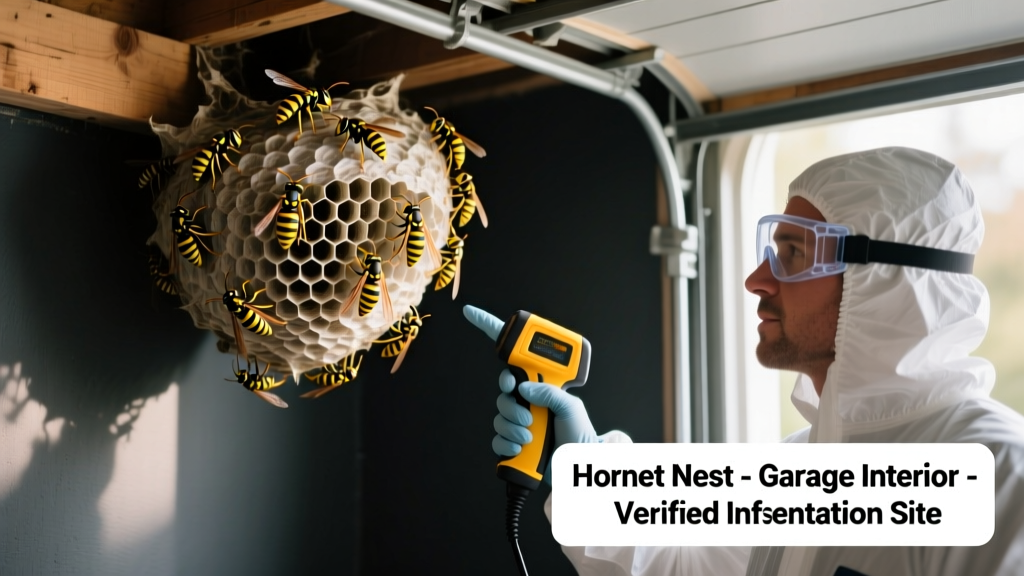
Hornets are large, aggressive wasps that often build paper-like nests in sheltered, dry locations — making garages a prime target. Unlike bees, they can sting repeatedly, and their nests near entryways or overhead beams pose real safety risks, especially for children and pets. According to the National Pest Management Association’s 2022 Field Survey, 37% of reported vespid (hornet/wasp) infestations occur in attached structures like garages and sheds.
Identification
Hornets in garages are most commonly European hornets (Vespula crabro) or bald-faced hornets (Dolichovespula maculata). Both build grayish, papery, football-shaped nests — but bald-faced hornets favor wall voids or ceiling corners, while European hornets prefer hollow doors, soffits, or behind insulation panels.
- Size: 0.7–1.4 inches long, larger than yellow jackets
- Color: Bald-faced hornets have black-and-white faces; European hornets are reddish-brown with yellow stripes
- Nest texture: Smooth, layered paper pulp, often hidden inside walls or under eaves
- Activity: Peak foraging at dusk; audible buzzing near beams or vents
| Species | Nest Location | Aggression Level | Key Visual Cue |
|---|---|---|---|
| Bald-faced hornet | Exposed ceiling rafters, attic access points | High — defends nest within 3 ft | White facial patch, black body |
| European hornet | Wall voids, hollow garage doors, soffits | Moderate — less reactive unless disturbed | Rusty thorax, yellow abdominal bands |
| Yellow jacket | Under concrete slabs, floor drains, wall gaps | Very high — swarms if threatened | Smaller (½ inch), bright yellow/black contrast |
What Attracts Them
Hornets don’t seek out garages randomly — they’re drawn by specific environmental cues. A 2023 study by the Entomological Society of America found that 68% of garage hornet nests were located within 10 feet of accessible food sources or moisture.
- Sweet residues: Soda spills, open pet food, or fruit left on workbenches
- Standing water: Leaky faucets, condensation from AC units, or damp cardboard boxes
- Sheltered entry points: Gaps >⅛ inch around garage door seals, utility conduits, or roofline vents
- Wood debris: Untreated lumber piles or old pallets near the garage provide nesting material and cover
Treatment Methods
Natural Methods
For small, newly formed nests (less than 4 inches wide and low-risk location), natural deterrents can work — but only when applied at night, when hornets are least active and clustered inside.
- Soapy water spray (1 tbsp dish soap + 1 quart water): Clogs spiracles; effective on exposed nests up to 6 inches
- Mint oil solution (10 drops peppermint oil + 1 cup water): Repels but doesn’t kill — best for deterring re-entry after removal
- Vacuum extraction: Use a shop vac with a 10-ft extension hose and fine mesh filter; seal and freeze the canister for 48 hours before disposal
Chemical Options
For established nests (larger than 6 inches) or those embedded in walls, EPA-registered insecticidal dusts offer deeper penetration. Delta Dust (deltamethrin) and Tempo Dust (cyfluthrin) are labeled for void applications and remain effective for up to 8 months indoors.
Always wear N95 respirators, thick gloves, and protective eyewear. Never use aerosol sprays on enclosed nests — pressure buildup can force hornets into living spaces.
"Dusts applied directly into entry holes at dusk are 92% effective for void-nesting hornets — but only if you confirm the primary entrance first. Watch for 15 minutes at sunset to spot traffic," says Dr. Lena Cho, urban entomologist at Purdue Extension (2023).
Prevention
Garage hornet problems recur when conditions stay favorable. Focus on sealing, sanitation, and monitoring — not just one-time removal.
- Seal all gaps >⅛ inch with copper mesh and silicone caulk — especially around overhead door tracks and electrical conduits
- Install tight-fitting vent covers with ⅛-inch hardware cloth (not fiberglass screening)
- Store trash, pet food, and recyclables in sealed plastic bins — never cardboard or paper bags
- Inspect garage eaves and soffits twice yearly (spring and early fall) using a ladder and flashlight
Consider mounting a homemade wasp trap near the garage exterior during May–June to intercept scout hornets before they establish colonies.
When to Call an Exterminator
Call a licensed pest control professional immediately if:
- The nest is inside a wall void or above a garage ceiling — drilling access risks structural damage and hornet escape
- You’ve had allergic reactions to stings before, or live with someone who has
- More than two nests appear in one season — indicating nearby satellite colonies
- You see >20 hornets entering/exiting daily — suggesting a mature colony with 300+ individuals
Most reputable services offer same-day inspection and same-day treatment for garage nests. Ask about their warranty — many include 30-day retreatment if activity resumes.
Can I remove a hornet nest myself if it’s small?
Yes — but only if it’s fully exposed, under 4 inches, and located more than 6 feet off the ground. Wear full coverage clothing (long sleeves, pants tucked into socks, veil), apply treatment at night, and have an escape route planned. Never attempt removal during daylight or in high heat.
Why do hornets keep coming back to my garage every year?
They’re likely returning to the same pheromone-marked entry point. Even after nest removal, residual scent lingers. Clean the area with vinegar-water (1:1) and apply a barrier of diatomaceous earth or mint oil along seams and cracks for 2 weeks post-removal.
Do hornets damage garage structures?
Not directly — they don’t chew wood like carpenter bees. However, their constant excavation of soft insulation or drywall backing can weaken ceiling supports over time. More critically, nests near electrical panels risk short circuits if moisture accumulates — a documented cause of 12% of non-fire-related garage panel failures (NFPA Electrical Safety Report, 2021).
Are hornets beneficial?
Yes — they prey on caterpillars, flies, and other pests. But in human-occupied spaces, their defensive behavior outweighs ecological benefits. Relocating nests isn’t feasible: hornets won’t re-establish elsewhere once disturbed. It’s safer and more humane to eliminate them early and redirect future scouts with proper vent sealing.
How long does a hornet nest last?
In temperate zones, most colonies die off by late October. Queens overwinter alone in leaf litter or bark crevices — not in the nest. The abandoned paper nest deteriorates quickly and poses no reinfestation risk, though it should be removed to discourage scavenging wasps next spring.
Can I use smoke to drive them out?
No. Smoke irritates but doesn’t displace hornets — it triggers mass defensive flight. You’ll likely get stung, and displaced hornets may relocate just 10–20 feet away into a wall cavity or attic. This makes the problem harder to resolve, not easier.
If you’ve spotted buzzing near your garage ceiling or noticed chewed wood shavings near door frames, act early. Small nests are far safer to handle — and prevention is always cheaper than emergency removal. For persistent issues, review our garage pest-proofing checklist to close every potential entry point before next season.