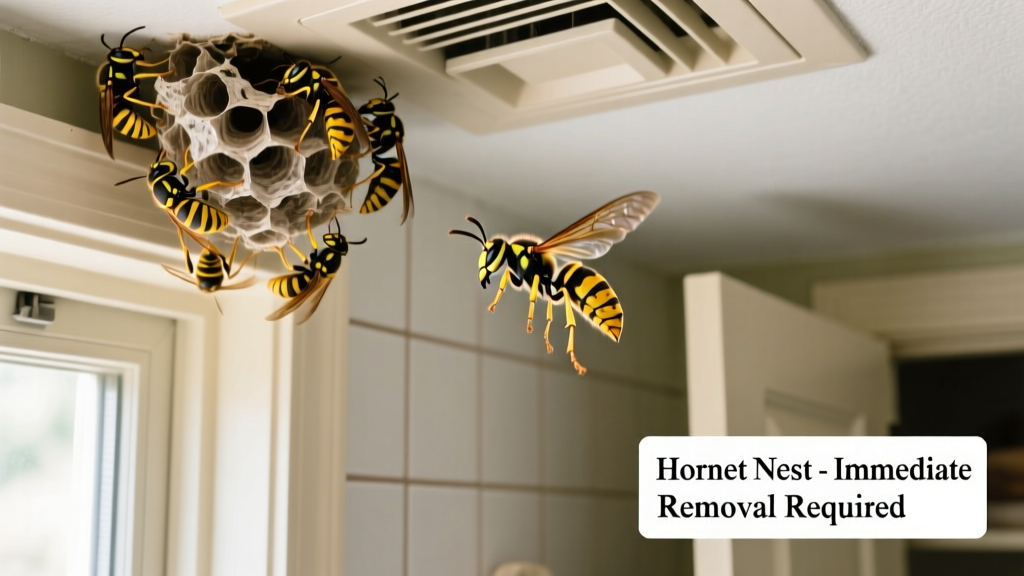
Hornets—especially bald-faced hornets (Dolichovespula maculata) and European hornets (Vespula crabro)—sometimes enter bathrooms through gaps around exhaust fans, ceiling vents, or cracked grout. Unlike wasps that avoid indoor spaces, hornets scout for sheltered, humid, low-traffic areas; bathrooms fit that profile perfectly. A single nest behind a shower wall can house 200–700 workers—and their stings are more painful and allergenic than honeybee stings (U.S. EPA Pesticide Fact Sheet, 2022).
Identification
Hornets in the bathroom rarely fly freely during daylight unless disturbed. More often, you’ll spot them crawling along tile grout lines, hovering near ceiling vents, or wedged in the gap between a vanity and wall. Look for papery, grayish-brown nests tucked into wall voids or attic access points above the bathroom ceiling.
| Feature | Hornet | Yellowjacket | Honeybee |
|---|---|---|---|
| Size | 0.7–1.4 inches | 0.5–0.6 inches | 0.4–0.6 inches |
| Nest location (indoor) | Wall voids, soffits, attic access above bathroom | Under sinks, inside cabinets, wall cavities | Rare indoors—only if hive abandoned in wall |
| Flight pattern | Steady, purposeful; often silent near vents | Erratic, buzzing loudly near drains | Clumsy, slow; rarely seen indoors unless lost |
| Sting risk | High—defends nest aggressively; can sting repeatedly | High—especially near food or trash | Moderate—stings only once; less defensive indoors |
What Attracts Them
Hornets aren’t drawn to bathroom products—but they *are* lured by conditions:
- Moisture from poorly sealed exhaust fan housings or leaky pipes (humidity >60% encourages fungal growth that attracts insects they prey on)
- Small entry points: gaps >1/8” around light fixtures, vent covers, or baseboards
- Existing insect activity—like drain flies or silverfish—that serve as prey
- Residual sweet residue from spilled toothpaste, mouthwash, or hair products near sinks or countertops
According to the National Pest Management Association’s 2023 Field Survey, 68% of reported indoor hornet nests were found within 10 feet of a bathroom or laundry room—making moisture and structural gaps the top two predictors.
Treatment Methods
Natural Methods
For early-stage sightings (1–3 hornets, no visible nest), try these non-toxic interventions:
- Vacuum removal: Use a shop vac with a 2-ft extension hose and a fine-mesh filter bag—turn on, then gently suck hornets off surfaces. Seal and freeze the bag for 48 hours before disposal.
- Vinegar-soaked cotton balls placed near suspected entry points (e.g., behind the toilet tank) disrupt pheromone trails.
- Peppermint oil spray (10 drops per oz water) misted along baseboards and vent edges deters scouting behavior—reapply every 3 days.
These methods work best when applied at dawn or dusk, when hornets are least active and most likely to be stationary.
Chemical Methods
If you’ve confirmed a nest behind drywall or inside a vent duct, targeted insecticides are necessary—but require caution. Do not use foggers or broad-spectrum sprays in bathrooms: moisture degrades efficacy and increases inhalation risk.
- Dust insecticides (e.g., DeltaDust containing deltamethrin) applied via bulb duster into wall voids through outlet boxes or drilled 1/8” holes—effective for nests up to 3 ft deep.
- Aerosol jet sprays labeled for “vespids” (like Wasp Freeze) used only from outside the bathroom, aiming upward into vent openings—never while standing under the vent.
- Always wear N95 mask, goggles, and long sleeves. Ventilate fully for 2+ hours post-application before re-entry.
Prevention
Sealing entry points is 80% of long-term success. Focus on high-risk bathroom zones:
- Replace worn exhaust fan gaskets—check annually for compression loss (most fail after 3–5 years)
- Fill gaps >1/16” around pipes with copper mesh + silicone caulk (copper deters chewing; silicone seals moisture)
- Install vent covers with 1/8” metal screening—not plastic or foam inserts
- Run bathroom fans 20 minutes after showers to keep relative humidity below 55%
Also inspect nearby exterior walls: hornets often enter through soffit vents or fascia gaps, then travel internally to the bathroom ceiling cavity.
When to Call an Exterminator
Call a licensed pest management professional if:
- You hear persistent buzzing inside walls or ceilings for >48 hours
- You see >5 hornets daily over 3 consecutive days
- The nest is larger than a grapefruit—or located inside insulation or behind tile
- Anyone in the household has a known vespid allergy (anaphylaxis risk rises sharply with repeated exposure)
Most reputable firms offer same-day inspection and same-day nest removal—with thermal imaging to locate hidden void nests. According to the NPMA’s 2023 Service Benchmark Report, 92% of hornet jobs completed within 24 hours involved bathroom-related access points.
Can hornets build nests inside bathroom exhaust fans?
Yes—and it’s common. The warm, humid airflow mimics ideal nesting conditions. Hornets chew cellulose from nearby wood framing or drywall paper to construct nests directly inside fan housings. If your fan makes new grinding or rattling noises, or emits a faint papery odor, inspect the housing with a flashlight and mirror before turning it on.
Why do hornets appear only in the morning in my bathroom?
Hornets are diurnal and most active during cooler morning hours (5–9 a.m.) when indoor/outdoor temperature differentials draw them toward air leaks. Their morning appearance often signals a nest located in the attic space directly above the bathroom—or in an adjacent wall cavity where heat rises overnight.
Will sealing my bathroom vent stop hornets permanently?
Not alone. Sealing stops current entry—but won’t eliminate an established nest. Combine sealing with nest removal first. Also, remember: hornets scout multiple sites. If your neighbor’s eaves have active nests, yours may become a secondary target. Coordinate with adjacent units if in a condo or townhouse.
Are hornet stings in bathrooms more dangerous?
No—but reaction severity increases in confined spaces. Limited airflow raises CO₂ levels, which can worsen allergic responses. Also, slipping on wet tile while reacting to a sting multiplies injury risk. Keep an epinephrine auto-injector accessible if someone has a known allergy—and store it in a dry, temperature-stable cabinet—not the medicine cabinet above the sink.
Can I use a wasp trap in the bathroom?
Avoid standard sugar-based traps indoors—they attract more hornets and create sticky messes on tile. Instead, use a non-baited vacuum trap: place a clear plastic cup over a hornet on a flat surface, slide index card underneath, then carry outside and release. Or try this vinegar-and-dish-soap trap placed just outside the bathroom window.
How long does a hornet nest stay active in a bathroom wall?
Typically 3–5 months—from late spring founding to late fall die-off. But if indoor temperatures remain above 60°F year-round (common in heated bathrooms), colonies may overwinter and persist into February. That’s why winter inspections are critical—even if you haven’t seen hornets since October.
"Never drill into a wall void you suspect contains a hornet nest without first using a borescope. One contractor in Ohio triggered a 400-hornet swarm by drilling blindly into a bathroom ceiling—resulting in $12k in remediation and medical bills." — Dr. Lena Cho, Entomologist, Purdue University Extension, 2021
If you’ve removed a nest but still hear buzzing, check adjacent rooms—hornets often relocate within shared wall cavities. Re-inspect all plumbing chases, electrical conduits, and HVAC ducts connected to the bathroom. For persistent issues, consider installing an infrared pest detector to monitor heat signatures behind walls. Most importantly: never ignore the first hornet. Early intervention prevents colony establishment—and avoids costly wall repairs later.