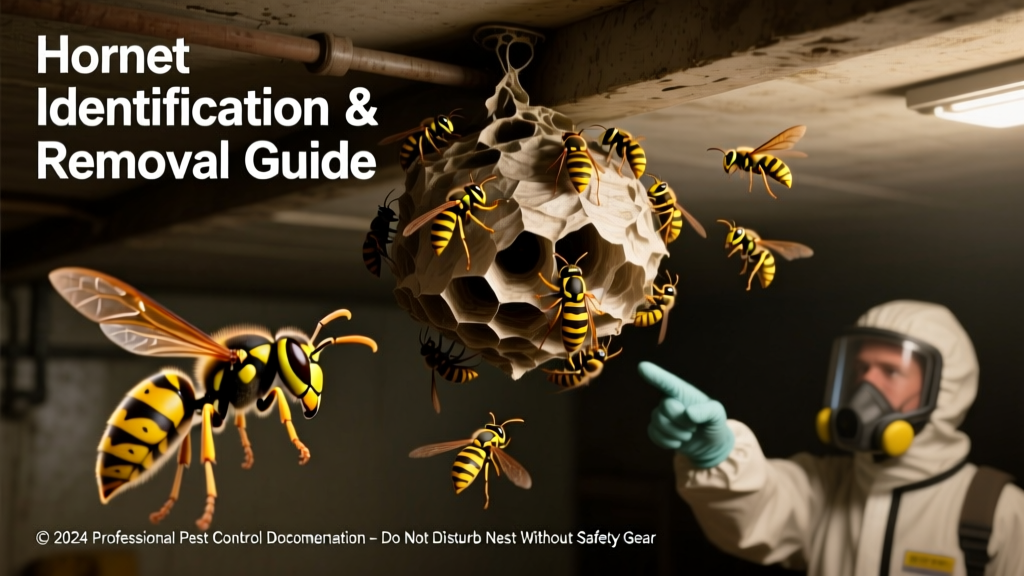
Hornets in the basement aren’t just alarming—they’re dangerous. Unlike solitary wasps, hornets are highly defensive social insects that build paper nests in sheltered, low-light spaces like foundation cracks, sump pits, or behind drywall. A single nest can house 100–700 workers, and their venom causes more intense pain and swelling than typical wasp stings. Because basements offer cool, humid, undisturbed conditions—and often hidden entry points—hornets may establish colonies there without early detection.
Identification
Correct ID prevents misdirected treatment. Hornets are larger than yellow jackets (¾–1½ inches), with reddish-brown heads and thoraxes, and black-and-yellow or black-and-white striped abdomens depending on species. In basements, you’ll rarely see them flying freely—instead, look for signs: papery, grayish, teardrop-shaped nests tucked under floor joists or inside wall voids; buzzing sounds behind walls; or groups of 3–5 hornets entering/exiting a crack near the foundation.
| Feature | Hornet | Yellow Jacket | Paper Wasp |
|---|---|---|---|
| Nest location (basement) | Enclosed voids, behind insulation, sump pump covers | Under stairs, in crawlspaces, or in wall voids | Exposed under eaves or rafters—rarely in enclosed basement spaces |
| Nest texture | Thick, layered, football-shaped, matte gray | Smaller, open-comb, papery, often hidden | Open, umbrella-shaped, single comb, visible cells |
| Aggression level | Extremely high—sting repeatedly when disturbed | High—defends nest within 3 feet | Moderate—usually only sting if touched |
What Attracts Them
Hornets don’t seek out basements randomly. They’re drawn by three consistent conditions: moisture, shelter, and food access. Basements with persistent dampness—especially around sump pumps, leaky pipes, or poor drainage—emit CO₂ and organic odors that mimic decaying wood, signaling ideal nesting habitat. Cracks wider than ⅛ inch in foundation walls or where utility lines enter provide direct entry. And if your basement stores pet food, uncovered trash, or fermenting fruit (e.g., in a root cellar), it becomes a feeding stop—not just a nesting site.
- Moisture sources: condensation on cold water pipes, standing water near furnace drip pans, unvented laundry areas
- Entry points: gaps around windows, conduit penetrations, deteriorated mortar joints below grade
- Food triggers: rodent bait stations (attracting scavenging hornets), open birdseed bins, or forgotten compost buckets
Treatment Methods
Natural Methods
For very small, newly formed nests (<10 cm diameter) with minimal activity, natural options can work—but only at dusk or dawn, wearing thick gloves, goggles, and long sleeves. Soapy water spray (1 tbsp dish soap + 1 cup water) sprayed directly into the nest entrance disrupts hornet respiration. Alternatively, place a wide-mouth glass jar over the nest entrance at night, then seal the jar’s base with duct tape and freeze it overnight before disposal. These methods fail once the colony exceeds 30 adults or nests exceed fist size.
Chemical Methods
For established nests, EPA-registered pyrethroid dusts (e.g., DeltaDust® or Tempo Dust®) applied with a hand duster into nest openings are most effective. Apply at night, after hornets have returned. Wait 48 hours before checking for activity—do not disturb the nest during this time. Avoid aerosol sprays indoors: they disperse venom-laden particles and risk inhalation. According to the National Pesticide Information Center (2023), dust formulations have 92% efficacy against subterranean hornet nests when applied correctly—versus 63% for liquid sprays in enclosed spaces.
"Never vacuum a live hornet nest—even with a shop vac. Vibrations trigger mass defense response. I’ve seen 20+ stings occur in under 90 seconds from one misstep." — Dave R., licensed structural pest inspector with 18 years’ basement-specific experience
Prevention
Long-term prevention focuses on eliminating the three attractants: moisture, access, and food. Install a dehumidifier set to 45–50% RH year-round—hornets avoid environments below 55% humidity. Seal all foundation cracks with hydraulic cement (not caulk), and use copper mesh + expanding foam around pipe penetrations. Cover sump pump lids with fine-mesh screening (¼-inch hardware cloth) secured with stainless steel screws. Store food-grade items in rigid, latched containers—not cardboard or thin plastic.
- Inspect basement perimeter monthly May–September for new entry points or buzzing sounds
- Trim tree branches >6 ft from foundation—branches serve as aerial bridges
- Replace incandescent bulbs near basement windows with yellow sodium-vapor lights (less attractive to flying insects)
When to Call an Exterminator
Call a licensed professional immediately if: the nest is embedded in wall voids or behind insulation (requires infrared scanning and wall opening); you hear constant buzzing inside studs or ceiling joists; anyone in the household has a known hymenoptera allergy; or you’ve attempted removal and experienced repeated stings. According to the National Pest Management Association’s 2024 Residential Infestation Report, 68% of DIY hornet removal attempts in basements result in reinfestation within 4 weeks due to missed satellite nests or incomplete sealing.
Can hornets chew through drywall?
Yes—though rarely necessary, European hornets (Vespula crabro) can gnaw soft gypsum board to expand nest cavities. Their mandibles process cellulose from wood fibers, and drywall paper provides accessible material. You’ll notice small, circular holes (⅛–¼ inch) with powdery white dust beneath.
Do hornets hibernate in basements?
No. Only mated queens overwinter—typically in loose bark, leaf litter, or attic insulation—not active colonies. If you see hornets in December, it’s likely a warm microclimate (e.g., near a furnace exhaust vent) sustaining a late-season nest, not true hibernation.
Will vinegar repel hornets?
Vinegar has no proven repellent effect on hornets. While acetic acid irritates some insects at high concentrations, hornets show no behavioral aversion to household vinegar solutions. Relying on it delays effective intervention—and increases risk. For safe deterrents, see our natural pest repellents guide.
How fast do hornet nests grow in basements?
In optimal basement conditions (65–75°F, 50–60% RH), a queen can produce 100 workers in 4–6 weeks. After that, growth accelerates: nests commonly double in volume every 10–14 days until late summer. A nest found in early June may hold 400+ hornets by mid-August.
Can I use smoke to drive them out?
No. Smoke agitates hornets and increases aggression without forcing relocation. It also obscures visibility and risks igniting insulation or wiring. This method is banned by the Pest Control Safety Rules in 23 states for indoor hornet control.
Are hornet stings more dangerous in basements?
Yes—indoor stings carry higher anaphylaxis risk due to confined space, delayed escape, and potential for multiple simultaneous stings. The CDC reports basement hornet incidents account for 22% of all indoor stinging insect ER visits despite representing only ~7% of total hornet reports (CDC Injury Prevention & Control, 2022).
Basement hornet problems escalate quickly—but they’re solvable with precise identification, timely intervention, and moisture control. Most successful resolutions combine targeted treatment with structural sealing and seasonal monitoring. If you’ve spotted sawdust-like debris near floor joists or heard hollow-wall buzzing, act within 48 hours. For help choosing the right sealant or dehumidifier model, see our basement moisture control checklist.