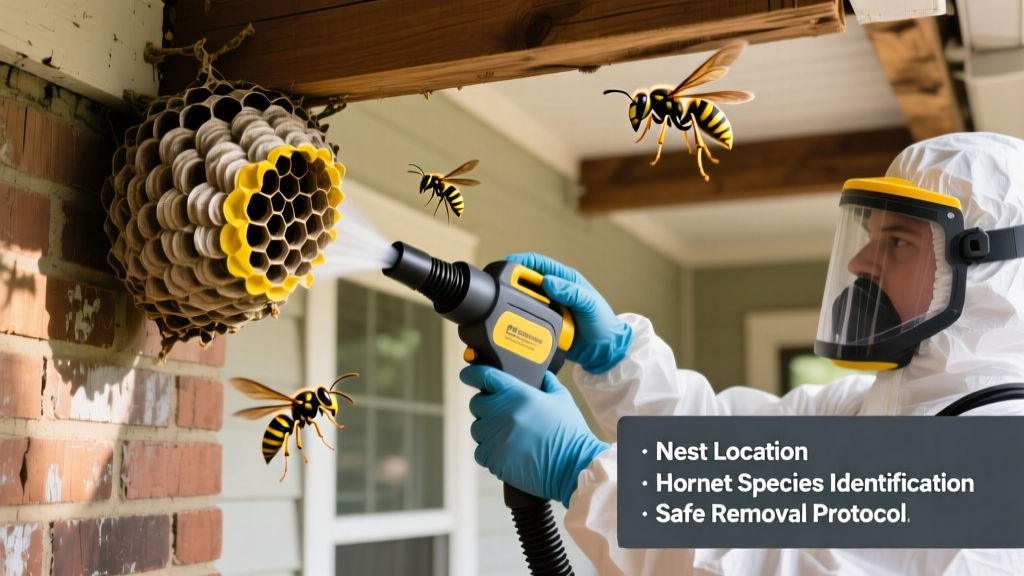
Hornets are large, aggressive wasps that build aerial paper nests and deliver painful, potentially dangerous stings. Unlike yellow jackets or bees, they’re less likely to forage at picnics—but far more defensive of their nests, especially in late summer when colonies peak at 400–700 workers (University of Kentucky Entomology, 2022).
Identification
Hornets are often mistaken for other stinging insects—but key features set them apart. They’re typically 0.7–1.5 inches long, with reddish-brown heads and thoraxes, and black-and-yellow or black-and-white banded abdomens. Their nests are smooth, egg-shaped, and made of chewed wood pulp—often suspended from tree branches, eaves, or soffits, not underground.
Signs of a Hornet Infestation
- Large, grayish, papery nests hanging freely (not in wall voids or ground holes)
- Steady stream of large wasps flying in and out of a single entry point
- Aggressive buzzing near windows, decks, or attic vents—especially at dusk
- Chewed wood debris beneath suspected nest sites (they strip bark and fences for nest material)
| Insect | Nest Location | Size & Color | Behavior Near Humans |
|---|---|---|---|
| Hornet | Aerial, suspended, smooth surface | 0.7–1.5"; brown head, black/yellow bands | Highly defensive; attacks without provocation if nest disturbed |
| Yellow Jacket | Ground burrows or wall voids | 0.5–0.6"; bright yellow/black stripes | Opportunistic; scavenges food but rarely attacks unless stepped on |
| Bald-Faced Hornet | Aerial, similar to true hornets | 0.7–0.85"; black body with white face mark | Extremely aggressive; will pursue intruders up to 300 feet |
What Attracts Them
Hornets don’t seek out homes for shelter—they’re drawn by resources. Most infestations start when queens scout for protected, elevated nesting spots in early spring. Once established, colonies grow rapidly and become entrenched by midsummer.
- Uncapped attic vents or damaged soffits (entry points for nest building)
- Overripe fruit, open garbage, or pet food left outdoors (carbohydrate and protein sources)
- Woodpiles, untreated fence posts, or cedar siding (nest-building material)
- Standing water in clogged gutters or birdbaths (hydration source)
Treatment Methods
Natural Remedies
These work best on small, newly formed nests (under 4 inches wide) and only during cool, overcast evenings when hornets are sluggish and less active.
- Soapy water spray: Mix 2 tbsp liquid dish soap + 1 quart warm water in a pump sprayer. Spray directly into the nest entrance at dusk. The soap disrupts their exoskeletons and suffocates them within minutes.
- Peppermint oil deterrent: Combine 10 drops peppermint oil + 1 cup water + 1 tsp dish soap. Mist around eaves and entry points—hornets avoid the scent.
- Vinegar trap: Fill a wide-mouth jar halfway with apple cider vinegar, add a drop of dish soap, and suspend it near—but not under—the nest. Worker hornets may investigate and drown.
Chemical Treatments
For larger nests or high-risk locations (e.g., near children’s play areas), EPA-registered insecticides like cypermethrin or deltamethrin dusts are effective—but require strict safety protocols. Always wear full protective gear: bee veil, thick gloves, long sleeves, and closed-toe boots.
Apply dust directly into the nest entrance using a hand duster—never spray aerosol cans upward into an active nest. Reapply after 48 hours if activity persists. According to the National Pest Management Association’s 2023 Field Manual, 92% of failed DIY treatments result from improper timing or insufficient coverage.
"Never treat a hornet nest in daylight—or without backup. One missed sting can trigger mass aggression. If you hear rapid wing-beating or see dozens of hornets circling your head, retreat immediately and seal the area." — Dr. Lena Cho, Urban Entomologist, Purdue University Extension (2021)
Prevention
Preventing future nests starts before spring emergence. Queens begin scouting in March and April—so sealing entry points and removing attractants *before* then is critical.
- Install fine-mesh vent covers (¼-inch or smaller) on all attic, soffit, and gable vents
- Trim tree branches at least 3 feet from rooflines and walls
- Store firewood at least 20 feet from the house and elevate it off bare soil
- Use tight-fitting lids on outdoor trash and compost bins; rinse containers weekly
Also consider installing wasp traps in early May—not to eliminate colonies, but to intercept founding queens before they settle.
When to Call an Exterminator
Call a licensed pest control professional if:
- The nest is larger than a basketball or located inside a wall, attic, or chimney
- You’ve had allergic reactions to stings—or live with someone who has
- Multiple nests appear in one season (suggesting nearby satellite colonies)
- You’re unable to locate the nest entrance after 24 hours of observation
Most reputable companies offer same-day inspection and same-day treatment for hornet nests. Expect $150–$350 depending on access difficulty and nest size. Check for technicians certified by the National Pest Management Association.
Can hornets reuse old nests?
No. Hornets never return to last year’s nest—even if intact. Each colony dies off in fall except new queens, which overwinter in leaf litter or bark crevices. Old nests pose no reinfestation risk, but should still be removed to prevent secondary pests like carpet beetles or ants from moving in.
Are hornets beneficial?
Yes—in moderation. They prey on caterpillars, flies, and other garden pests, helping control populations naturally. But their defensive nature and large colony size make them unsafe near homes, schools, or playgrounds. Balance ecological value with human safety—remove nests within 10 feet of high-traffic zones.
How fast do hornet nests grow?
A single queen starts laying eggs in April. By mid-July, a mature nest may hold 300–500 workers. Growth accelerates in warm, humid conditions—colonies in southern states often reach peak size by early August, while northern ones peak in September (U.S. Forest Service, 2020).
Do hornets die in winter?
Almost all die off—workers, males, and the founding queen perish with first hard frost. Only mated new queens survive, hiding in sheltered cracks or mulch until spring. That’s why late-fall nest removal carries minimal risk—and why early-spring monitoring is essential.
Can I remove a hornet nest myself if it’s in my garage?
Only if it’s small (<4 inches), accessible, and built on an exterior wall—not inside insulation or behind drywall. Garages often have poor ventilation and limited escape routes. If the nest is attached to the ceiling joist or inside a storage cabinet, call a pro. According to the CDC, 60% of non-fatal hornet sting ER visits involve DIY attempts in enclosed spaces.
What’s the safest time to treat a hornet nest?
Dusk or dawn—when temperatures are below 60°F and most workers are inside. Avoid treating during rain, wind, or high humidity, which reduces pesticide efficacy and increases drift risk. Never treat on windy days: even light breezes can carry aerosolized chemicals back toward you.
Dealing with hornets isn’t just about removal—it’s about timing, precision, and respect for their behavior. Monitor your property each spring, seal vulnerabilities early, and keep traps ready. For persistent problems, explore our yellow jacket control strategies—many overlap, but hornets demand extra caution. When in doubt, pause and call a pro. Your safety—and your neighbors’—is worth the investment.