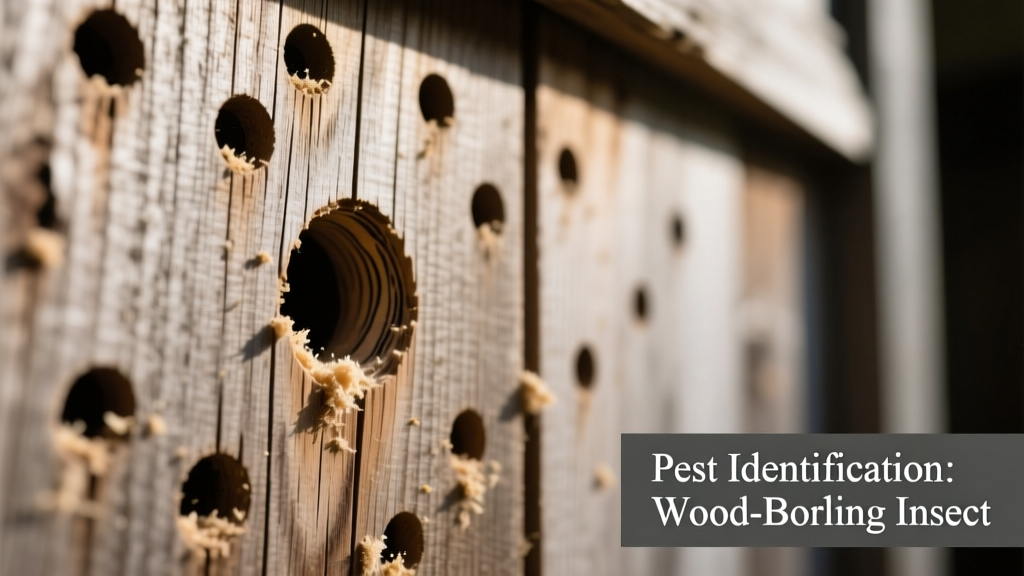
Small, round holes in deck railings, attic beams, or antique furniture aren’t just cosmetic—they’re evidence of active wood-destroying pests. Left unchecked, these insects can weaken load-bearing timbers, reduce property value, and trigger costly repairs. Early identification is the most effective defense.
Identification
Not all wood holes are created equal. The diameter, depth, surface texture, frass (insect waste), and seasonality tell you exactly which pest is at work. Carpenter bees drill smooth, 1/4-inch entrance holes—often on unpainted cedar or redwood surfaces. Termites rarely leave visible exit holes; instead, they tunnel internally and may leave mud tubes or tiny kickout holes (less than 1/32 inch) near seams. Powderpost beetles create dime-sized, scattered holes with fine, flour-like frass beneath them—especially in hardwood floors or oak cabinets.
| Pest | Hole Diameter | Frass Appearance | Common Locations |
|---|---|---|---|
| Carpenter bee | ¼ inch, perfectly round | None (sawdust piles below) | Unpainted softwoods: eaves, fascia, decks |
| Old-house borer | ⅛–⅜ inch, oval or irregular | Coarse, gritty pellets | Structural pine framing (often 5+ years old) |
| False powderpost beetle | 1/64–1/16 inch, numerous | Fine, talcum-like dust | Hardwood flooring, furniture, trim |
| Formosan termite | Pinpoint (<0.03 inch), often hidden | None visible; mud tubes present | Subfloor joists, sill plates, crawl spaces |
What Attracts Them
Moisture is the universal magnet. Wood with >20% moisture content attracts both termites and powderpost beetles. Carpenter bees prefer bare, weathered softwoods—especially if previous nests exist nearby. Old-house borers target kiln-dried lumber that wasn’t properly heat-treated before installation, often hiding in dimensional pine used in homes built between 1970–1995.
- High humidity in crawl spaces or attics (above 65% RH)
- Wood-to-soil contact (e.g., deck posts embedded in dirt)
- Untreated or unpainted exterior wood surfaces
- Stored firewood stacked against house siding
Treatment Methods
Natural Options
For isolated carpenter bee holes: inject ½ tsp of diatomaceous earth into the opening using a duster, then seal with steel wool and caulk after 3–5 days. For powderpost beetles in furniture: place infested items in a deep freeze (0°F) for 72 hours—this kills larvae in dry hardwoods, per University of Florida Entomology’s 2022 protocol.
Chemical Treatments
Borate-based sprays (e.g., Bora-Care) penetrate wood up to 4 inches and prevent reinfestation for 12+ years when applied to raw, dry timber. For active termite galleries, licensed applicators use non-repellent liquid termiticides like Termidor SC—applied via trenching or drilling, with efficacy confirmed in 92% of structures treated within 3 months (National Pest Management Association, 2023).
"Carpenter bees don’t eat wood—but their repeated nesting weakens structural members over time. One female can excavate 6–8 feet of tunnel in a single season." — Dr. Karen Lopez, UC Riverside Urban Entomology Extension, 2021
Prevention
Seal every exposed end grain with paint, stain, or polyurethane—carpenter bees avoid finished surfaces. Install 1/8-inch metal mesh behind soffit vents to block entry. Keep gutters clean and downspouts directed away from foundations to maintain soil moisture below 18%. Replace any wood showing advanced decay with pressure-treated or naturally resistant species like black locust or white oak.
- Inspect exterior wood annually in early spring (peak carpenter bee activity)
- Use moisture meters to verify subfloor and rim joist readings stay below 16%
- Store firewood at least 20 feet from the house and elevated off the ground
When to Call an Exterminator
Call immediately if you find more than three active exit holes in one 10-square-foot area—or if holes appear in load-bearing beams, floor joists, or header boards. Also call if you spot mud tubes, hollow-sounding wood, or frass that reappears within 48 hours of cleaning. Termite damage is rarely surface-level; by the time holes appear, colonies may have been active for 2–5 years.
Are the holes perfectly round and on the underside of eaves?
That’s almost certainly carpenter bees. They avoid direct sunlight and drill upward into softer grain. Look for yellowish pollen stains near entrances and listen for buzzing inside walls during midday in April–June.
Do holes appear only in hardwood floors or antique furniture?
Powderpost beetles are the likely culprit—especially if you see tiny, pale dust piles in cracks or under baseboards. These beetles lay eggs in pores of oak, ash, or hickory; larvae feed for 1–5 years before emerging.
Is there mud packed around or near the holes?
Mud tubes signal subterranean termites—not carpenter ants (which don’t use mud). Tubes may be as thin as pencil lead or as wide as your thumb, often bridging foundation cracks to interior walls.
Do holes cluster along board edges or joints?
Old-house borers favor the sapwood edge of pine framing. Their emergence holes are often aligned with growth rings—and you may hear faint ticking sounds at night from larval feeding.
Can I hear chewing or scraping inside walls?
That’s a red flag. Termites are silent, but carpenter bees produce a distinct high-frequency buzz. If you hear rhythmic tapping or rasping, suspect powderpost beetle larvae—though this is rare without magnification.
Are holes appearing in newly installed lumber?
It’s likely old-house borer larvae that hatched from wood cut years earlier. These beetles can remain dormant for up to 10 years before emerging—so new construction isn’t immune. Always ask suppliers for kiln-dry certification with temperature logs.
Wood damage doesn’t wait for perfect conditions—it exploits small oversights. Catching the right pest early means choosing the right solution: sealing, freezing, or calling in specialists before repair costs climb. For more on carpenter bee control, or to compare termite vs. carpenter ant signs, explore our targeted guides. And if you’re evaluating a home purchase, read our guide on what a WDIR really reveals.