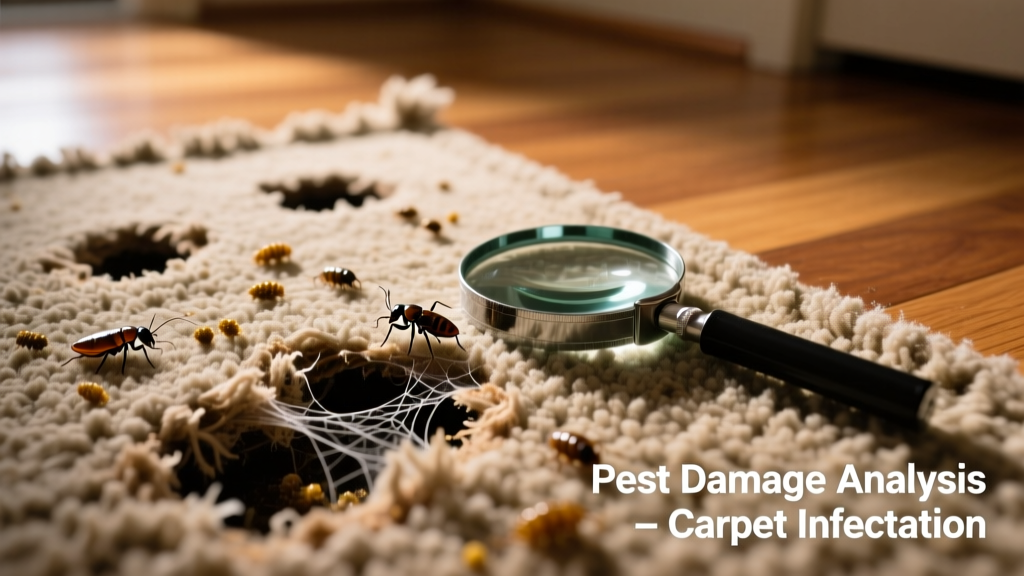
Holes in your carpet aren’t just unsightly—they’re a red flag that something is feeding on natural fibers, nesting beneath padding, or tunneling through backing layers. Most commonly, it’s not rodents (they rarely chew carpet for food) but fabric pests like carpet beetles or clothes moths—and occasionally subterranean termites if the carpet covers damp concrete slabs.
Identification
Carpet damage varies by pest species, life stage, and fiber type. Wool, silk, and other animal-based fibers are especially vulnerable. Look closely at hole edges: frayed vs. clean-cut, presence of shed skins or tiny pellets, and whether holes cluster near baseboards, under furniture, or along seams.
| Pest | Hole Appearance | Key Clues | Typical Locations |
|---|---|---|---|
| Varied carpet beetle (Anthrenus verbasci) | Irregular, shallow pits; often no full-through holes—just surface fuzz removal | Tiny black-and-white spotted adults; larvae look like fuzzy brown caterpillars with bristly tails | Under rugs, behind baseboards, inside closets, near windowsills |
| Webbing clothes moth (Tineola bisselliella) | Smooth-edged, round holes; sometimes webbing or silken tubes | No wings on adult males; larvae spin silk tunnels while feeding | Dark, undisturbed areas—under furniture, in stored wool blankets, along carpet edges |
| Subterranean termite (Reticulitermes spp.) | Small mud-lined tunnels piercing carpet backing—not true ‘holes’ but ruptured pathways | Mud tubes on walls/floor joints; discarded wings near windows; hollow-sounding floorboards | Ground-floor rooms over slab foundations, basements, bathrooms with chronic moisture |
- Carpet beetles leave behind molted larval skins—look for translucent, C-shaped casings near damaged zones.
- Clothes moths avoid light: inspect at night with a flashlight after turning off overhead lights for 10 minutes.
- If holes appear only where carpet meets hardwood or tile, check for gaps—carpet beetles exploit those micro-habitats.
What Attracts Them
These pests don’t invade randomly. They follow scent trails, moisture gradients, and shelter opportunities. Carpet beetles seek keratin-rich debris—pet dander, human hair, dead insects trapped in fibers. Moths track lanolin and sweat residues in wool rugs. Termites respond to cellulose (in carpet padding or subfloor) plus humidity above 60% RH.
According to the National Pest Management Association’s 2022 Residential Pest Report, 68% of carpet beetle infestations begin within 3 feet of exterior doors or windows—entry points for flying adults.
Treatment Methods
Natural Methods
Vacuuming with a HEPA filter is the single most effective first step—remove larvae, eggs, and food sources. Focus on seams, under furniture legs, and along wall junctions. Follow with freezing: place small rugs or runners in sealed plastic bags and freeze at 0°F for 72 hours to kill all life stages.
- Apply food-grade diatomaceous earth (DE) along baseboards and under furniture—reapply after vacuuming.
- Use cedar oil sprays (0.5% dilution) on carpet edges—repels moths but won’t kill beetles outright.
- Steam clean at >120°F for 15+ seconds per square foot: kills larvae and eggs without chemicals.
Chemical Methods
For persistent infestations, targeted insect growth regulators (IGRs) like pyriproxyfen disrupt larval development. Apply as a fine mist only to affected zones—not broadcast sprays. Avoid carbaryl or permethrin indoors unless labeled for carpet use; these can irritate respiratory systems and harm pets.
"Carpet beetle larvae can survive up to 9 months without food—but they die within 48 hours of sustained 130°F exposure." — Dr. Elena Ruiz, Entomologist, UC Riverside Integrated Pest Management Program, 2021
Prevention
Stop reinfestation by breaking the breeding cycle. Replace wool or silk area rugs with synthetic blends in high-traffic zones. Install door sweeps and repair window screens to block adult beetles and moths from entering. Maintain indoor humidity below 50% using dehumidifiers—especially in basements and laundry rooms.
- Rotate and flip area rugs every 3 months to expose hidden larvae to light and airflow.
- Store off-season wool garments in airtight plastic bins—not cedar chests (beetles eat cedar oils, then move to wool).
- Wash or dry-clean wool carpets annually—even if they look clean—to remove embedded dander and skin cells.
When to Call an Exterminator
Call a licensed pest professional if you find more than five active larvae per square foot, notice mud tubes under carpet edges, or see winged swarmers indoors between March–June. Also call if holes multiply after two weeks of DIY treatment—or if you spot live termites in flooring joints.
For localized issues, try carpet beetle treatment first. If damage spreads across multiple rooms, consider clothes moth control or termite inspection depending on evidence.
Do carpet beetles chew through synthetic carpet?
No—they feed almost exclusively on keratin, so polyester, nylon, and olefin remain untouched. Damage to synthetics usually means secondary invaders (like silverfish feeding on glue backings) or mechanical wear misdiagnosed as pest activity.
Can mice cause holes in carpet?
Rarely. Mice gnaw wood, wires, and insulation—not carpet fibers. If you see paired parallel grooves, shredded padding, or droppings near holes, suspect mice—but confirm with a mouse droppings identification guide first.
Why do holes appear only in one room?
Localized conditions—like a leaky HVAC vent increasing humidity, pet bedding left undisturbed for weeks, or sunlight warming a south-facing corner—create ideal microhabitats for moths or beetles. Check for thermal drafts and organic debris buildup before assuming widespread infestation.
Are carpet holes always caused by pests?
No. Fungal degradation (from chronic moisture), UV fading weakening fibers, or even chemical spills (like bleach or ammonia) mimic pest damage. Test by rubbing a cotton swab dipped in water on the hole edge—if color bleeds or fibers disintegrate, it’s likely non-biological.
How long does it take for carpet beetles to destroy a rug?
In warm, humid homes with heavy pet traffic, severe damage can occur in 3–6 months. A single female lays 50–100 eggs; larvae feed 6–12 months before pupating. That’s why early detection matters—most homeowners don’t notice until 2nd-generation larvae emerge.
Will vacuuming alone eliminate carpet beetles?
It removes ~70% of larvae and eggs—but not those embedded deep in padding or glued to tack strips. Combine vacuuming with heat treatment and exclusion for lasting results. Use a crevice tool on every seam and along every quarter-inch of perimeter.
Don’t wait until holes widen into bare patches. Catching these pests early preserves both your carpet’s lifespan and your peace of mind. Regular inspection—especially in low-light corners and under seldom-moved furniture—is smarter than reactive treatment.