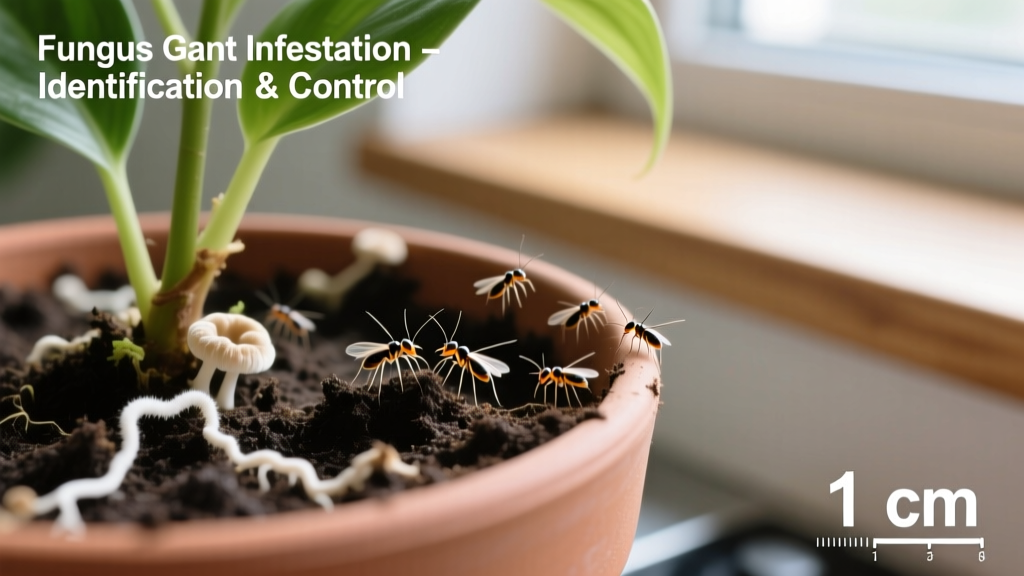
Fungus gnats are tiny, dark, mosquito-like insects that hover around damp houseplant soil — not fruit flies or drain flies, but a distinct pest tied directly to overwatered pots. They don’t bite people, but their larvae feed on root hairs and fungal growth, stunting young plants and spreading disease.
Identification
Fungus gnats (Bradysia spp.) are 1/8-inch long, slender, with long legs and antennae, grayish-black bodies, and delicate, clear wings. Adults resemble mini mosquitoes but lack biting mouthparts. You’ll spot them flying weakly near soil surfaces or windows — especially after watering. Larvae are translucent, legless maggots with shiny black heads, living in the top 1–2 inches of moist soil.
| Pest | Size & Color | Flight Pattern | Primary Habitat | Larval Food Source |
|---|---|---|---|---|
| Fungus gnat | 1/8"; dark gray/black | Weak, short bursts near soil | Moist potting mix | Fungal hyphae, root hairs |
| Fruit fly | 1/8"; tan/red eyes | Strong, persistent flight toward fermenting matter | Kitchen counters, drains, overripe fruit | Yeast, alcohol, rotting produce |
| Drain fly | 1/10"; fuzzy, moth-like | Fluttery, low-to-surface flight | Slime in drains, sewage traps | Biofilm, organic sludge |
What Attracts Them
Fungus gnats thrive where moisture, organic matter, and warmth converge — exactly the conditions we create for houseplants. Overwatering is the #1 trigger: saturated soil encourages fungal growth, which larvae devour. Potting mixes high in peat moss retain too much water and support fungi. New plants from nurseries often arrive with eggs already in the soil — 73% of retail houseplants tested in a 2022 University of Florida study carried gnat eggs or larvae (UF IFAS Extension, 2022).
- Consistently wet top 2 inches of soil
- Unclean pots with algae or biofilm buildup
- Using compost-rich or unsterilized potting soil
- Grouping plants tightly, reducing airflow
Treatment Methods
Natural Treatments
Start here — most infestations resolve in 2–3 weeks with consistent cultural controls. Let soil dry completely between waterings (down to 1.5 inches deep). Place yellow sticky cards vertically at soil level to trap adults and monitor population decline. Apply a 1/4-inch layer of horticultural sand or diatomaceous earth (food-grade) to the soil surface — it desiccates larvae and deters egg-laying.
For severe cases, drench soil with diluted hydrogen peroxide: mix 1 part 3% H₂O₂ with 4 parts water and apply until it bubbles — this kills larvae on contact without harming most roots. Repeat every 5 days for two cycles.
Chemical Treatments
Reserve these for persistent infestations after natural methods fail. Use Bacillus thuringiensis var. israelensis (Bti), sold as Mosquito Bits® or Gnatrol®. It’s EPA-registered, non-toxic to humans and pets, and targets only fly larvae. Apply as a soil drench every 5–7 days for three applications. Avoid broad-spectrum insecticides — they kill beneficial soil microbes and rarely reach larvae deep in soil.
- Bti drench: 1 tsp Mosquito Bits per quart water, soak soil for 20 minutes
- Pyrethrin sprays: only for adult knockdown — ineffective on eggs/larvae
- Neem oil soil drench: disrupts larval development but requires weekly reapplication
Prevention
Prevent recurrence by resetting your watering rhythm and improving soil structure. Switch to a well-draining mix: combine 2 parts potting soil, 1 part perlite, and 1 part coarse orchid bark. Repot plants annually using fresh, sterile medium — never reuse old soil. Always inspect new plants for gnat activity before bringing them indoors; quarantine for 7 days and place yellow sticky cards nearby.
Keep humidity below 60% in plant rooms — use a hygrometer and dehumidifier if needed. Wipe saucers dry after watering, and avoid letting pots sit in standing water for more than 30 minutes.
When to Call an Exterminator
Professional help isn’t usually needed for fungus gnats — they’re a horticultural issue, not a structural pest. But call a licensed pest management professional if: (1) gnats persist after 4 weeks of strict treatment across 5+ plants, (2) you find larvae in wall voids or baseboards (indicating a hidden moisture leak), or (3) other pests like springtails or mold mites appear alongside them — signaling chronic moisture damage.
“Fungus gnats are almost always a symptom — not the disease. Fix the moisture, and the gnats vanish. Spray first, and you’re just treating the cough while ignoring pneumonia.” — Dr. Elena Ruiz, Urban Horticulture Specialist, Cornell Cooperative Extension, 2023
Do fungus gnats harm humans?
No. They don’t bite, transmit disease, or colonize human skin or food. Their presence is strictly a plant health and nuisance issue — though large swarms can be alarming near faces or electronics.
Can I reuse gnat-infested soil?
Not safely. Baking or microwaving soil risks uneven heating and toxic fumes. Instead, discard infested soil outdoors away from gardens, then sterilize pots with 10% bleach solution for 10 minutes before reuse.
Why do gnats swarm my face?
Adults are attracted to CO₂, warmth, and moisture — your breath and skin emit all three. They’re not targeting you; they’re mistaking you for a humid microclimate. Wearing glasses or using a small fan near your desk breaks up the CO₂ plume and deters them.
Are fungus gnats the same as soil mites?
No. Soil mites are arachnids (not insects), usually white or brown, and move slowly in clusters. They’re mostly beneficial decomposers. Fungus gnats are true flies — they fly, lay eggs in soil, and their larvae actively damage roots. Confusing them leads to unnecessary soil replacement.
Will cinnamon kill fungus gnat larvae?
Cinnamon has antifungal properties and may suppress the fungi larvae eat — but it doesn’t kill larvae directly. A light dusting can help reduce fungal growth, yet it’s not a standalone treatment. Pair it with drying soil and sticky traps for best results.
How long does it take to get rid of fungus gnats?
With consistent drying and Bti drenches, adults drop within 5–7 days; full lifecycle interruption takes 18–21 days (the time from egg to adult). Monitor with sticky cards — zero catches for two weeks confirms elimination.
Once the soil stays dry between waterings and sticky cards stay clean for 14 days, you’ve won. Keep a watering log and check moisture with a chopstick or digital meter — not just your finger. Healthy roots need air as much as water, and fungus gnats vanish when that balance returns.