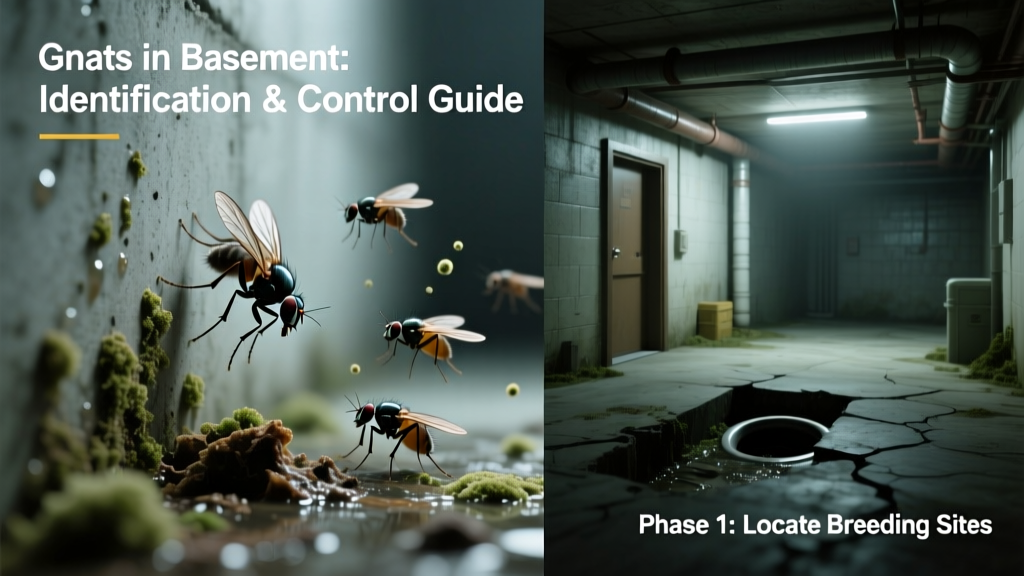
Gnats in the basement aren’t just a nuisance—they’re a red flag. These tiny flying insects (usually 1–3 mm long) thrive where moisture, organic decay, and poor ventilation converge. Unlike outdoor gnats, basement populations often point to hidden leaks, standing water, or decaying organic matter behind walls or under slabs—and left unchecked, they can multiply rapidly, with some species laying up to 200 eggs in 48 hours.
Identification
Basement gnats are most commonly fungus gnats (Bradysia spp.) or drain flies (Psychoda spp.). Fungus gnats have slender black bodies, long legs, and delicate, mosquito-like wings. Drain flies are fuzzy, moth-shaped, and grayish-black with broad, hairy wings held roof-like over their bodies. Both hover near damp corners, sump pits, floor drains, or potted plants stored in the basement.
| Feature | Fungus Gnat | Drain Fly |
|---|---|---|
| Size | 1–3 mm | 1.5–5 mm |
| Wing Shape | Clear, narrow, veinless | Fuzzy, broad, triangular |
| Flight Pattern | Erratic, weak fliers | Short, fluttery hops |
| Primary Habitat | Moist soil, decaying plant matter | Gelatinous biofilm in drains, pipes, sump pits |
| Larval Food Source | Fungal hyphae & algae | Bacteria, sewage slime, organic sludge |
What Attracts Them
Basements provide ideal conditions: high humidity (above 60% RH), stagnant air, and hidden moisture sources. According to the U.S. EPA’s 2022 Indoor Air Quality Guide, basements average 70–90% relative humidity during summer months—well above the 50% threshold that supports gnat breeding.
- Leaking water heaters or HVAC condensate lines
- Clogged or slow-draining floor drains with organic buildup
- Stored wet cardboard boxes or old carpet padding
- Overwatered houseplants kept in the basement
- Cracks in foundation walls allowing groundwater seepage
Treatment Methods
Natural Solutions
Start here—especially if children or pets use the space. Vinegar traps work best for adult fungus gnats: fill a shallow dish with ½ cup apple cider vinegar, 2 tbsp sugar, and 1 tsp liquid dish soap. The soap breaks surface tension so gnats drown upon landing. Replace every 3–4 days.
For drain flies, pour ½ cup baking soda followed by ½ cup white vinegar down suspect drains. Wait 15 minutes, then flush with boiling water. Repeat for three nights. This dissolves the slimy biofilm larvae cling to.
Chemical Options
Use only as a last resort—and never indoors without ventilation. Pyrethrin-based aerosols (like CB-80) offer fast knockdown but don’t address larvae. For persistent drain infestations, enzyme-based drain cleaners (e.g., Green Gobbler) digest organic sludge without corroding pipes. Avoid bleach: it kills surface adults but leaves biofilm intact—and may react dangerously with other cleaners.
"Fungus gnat larvae feed on root hairs and fungal spores—not just soil. That’s why simply drying the area isn’t enough; you must disrupt the food web." — Dr. Monica Pugh, Entomologist, Cornell Cooperative Extension, 2021
Prevention
Sustained control hinges on moisture management. Install a dehumidifier set to 45–50% RH and empty it daily—or connect it to a floor drain with a condensate pump. Seal cracks in concrete floors and foundation walls with hydraulic cement, not caulk. Keep all basement storage off the floor using plastic pallets, not cardboard.
- Inspect sump pump basin weekly for algae or scum
- Clean floor drains monthly with a stiff brush and enzyme cleaner
- Remove all organic debris—including old mulch bags or compost buckets
- Check HVAC drip pans for standing water and mold growth
- Install exhaust fans vented outdoors in windowless utility rooms
When to Call an Exterminator
Call a licensed pest professional if: gnats persist after 10 days of consistent treatment; you spot larvae in wall voids or behind baseboards; or your sump pit emits a sulfur odor (indicating anaerobic decay). A certified technician can perform thermal imaging to locate hidden moisture pockets and apply targeted larvicide like Bifen IT in inaccessible areas.
Why do gnats gather around my sump pump?
Sump pumps collect groundwater rich in organic particles and nutrients—ideal for fungus gnat larvae and drain fly breeding. Algae and biofilm build up quickly in stagnant water, especially when the pump runs infrequently. Clean the basin with diluted hydrogen peroxide (3%) and scrub with a nylon brush every two weeks.
Can gnats damage my home’s structure?
Direct structural damage is rare—but their presence signals deeper issues. Persistent moisture attracts wood-destroying organisms like carpenter ants and termites. In fact, the National Pest Management Association’s 2023 report linked 32% of termite inspections to prior unaddressed gnat or mold complaints in basements.
Do gnats bite in the basement?
Most common basement gnats—fungus gnats and drain flies—do not bite humans. However, biting midges (Ceratopogonidae) occasionally enter through unscreened windows and can deliver painful, itchy bites. If you’re being bitten, inspect window screens and exterior lighting that may draw them in.
Will a dehumidifier alone get rid of gnats?
No—it reduces adult activity and slows reproduction but won’t eliminate existing larvae in drains or soil. Pair it with physical cleaning and biological controls like Steinernema feltiae nematodes, which target fungus gnat larvae in moist substrates.
Are fruit flies the same as basement gnats?
No. Fruit flies (Drosophila melanogaster) prefer fermenting produce and alcohol residues—not damp concrete or drains. Their presence in the basement usually means food waste was stored there (e.g., recycling bins with juice bottles) or a forgotten bag of onions in a corner.
How long does it take to eliminate a gnat infestation?
With consistent treatment, most populations decline within 7–10 days. Full elimination—including breaking the life cycle—takes 3–4 weeks, since fungus gnat eggs hatch in 3 days, larvae mature in 10–14 days, and adults live 7–10 days. Skipping even one treatment round risks resurgence.
Basement gnats are rarely about the insects themselves—they’re messengers. Addressing them means confronting moisture, decay, and airflow issues that affect indoor air quality, energy efficiency, and long-term structural health. Fix the conditions, and the gnats vanish. Ignore them, and you’re likely solving bigger problems down the line—like mold remediation or foundation repair. Start with your sump pit, your drains, and your humidity meter. That’s where real control begins.