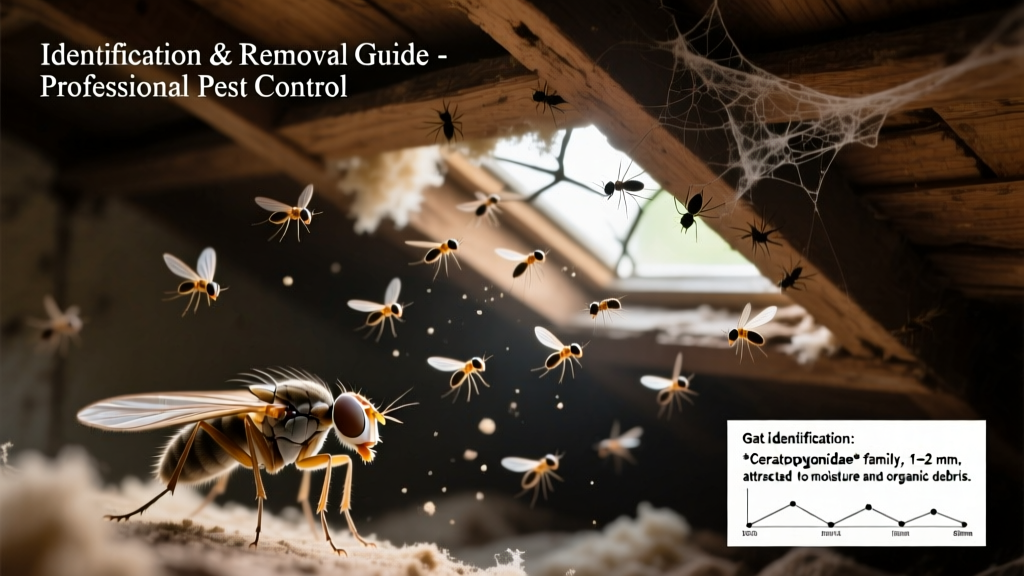
Gnats in the attic aren’t just a nuisance—they’re a red flag. Unlike kitchen fruit flies, attic-dwelling gnats (often fungus gnats or drain flies) signal moisture intrusion, decaying organic material, or hidden plumbing leaks. Left unchecked, their presence can accelerate wood rot, compromise insulation integrity, and attract secondary pests like spiders and ants.
Identification
Fungus gnats (Bradysia spp.) are the most common attic invaders. Adults are 1–3 mm long, slender, black or gray, with long legs and delicate, mosquito-like wings. They don’t bite but hover near damp surfaces. Drain flies (Psychoda spp.) are slightly larger (2 mm), fuzzy, moth-like, and often cluster near roof vent condensation or leaky HVAC drip pans.
| Feature | Fungus Gnat | Drain Fly | Phorid Fly |
|---|---|---|---|
| Size | 1–3 mm | 1.5–5 mm | 0.5–6 mm |
| Wing Shape | Clear, narrow | Heart-shaped, hairy | Held flat over abdomen |
| Primary Habitat | Damp insulation, wet drywall paper, composted debris | Clogged roof vents, HVAC condensate pans, sewer vent stacks | Decaying animal matter (e.g., dead rodent in soffit) |
| Larval Food Source | Fungal hyphae & algae | Biofilm in drains & pipes | Decomposing protein |
Look for swarms near attic access hatches, around recessed lighting fixtures with moisture buildup, or near roof vents after rain. Larvae appear as translucent, legless maggots with black head capsules—check under insulation batts or behind vapor barriers.
What Attracts Them
Attics become gnat magnets when three conditions converge: moisture, organic debris, and warmth. The U.S. Department of Housing and Urban Development’s 2022 moisture assessment found that 68% of attic gnat infestations correlated with unvented bathroom exhaust ducts terminating inside the attic space—not outside.
- Roof leaks or ice dam damage saturating insulation
- Improperly terminated bathroom or kitchen exhaust vents dumping humid air into attic
- Abandoned bird nests or rodent carcasses in eaves or soffits
- Stored cardboard boxes, old carpet padding, or wet plywood sheathing
- Condensation buildup on cold water pipes or HVAC lines
Unlike basements or kitchens, attics rarely have food sources—so gnats here almost always point to hidden decay or persistent humidity above 60% RH.
Treatment Methods
Natural Remedies
Start with targeted physical removal before introducing chemicals. Vacuum adult gnats with a shop vac fitted with a fine-mesh filter—do this at dawn when activity is lowest. Remove and discard any visibly moldy or water-damaged insulation (wear an N95 mask). For larvae, drench affected areas with a 1:1 mix of hydrogen peroxide (3%) and water—this kills fungus without harming wood framing.
- Place yellow sticky traps near vents and light fixtures to monitor population trends
- Use a dehumidifier set to 45–50% RH for 72+ hours—fungus gnat eggs desiccate below 55% RH
- Sprinkle diatomaceous earth (food-grade) along rafter bases where larvae crawl
Chemical Options
Only consider labeled insecticides after confirming breeding sites. Bifen IT (bifenthrin) diluted at 1 oz per gallon is EPA-registered for crack-and-crevice treatment in attics—but never spray directly on insulation or wiring. For drain fly breeding in vent stacks, use Gentrol IGR (hydroprene) aerosol—applied only to non-porous surfaces per label instructions.
"Fungus gnat larvae survive 3–4x longer in cellulose-based insulation than fiberglass. Always replace wet cellulose—it’s not salvageable." — Dr. Lena Cho, Entomologist, University of Florida IFAS Extension, 2023
Prevention
Long-term prevention hinges on moisture control and exclusion. Seal all roof penetrations (vents, pipes, chimneys) with butyl rubber flashing tape—not caulk, which cracks in temperature swings. Install continuous soffit and ridge ventilation to maintain airflow rates above 0.3 air changes per hour (ACH), per ASHRAE Standard 62.2-2022.
- Redirect bathroom/kitchen exhaust ducts to terminate outdoors—never into attic or soffit
- Install a smart attic humidity sensor (e.g., TempStick TH) with email alerts at >55% RH
- Inspect and clean roof vent screens twice yearly to prevent leaf/debris clogs
- Replace damaged roof shingles or flashing within 48 hours of storm damage
- Store holiday decorations in sealed plastic totes—not cardboard boxes
For homes with cathedral ceilings or unvented attics, consult our attic ventilation checklist to verify airflow balance.
When to Call an Exterminator
Call a licensed pest management professional if you see more than 20 gnats per minute during daylight hours—or if you find live larvae in structural wood, not just insulation. These indicate either chronic moisture intrusion or a concealed animal carcass. Most general pest services lack attic-specific training; look for firms certified in moisture intrusion inspection by the Indoor Air Quality Association (IAQA).
Why do gnats appear only in summer?
Warmth accelerates fungal growth in damp insulation—their primary food source. Peak activity occurs between June and September when attic temps exceed 75°F and relative humidity stays above 60% for >48 consecutive hours.
Can gnats damage my roof decking?
Not directly—but their presence confirms prolonged moisture exposure. The U.S. Forest Products Laboratory reports that OSB and plywood lose up to 40% of structural strength after 72 hours at 90% RH. Gnats are an early-warning indicator, not the cause.
Will attic fans eliminate gnats?
No. Standard attic fans move air but don’t reduce humidity unless paired with adequate intake ventilation. In fact, negative pressure from unbalanced fans can draw moist indoor air into the attic through ceiling penetrations—feeding gnat breeding sites.
Are gnats in the attic dangerous to pets?
Fungus and drain gnats pose no direct health risk to dogs or cats. However, if gnats are emerging from a rodent carcass or mold colony, secondary toxins (e.g., mycotoxins or ammonia off-gassing) may affect respiratory health—especially in birds or small mammals.
Do ultrasonic devices work against attic gnats?
No credible evidence supports ultrasonic repellents for flying insects. A 2021 University of Nebraska-Lincoln entomology trial tested 12 commercial units in simulated attic environments and recorded zero reduction in gnat flight activity or larval survival.
How long until gnats disappear after fixing the leak?
Adults die within 7–10 days without breeding sites, but eggs and pupae persist. Full elimination typically takes 21–28 days post-repair—assuming all moisture sources are resolved and no residual organic matter remains. Monitor with sticky traps to confirm decline.
Attics are often overlooked until problems escalate—but gnats don’t lie. They reveal what your roof, vents, and insulation are trying to tell you. Fix the moisture, remove the fuel, and seal the entry points. For related issues, see our guides on roof leak detection and attic mold removal.