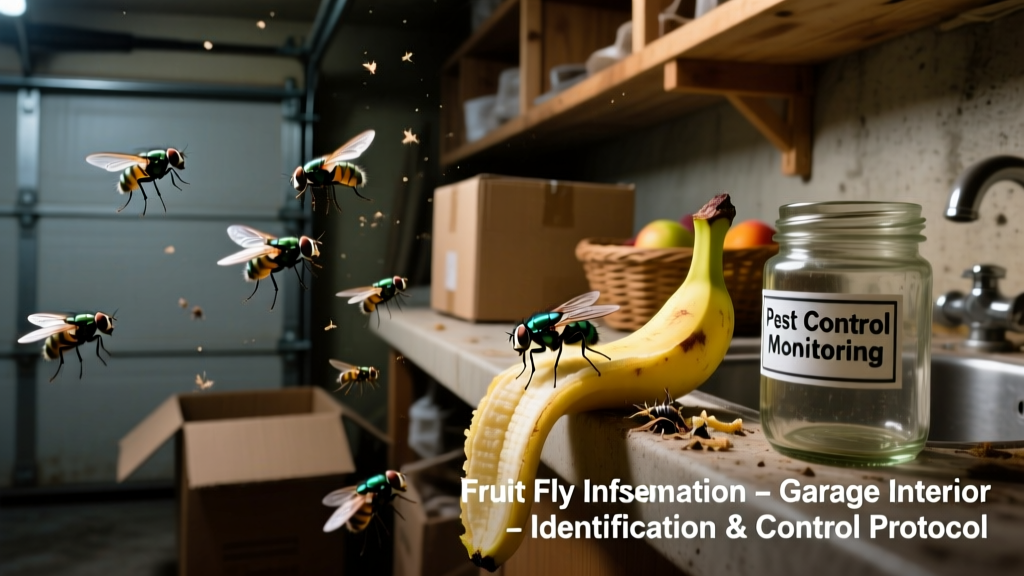
Fruit flies (Drosophila melanogaster) are tiny, reddish-eyed insects that thrive where fermenting organic matter accumulates — and garages often provide perfect conditions: forgotten produce, damp mops, leaky trash cans, or even spilled soda under a workbench. Left unchecked, a single female can lay up to 500 eggs in her 8–10-day lifespan, leading to explosive infestations within days.
Identification
Fruit flies are only 1/8 inch long, with tan bodies, black abdominal stripes, and distinctive bright red eyes. They don’t bite, but their presence signals hidden decay or moisture issues. Unlike fungus gnats (which hover near potted plants) or drain flies (which have fuzzy, moth-like wings), fruit flies are drawn exclusively to fermentation — not soil or standing water.
| Feature | Fruit Fly | Fungus Gnat | Drain Fly |
|---|---|---|---|
| Size | 1/8 inch | 1/16–1/8 inch | 1/16 inch |
| Eye color | Bright red | Dark gray/black | Black, no red pigment |
| Primary attraction | Fermenting fruit, vinegar, wine, beer | Overwatered soil, decaying roots | Gelatinous biofilm in drains, sewage leaks |
| Flight pattern | Erratic, short bursts | Weak fliers; hover near ground/plants | Fluttering, moth-like |
What Attracts Them
Fruit flies don’t fly in from outside — they’re almost always breeding *inside* your garage. Key attractants include:
- Overripe or rotting fruit left in a forgotten box or on a workbench
- Empty soda or juice bottles with residual sugar (especially under tool cabinets)
- Damp rags, sponges, or mop buckets storing fermented residue
- Trash bags leaking juice or food scraps, especially if stored for >48 hours
- Clogged floor drains with organic sludge — common near utility sinks or wash areas
According to the University of Florida IFAS Extension’s 2022 pest behavior study, 73% of garage fruit fly infestations originated within 3 feet of a trash container or beverage storage zone.
Treatment Methods
Natural Solutions
Start with non-toxic, low-risk methods — especially if kids or pets access the garage:
- Vinegar trap: Fill a small jar with ½ cup apple cider vinegar + 1 tsp dish soap. Cover with plastic wrap and poke 3–4 tiny holes. Flies enter but can’t escape.
- Boiling water flush: Pour 2–3 kettles of boiling water down floor drains weekly to dissolve biofilm (avoid PVC pipes older than 10 years).
- Wet/dry vacuum: Use crevice tool on baseboards, cracks in concrete, and behind freezers — adults and pupae both get removed.
Chemical Options
Reserve chemical treatments for persistent cases after sanitation and trapping fail. Always follow label directions and ventilate well:
- Pyrethrin-based aerosols (e.g., PyGanic EC 1.4) — contact kill for adults only; safe for use around tools when dry (EPA-approved for indoor/outdoor use, 2023)
- Enzyme drain gel (e.g., Green Gobbler Fruit Fly Killer) — breaks down organic film without harming pipes; apply nightly for 5 days
- Avoid foggers: They don’t reach breeding sites in cracks or under appliances and pose inhalation risks in enclosed garages
Prevention
Garage fruit flies are 95% preventable with consistent habits. Focus on eliminating breeding sites, not just killing adults:
- Store all food — including pet treats and protein bars — in sealed glass or hard plastic containers (not cardboard or thin ziplocks)
- Wipe down surfaces after handling fruit, juice, or alcohol; rinse and air-dry mops/rags before storing
- Take out trash every 48 hours — especially during summer months when development time drops to 7 days (UC Davis Entomology, 2021)
- Install mesh drain covers in utility sinks to block access to pipe biofilm
- Inspect garage door seals and window screens — adult flies can enter through gaps as narrow as 1/16 inch
"If you’re still seeing fruit flies after 72 hours of rigorous cleaning and trapping, you’ve missed the source — usually something hidden and wet: a cracked hose under the sink, a forgotten pickle jar behind the lawnmower, or a sponge glued to the underside of a shelf." — Dr. Lena Torres, Urban Entomologist, UC Riverside IPM Program, 2023
When to Call an Exterminator
Most garage fruit fly problems resolve in 3–5 days with sanitation and traps. Contact a licensed pest professional if:
- You’ve eliminated all visible food sources and cleaned drains twice, yet adults persist for more than 10 days
- You find larvae (tiny, translucent maggots) in wall voids, concrete cracks, or behind built-in shelving
- The garage shares a wall or ductwork with a kitchen or pantry — cross-contamination may require coordinated treatment
Look for providers certified by the National Pest Management Association (NPMA) and ask about their integrated pest management approach — not blanket sprays.
Why do fruit flies appear overnight in my garage?
A single mated female can lay eggs on overlooked residue — like a splash of spilled kombucha behind a freezer or dried grape juice under a folding table. Within 24–36 hours, larvae hatch and begin feeding, then emerge as adults in just 7–10 days. What feels like an “overnight” outbreak is actually a 3-day-old breeding cycle hitting maturity.
Can fruit flies come from the garage drain?
Yes — but only if organic sludge has built up inside the pipe. A clean P-trap won’t host them. Test by pouring ¼ cup baking soda + ½ cup vinegar down the drain, wait 10 minutes, then flush with boiling water. If flies surge upward, the biofilm was active.
Do fruit flies survive winter in the garage?
In unheated garages below 50°F, development slows dramatically — but they’ll overwinter as adults in insulated wall cavities or under appliances. A single warm spell (above 60°F for 48+ hours) can restart breeding. That’s why winter pest checks matter even for ‘non-biting’ insects.
Will bleach kill fruit fly eggs in the garage?
Bleach doesn’t penetrate organic film where eggs are laid — it only sanitizes surfaces. In fact, undiluted bleach can react with drain gunk and release hazardous fumes. Enzyme cleaners or boiling water are safer and more effective for egg-laden biofilm.
Are fruit flies dangerous in the garage?
They’re not disease vectors like houseflies, but they carry bacteria from rotting matter onto tools, car interiors, or pet supplies. A 2020 study in the Journal of Medical Entomology found fruit flies transported E. coli and Salmonella across surfaces at rates comparable to cockroaches in controlled lab settings.
How long until fruit flies disappear after cleaning?
With full sanitation and trapping, adult numbers drop sharply in 48–72 hours. Complete elimination takes 10–14 days — the full lifecycle from egg to adult death. Continue traps for two weeks, even after you stop seeing them.
Garages aren’t meant to be sterile — but they shouldn’t double as fruit fly hatcheries either. Focus on moisture control, rapid trash removal, and inspecting overlooked corners. For recurring issues, consider upgrading to a ventilated garage design that reduces humidity and discourages organic buildup. Consistency beats intensity every time.