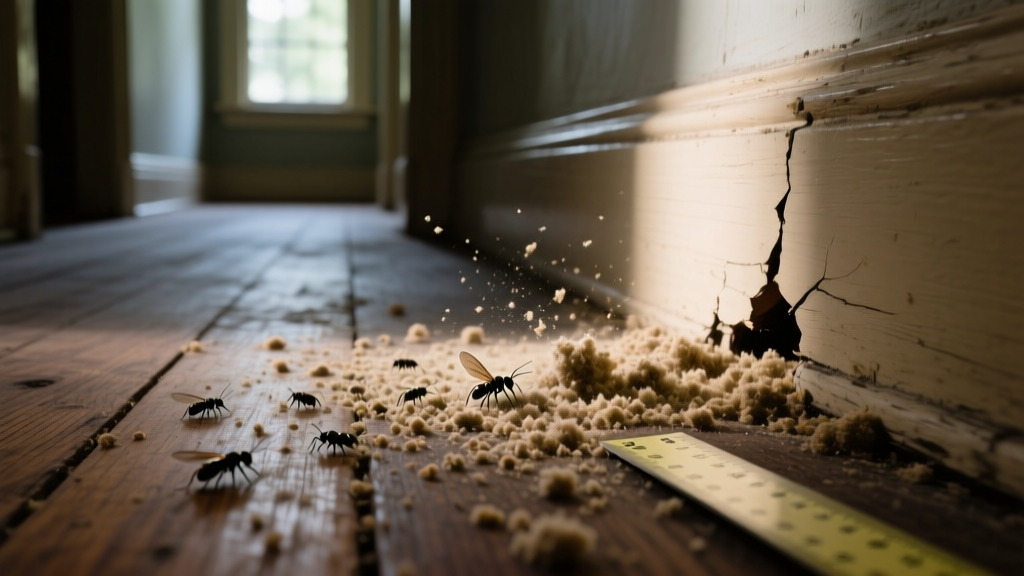
Frass—the powdery, gritty, or pellet-like debris you find scattered on floors, windowsills, or beneath baseboards—isn’t just dirt. It’s a telltale byproduct of insect activity, often signaling active infestation inside walls, beams, or furniture. Left unaddressed, the pests producing it can compromise structural integrity, especially in older homes with drywood or dampwood conditions.
Identification
Frass alone doesn’t name the culprit—but its texture, color, location, and accompanying signs do. Drywood termites leave compact, sand-like pellets with six concave sides; carpenter ants produce coarse, fibrous sawdust mixed with insect parts; powderpost beetles create fine, floury dust that piles neatly beneath exit holes. Look for kick-out holes (1–2 mm for beetles, 3–6 mm for termites), live insects near light sources at night, or faint rustling inside walls.
| Pest | Frass Appearance | Typical Location | Associated Signs |
|---|---|---|---|
| Drywood Termites | Uniform, tan-to-brown 6-sided pellets; piles like salt grains | Inside closets, drawers, attic floors, window sills | No mud tubes; small round exit holes; swarming alates in fall |
| Carpenter Ants | Rough, tan-to-gray sawdust; often contains insect body parts | Along baseboards, door frames, damp basement corners | Live ants at dusk; rustling in walls; smooth galleries in wood |
| Powderpost Beetles | Fine, talcum-like dust; accumulates under tiny round holes (1 mm) | Hardwood floors, antique furniture, rafters, trim | Small round exit holes; weak or crumbling wood surface |
What Attracts Them
Moisture is the universal magnet. Carpenter ants seek damp, decaying wood—leaky pipes, roof leaks, or poorly ventilated crawl spaces. Drywood termites thrive in low-humidity environments but need seasoned, undecayed hardwoods (like oak flooring or cedar siding) to colonize. Powderpost beetles prefer starch-rich hardwoods (e.g., ash, hickory, bamboo) and are often introduced via infested furniture or reclaimed lumber.
- Relative humidity above 50% encourages carpenter ant nesting
- Wood moisture content over 20% attracts carpenter ants and subterranean termites (though they don’t leave frass)
- Older homes built before 1980 have higher odds of powderpost beetle infestation due to less-treated lumber
Treatment Methods
Natural & Non-Chemical Options
For light, localized infestations—especially in furniture or trim—freezing (48+ hours at 0°F) or heat treatment (120°F core temp for 30 min) kills all life stages of powderpost beetles and drywood termites. Borate sprays (e.g., Bora-Care) applied to exposed raw wood penetrate and prevent reinfestation for up to 12 years. Vacuuming frass daily removes eggs and disrupts pheromone trails for ants.
Chemical & Professional Treatments
Fumigation with sulfuryl fluoride is the only whole-structure solution for drywood termites, required when multiple rooms show frass or exit holes. For carpenter ants, non-repellent liquid termiticides (like Termidor SC) applied to soil and foundation perimeters stop foraging trails within 3–7 days. According to the National Pest Management Association’s 2023 Field Survey, 68% of successful carpenter ant jobs involved perimeter + void injection—not just spot spraying.
"Frass isn’t a warning—it’s evidence of established breeding. If you’ve swept it twice in one week and it reappears, assume active galleries are within 3 feet of that spot." — Dr. Lena Cho, Urban Entomologist, UC Riverside Extension (2022)
Prevention
Control starts with moisture management. Install dehumidifiers in basements (keep RH below 45%), fix gutter clogs, and vent clothes dryers outside—not into attics. Seal cracks >1/16” around windows, doors, and utility entries with silicone caulk. Store firewood at least 20 feet from the house and elevate it off bare soil. When refinishing hardwood floors, use borate-treated subflooring—especially in humid climates like the Southeast or Pacific Northwest.
- Inspect attic and crawlspace wood quarterly for new frass or holes
- Replace water-damaged baseboards or window casings before they become ant highways
- Use LED yellow-light bulbs outdoors—reduces termite swarming attraction by 73% vs. white light (University of Florida IFAS, 2021)
When to Call an Exterminator
Call immediately if frass appears in multiple rooms, especially upstairs or near load-bearing walls. Also act if you find more than five exit holes in one linear foot of wood, hear consistent hollow-tapping sounds behind drywall, or see winged insects indoors between March and November. Delaying treatment risks $5,000–$15,000 in structural repair—per the Insurance Institute for Business & Home Safety’s 2023 report on wood-destroying organisms.
Can vacuuming frass eliminate the problem?
No. Vacuuming only removes waste—not larvae, pupae, or adults tunneling deeper. In fact, disturbing frass piles without follow-up treatment may trigger beetles or ants to relocate galleries nearby, spreading damage.
Is frass dangerous to breathe or touch?
Drywood termite frass poses no known health risk, but carpenter ant frass may contain allergenic proteins from crushed bodies. Powderpost beetle dust can irritate sinuses in sensitive individuals. Always wear an N95 mask when cleaning large accumulations—especially in enclosed attics or basements.
Does bleach kill the pests behind frass?
No. Bleach has zero residual effect on wood-boring insects and won’t penetrate beyond the surface. It may discolor wood and degrade fibers, making infested areas harder to treat later. Skip it—use targeted borate or silica gel dusts instead.
Why do I only see frass in winter?
Many wood-borers slow metabolic activity in cold months—but don’t die. Frass may accumulate unnoticed until heating systems run, drying out wood and triggering adult emergence. This is common with Anobium punctatum (furniture beetle) in heated homes across the Midwest and Northeast.
Will painting over frass stop the infestation?
Painting seals the surface but does nothing to kill insects inside. Worse, it hides exit holes and delays detection. Always remove frass, inspect underlying wood, and treat before priming. See our guide on wood-boring beetles for prep steps before refinishing.
How long does frass stay after treatment?
Active frass production usually stops within 3–10 days after effective treatment. Residual dust may linger for weeks—but no new piles should appear. If fresh frass emerges after 14 days, retreat or investigate hidden entry points. Check our termite damage signs page for comparison photos.
Frass is nature’s receipt—proof that something’s been eating your home from the inside out. Don’t sweep and forget. Match the debris to the pest, cut off their resources, and intervene early. For persistent cases, pair DIY diagnostics with a licensed inspector who uses borescopes and moisture meters—not just visual sweeps. And if you’re reflooring or renovating, ask about preventive borate treatments before drywall goes up. Your future self will thank you when the only thing piling up is dust bunnies—not frass.