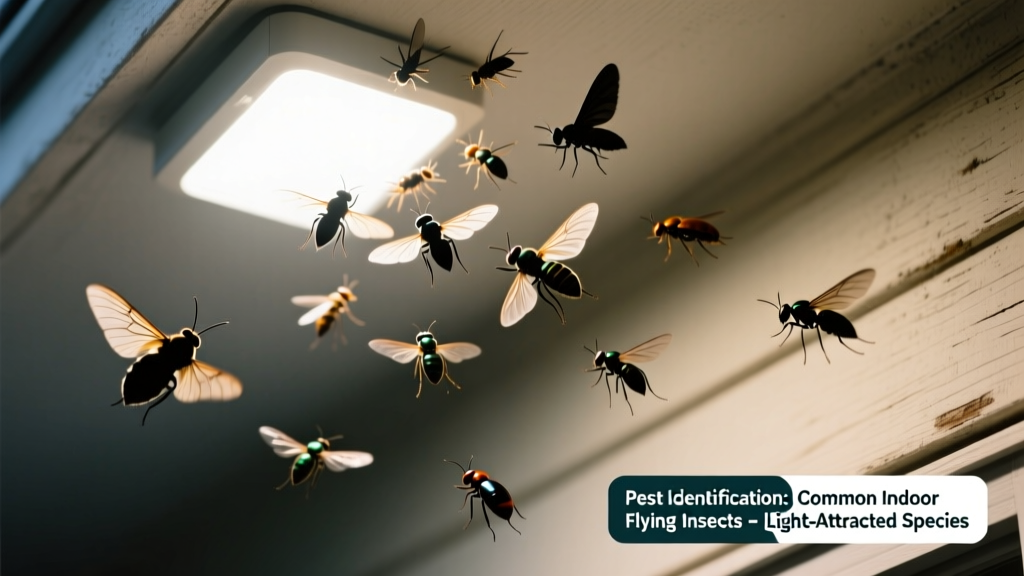
Flying insects swarming your porch light or buzzing against windowpanes at dusk aren’t just a nuisance—they’re clues. Different species behave differently around light, and misidentifying them leads to wasted time and ineffective treatments. Moths flutter erratically; midges hover in dense clouds; June beetles crash headfirst. Getting the ID right is step one to solving it.
Identification
Not all light-attracted fliers are the same. Size, wing shape, flight pattern, and time of year matter more than color alone. Use this table to narrow down suspects based on observable traits you can confirm without a microscope.
| Pest | Wings | Size (mm) | Flight Pattern | Peak Activity |
|---|---|---|---|---|
| Moths (e.g., Indian meal moth) | Fuzzy, triangular, often folded roof-like at rest | 8–12 | Erratic, fluttering, rarely land on skin | May–Oct |
| Non-biting midges (Chironomidae) | Slender, clear, held like a roof over body | 2–5 | Dense hovering clouds near water or damp soil | Apr–Sep, especially after rain |
| June beetles (Phyllophaga spp.) | Hard, shiny, metallic brown or tan | 12–25 | Clumsy, thumping into windows/lights | May–Jul, warm evenings |
| Drain flies (Psychodidae) | Fuzzy, moth-like, tiny (1.5–5 mm) | 1.5–5 | Weak, short hops; found near sinks/bathrooms | Year-round indoors, peaks in humidity |
Look for supporting signs: webbing near light fixtures points to moths; slimy trails on windows suggest drain flies; piles of hard-shelled bodies beneath lamps indicate beetles. If you see larvae in pantry foods, it’s almost certainly Indian meal moths. Larvae in sink traps? Drain flies.
- Use a white sheet under a porch light at night—collect specimens gently with a jar to examine wings and antennae
- Check for entry points: gaps around windows, torn screens, unsealed attic vents
- Record timing: midges peak within 48 hours after heavy rain; June beetles emerge after soil temps exceed 60°F (15.5°C)
What Attracts Them
Light is the trigger—but not the root cause. Most nocturnal fliers use moonlight for navigation; artificial light scrambles their internal compass. But why do some species swarm *your* home and not your neighbor’s? Three conditions stack the odds:
- Exterior lighting type: Mercury vapor and incandescent bulbs emit UV and broad-spectrum light that attracts 3× more insects than yellow sodium-vapor or LED bulbs (University of Florida IFAS Extension, 2022)
- Proximity to breeding habitat: Midges hatch from standing water within 100 ft; drain flies breed in gelatinous biofilm inside drains
- Indoor food sources: Pantry moths need open grains, nuts, or pet food; beetles may enter seeking shelter, then lay eggs in mulch or leaf litter near foundations
According to the U.S. EPA, homes with exterior lights left on all night see up to 70% more insect activity near doors and windows than those using motion-sensor or amber LEDs.
Treatment Methods
Natural Options
Start non-toxic—especially if children or pets are present. Vacuum adult midges and moths with a shop vac (dispose bag immediately outside). For drain flies, pour ½ cup baking soda + ½ cup vinegar down affected drains, wait 10 minutes, then flush with boiling water. Repeat for 3 nights. Install yellow “bug light” bulbs (2700K color temp) on porches and patios—these emit wavelengths less visible to most flying insects.
- Hang sticky traps near problem lights (use non-toxic, pesticide-free versions like Agrion sticky boards)
- Plant citronella, lavender, or basil near entryways—mosquitoes avoid them, and they mildly deter moths and midges
- Clean gutters and eliminate standing water in plant saucers, clogged downspouts, or low spots in the yard
Chemical Controls
Reserve chemical options for confirmed, persistent infestations—and always follow label directions. Pyrethrin-based aerosols (e.g., CB-80) work on contact for moths and midges outdoors but break down in sunlight. For drain flies, use an enzymatic drain gel (like Green Gobbler) weekly for two weeks—not bleach, which only kills adults and leaves biofilm intact. Indoor moth infestations require pheromone traps (delta traps with lure) placed near dry goods, plus thorough pantry cleaning.
"If you’re seeing more than 10–15 flying insects per hour around a single light source for three consecutive nights, it’s not random—it’s a sign of localized breeding nearby." — Dr. Elena Ruiz, Entomologist, UC Riverside IPM Program, 2023
Prevention
Long-term success means cutting off access *and* appeal. Replace all outdoor white-light bulbs with 2700K or lower amber LEDs—studies show this reduces insect attraction by 65–80% (Journal of Insect Behavior, Vol. 36, 2021). Seal cracks around windows, doors, and utility entries with silicone caulk—not just weatherstripping. Install fine-mesh (18-mesh or finer) screening on attic vents and soffits, where moths and beetles commonly enter.
- Trim shrubs and trees within 2 ft of exterior walls—dense foliage holds moisture and shelters midge larvae
- Store dry goods in rigid, airtight containers (glass or thick plastic), not cardboard boxes
- Run bathroom and kitchen exhaust fans for 20+ minutes after showers/cooking to reduce humidity that supports drain fly development
When to Call an Exterminator
Call a licensed pest professional if you find live larvae in pantry items *after* full cleanup and replacement of contaminated food—or if you collect >50 insects per night from one fixture for over a week. Also consult an expert if beetles appear indoors in winter (they shouldn’t be active then), or if drain fly activity continues after four weeks of enzymatic treatment and physical scrubbing of pipes.
Why do moths gather around lights but don’t land on people?
Moths use celestial navigation—locking onto the moon or stars to fly straight. Artificial lights confuse their dorsal light response, causing them to spiral inward. They lack mouthparts designed for biting or feeding on skin, so they ignore humans unless drawn by sweat-salt odors (rarely).
Are midges dangerous?
No—they don’t bite, transmit disease, or damage structures. But large swarms indicate nearby organic decay or stagnant water. Left unchecked, they can infiltrate HVAC intakes and clog filters. Their presence also signals poor drainage or neglected yard maintenance.
Can LED lights still attract bugs?
Yes—but far fewer. Cool-white LEDs (5000K+) emit more blue/UV light and attract 2–3× more insects than warm-white (2700K) or amber LEDs. A 2022 University of Arizona study found amber LEDs attracted only 12% as many moths as standard incandescents.
Why do I only see these insects at night?
Most light-attracted species are crepuscular or nocturnal by evolutionary design—avoiding daytime predators like birds and wasps. Their compound eyes are optimized for low-light contrast, making artificial sources overwhelming visual anchors after dark.
Do bug zappers work?
They kill indiscriminately—including beneficial insects like lacewings and parasitic wasps—and studies show they rarely reduce biting insect populations (University of Guelph, 2020). Worse, they draw pests *toward* your patio. Skip them—use targeted traps instead.
Is this a sign of a larger infestation?
Sometimes. A few moths near a lamp may be accidental strays. But consistent nightly swarms—especially paired with webbing, cocoons, or larvae in food—signal active breeding. Similarly, drain flies in multiple bathrooms point to systemic biofilm buildup, not just one clogged trap.
Identifying the pest isn’t about naming it—it’s about understanding its habits so your response matches reality. Swap the bulb, seal the gap, clean the drain, or call for help—based on evidence, not guesswork. And remember: if you’ve ruled out pantry moths and drain flies, and midges vanish after fixing a soggy corner of your yard, you’ve already solved it. That’s pest control done right.