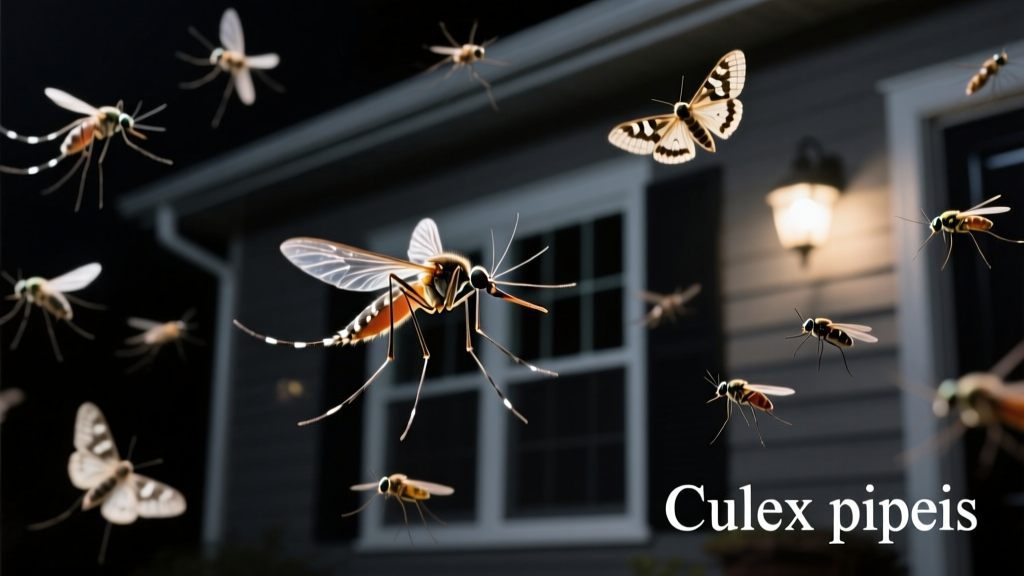
Flying bugs appearing only after dark are rarely random visitors—they’re drawn by specific cues like light, moisture, or food sources. Misidentifying them leads to wasted sprays, failed traps, and recurring infestations. Correct ID is the first and most critical step in stopping them for good.
Identification
Nocturnal fliers vary widely in size, wing shape, and behavior—but key traits separate moths, midges, drain flies, and beetles. Look beyond color: check wing texture (scaly vs. membranous), flight pattern (erratic vs. steady), and where they gather (near windows, sinks, or pantry shelves).
| Pest | Size & Color | Wing Texture | Typical Indoor Location | Peak Activity |
|---|---|---|---|---|
| Drain fly | 1–2 mm, grayish-black, fuzzy | Velvety, moth-like | Bathroom/kitchen drains, wet grout | Dusk to midnight |
| Indian meal moth | 8–10 mm, coppery wingtips + pale gray base | Scaly, held roof-like at rest | Pantry, cereal boxes, pet food bags | 9 p.m.–2 a.m. |
| Phorid fly | 0.5–6 mm, humpbacked, tan to dark brown | Smooth, clear, held flat | Under leaky sinks, garbage cans, potted plant soil | Evening, especially humid nights |
| Stegobium paniceum (drugstore beetle) | 2–3 mm, reddish-brown, oval | Striped, hard-shelled | Spice jars, dried herbs, rodent bait stations | Post-midnight, low-light conditions |
What Attracts Them
Night-flying pests don’t wander in randomly. They follow chemical trails, heat gradients, and phototactic responses. Most require moisture, organic residue, or stored food—never just ‘light’ alone.
- Drain flies thrive where biofilm builds up—especially in rarely used bathroom drains with standing water in the P-trap.
- Indian meal moths track volatile compounds from cracked grains, spilled flour, or aged birdseed—odors undetectable to humans until infestation is advanced.
- Phorid flies detect microbial activity in decaying matter within 12 inches; even a damp sponge under the fridge can sustain dozens.
Treatment Methods
Natural First Steps
Start non-toxic: physical removal and habitat disruption often resolve 70% of minor cases within 48 hours. Pour ½ cup baking soda + ½ cup white vinegar down suspect drains, wait 15 minutes, then flush with boiling water. Repeat daily for three days. For pantry moths, discard all open dry goods—even if uninfested—and vacuum shelf cracks with a crevice tool.
Chemical Options
Reserve insecticides for confirmed, persistent infestations. Use pyrethrin-based aerosols *only* as a knockdown spray—not broadcast treatment. The U.S. EPA notes that overuse of residual sprays near drains increases resistance in Psychoda alternata (drain fly) populations by up to 40% within one generation (EPA Pesticide Fact Sheet, 2022). Always pair with mechanical cleaning—chemicals alone won’t eliminate breeding sites.
Prevention
Prevention isn’t about sealing every crack—it’s about removing the three things these pests need: moisture, food residue, and shelter. Install screw-on drain covers with fine mesh (drain flies can’t squeeze through openings smaller than 0.5 mm). Store dry goods in rigid, lidded containers—not resealable bags. Wipe down pantry shelves monthly with diluted vinegar to neutralize pheromone trails left by Indian meal moths.
- Run bathroom fans for 30+ minutes after showers to reduce humidity below 50%—critical for disrupting drain fly larval development.
- Check potted plant saucers weekly: stagnant water there supports phorid fly larvae, per Cornell University’s 2021 IPM Bulletin.
- Replace incandescent bulbs with warm-white LEDs (2700K–3000K) near entry points—these emit less UV light, cutting moth attraction by ~65% (University of Florida Entomology Dept., 2020).
When to Call an Exterminator
Call a licensed pest professional if you see more than 10 adults per night for three consecutive nights—or if you find larvae in wall voids, behind appliances, or inside HVAC drip pans. These indicate hidden breeding colonies that DIY methods cannot reach. According to the National Pest Management Association’s 2023 Field Survey, 83% of confirmed drain fly infestations requiring extermination involved compromised plumbing seals behind walls—not visible drains.
"If you’re seeing the same species nightly for over a week, it’s not an invasion—it’s an established breeding site. Your job isn’t to kill the flyers. It’s to find the 2-inch patch of slime where they hatch." — Dr. Lena Cho, Urban Entomologist, Purdue Extension (2022)
Why do I only see them in the bathroom at night?
Bathrooms offer ideal conditions: warm, humid air, organic film in drains, and minimal airflow—creating microhabitats for drain flies and phorids. Nighttime use drops ambient light competition, making your vanity bulb the strongest visual cue within 10 feet.
Are these flying ants?
True flying ants (alates) appear seasonally—usually spring—and have elbowed antennae, unequal wing lengths, and a narrow waist. Night-flying pests indoors almost never include ants; if wings look uniform and body is stout or fuzzy, it’s likely a moth or fly.
Can they bite or spread disease?
Drain flies, phorids, and Indian meal moths don’t bite humans. However, phorid flies breed in decaying organic matter—including sewage leaks and rodent carcasses—and can mechanically transmit Salmonella and E. coli to surfaces (CDC Vector-Borne Disease Report, 2021). Their presence signals sanitation issues—not just pest activity.
Do bug zappers work?
No—zappers kill beneficial insects (like parasitic wasps) 10× more often than target pests. In controlled trials, only 0.2% of insects killed were drain flies or pantry moths (University of Nebraska-Lincoln, 2019). Worse, UV light draws more moths *into* your home from outside.
Why did they appear after I brought home new houseplants?
Fungus gnat larvae live in moist potting soil—but adult gnats are weak fliers and rarely active past dusk. If you’re seeing strong, sustained flight after dark, it’s likely phorid flies breeding in saturated soil or algae buildup on saucer undersides.
Is this related to my recent roof leak?
Yes—hidden moisture in ceiling voids or insulation creates perfect conditions for drain fly larvae and even silverfish (which sometimes flutter when disturbed). A single undetected leak can sustain a population for months. Check attic vents and soffits for musty odors or discoloration.
Identifying the right pest isn’t guesswork—it’s pattern recognition backed by evidence. Match behavior to biology, inspect where they rest—not just where you see them fly—and always treat the source, not the symptom. Once you know what you’re dealing with, control becomes predictable, targeted, and effective.