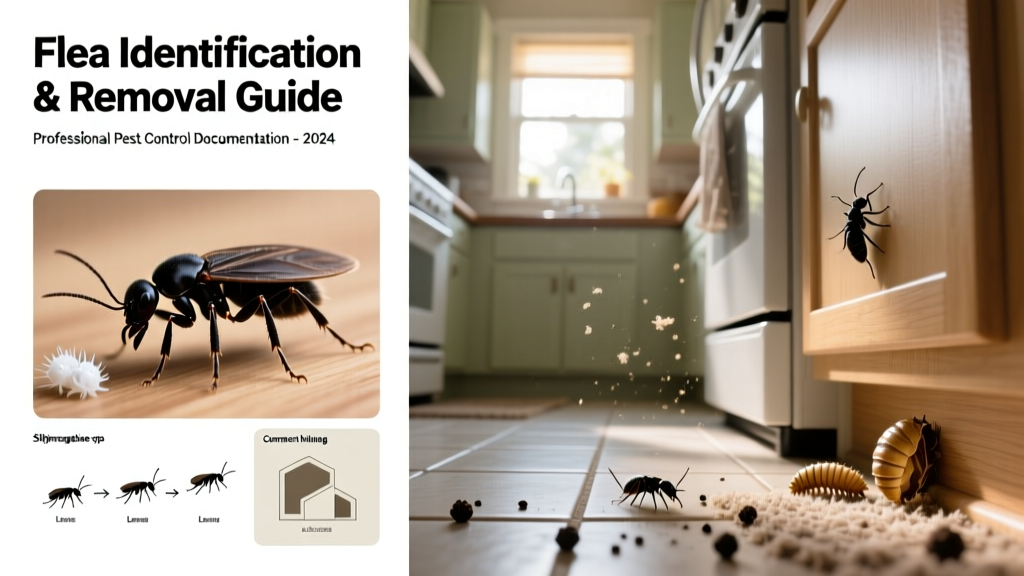
Fleas in the kitchen are uncommon but alarming—these tiny, blood-feeding insects rarely nest in food prep areas, yet they appear when pets track them indoors or rodents harbor infestations behind cabinets or under appliances. Their presence signals a broader pest issue and poses contamination risks to food surfaces, utensils, and pantry items.
Identification
Flea adults are 1–3 mm long, reddish-brown, wingless, and laterally compressed—built for jumping (up to 7 inches vertically). You’ll rarely see them crawling; instead, look for quick, dark specks darting across countertops, floors, or baseboards—especially near pet feeding zones or under the fridge.
| Pest | Size & Color | Behavior | Key Clue |
|---|---|---|---|
| Flea | 1–3 mm, reddish-brown | Jumps erratically; avoids light | “Flea dirt” (black pepper-like feces that turns red on damp paper) |
| Ant (pharaoh or odorous) | 2–4 mm, tan/black | Trails in lines toward food/moisture | Visible trails; no jumping |
| Springtail | 0.5–2 mm, gray/white | Hops with spring-like appendage (not true jump) | Thrives in damp corners; harmless, no blood-feeding |
| Booklice | 1–1.5 mm, pale brown | Crawls slowly; clusters in humid pantry areas | No jumping; feeds on mold, not blood |
What Attracts Them
Fleas don’t seek kitchens for food—they’re hitchhikers. They arrive on pets (especially cats and dogs that lounge near pantry doors or under breakfast nooks), or via rodents nesting in wall voids adjacent to kitchen walls. Warmth, humidity from dishwashers or leaky sinks, and undisturbed clutter (e.g., stacked boxes behind the stove) offer temporary refuge.
- Pets sleeping or eating in or near the kitchen
- Rodent activity: gnaw marks, droppings, or nesting debris behind baseboards or inside cabinet toe-kicks
- High humidity (>60% RH) near refrigerators, dishwashers, or under-sink cabinets
- Unwashed pet bedding stored in utility closets opening into the kitchen
Treatment Methods
Natural Methods
Start with thorough vacuuming—use a crevice tool along baseboards, under appliances, and inside cabinet toe-kicks. Empty the vacuum bag or canister immediately into a sealed trash bag and freeze it for 48 hours before disposal. Sprinkle food-grade diatomaceous earth (DE) along baseboards and behind the fridge; leave for 3 days before vacuuming. DE dehydrates adult fleas and larvae but requires dry conditions to work.
Chemical Methods
If natural methods stall after 10–14 days, apply an EPA-registered insect growth regulator (IGR) like methoprene as a crack-and-crevice spray along cabinet hinges, behind drawers, and under the sink. Avoid spraying food prep surfaces directly. According to the National Pesticide Information Center’s 2022 guidelines, IGRs disrupt flea development without harming mammals at labeled rates—and are safer than broad-spectrum pyrethrins in food-handling areas.
"Fleas in kitchens almost always trace back to pets or rodents—not poor hygiene. Finding one flea means hundreds more are hiding nearby—often within 3 feet of where you saw it." — Dr. Elena Ruiz, Entomologist, UC Riverside IPM Program, 2023
Prevention
Maintain a strict pet flea prevention schedule year-round—even indoor-only animals need monthly topical or oral treatment. Seal gaps around pipes, windows, and exterior doors leading to the kitchen using copper mesh and caulk. Store dry goods in hard-sided, lidded containers—not cardboard boxes—to eliminate harborage for rodent-associated fleas. Run a dehumidifier if basement-level kitchens exceed 55% RH.
- Wash pet bedding weekly in hot water (≥130°F)
- Inspect and clean behind the refrigerator and stove every 2 weeks
- Install door sweeps on exterior kitchen doors to block rodent entry
- Use sticky traps near baseboards to monitor for new activity
When to Call an Exterminator
Call a licensed pest professional if you find live fleas in the kitchen after two full rounds of vacuuming + DE application over 14 days—or if you spot rodent signs (droppings, grease marks, nesting material) behind walls or under flooring. Flea infestations linked to hidden rodent nests require integrated rodent exclusion + targeted flea control, which DIY methods can’t safely address.
Can fleas lay eggs in my kitchen cabinets?
No—they avoid laying eggs in open, dry, high-traffic areas like cabinets. But flea eggs *can* fall off pets near cabinet doors or get tracked in on shoes. Eggs hatch best in carpet fibers or pet bedding, not wood or laminate—but larvae may briefly hide in cracks or under loose kick plates if humidity is high.
Will cleaning my kitchen eliminate fleas?
Surface cleaning alone won’t. Fleas and larvae hide in micro-crevices, under appliances, and inside wall voids. Vacuuming (with HEPA filter), steam-cleaning baseboards, and treating pet zones are required—kitchen-specific sanitation supports control but isn’t sufficient on its own.
Are kitchen fleas dangerous to humans?
Yes—cat fleas (Ctenocephalides felis) bite humans, causing itchy, red papules—often in clusters on ankles or lower legs. More critically, they can transmit Bartonella henselae (cat scratch disease) and serve as intermediate hosts for tapeworms (Dipylidium caninum). The CDC reports over 22,000 U.S. cases of flea-borne typhus were documented between 2010–2022, primarily in homes with untreated pet infestations.
Do fleas survive in cold kitchens during winter?
Fleas thrive at 70–85°F and >70% RH—but central heating keeps most kitchens warm enough year-round for development. Unheated pantries or garages attached to kitchens may slow activity, but indoor kitchens remain viable habitats. A 2021 study in the Journal of Medical Entomology found flea pupae survived 30+ days at 50°F when shielded in carpet or fabric folds.
Can I use flea bombs in the kitchen?
No. Total-release foggers (flea bombs) are ineffective against fleas hiding in cracks and voids—and pose serious fire and inhalation hazards near stoves, microwaves, and food prep surfaces. The U.S. EPA explicitly warns against using foggers in kitchens due to residue risks on countertops and ventilation duct contamination.
How do I know if fleas came from my pet or a mouse?
Check for secondary signs: rodent droppings (3–6 mm, dark, tapered ends) near pipes or inside cabinets; gnawed packaging; or faint ammonia odor. Pet-related fleas appear suddenly after outdoor access or boarding; rodent-linked infestations often begin near floor level and intensify overnight. Inspect your mouse droppings in kitchen guide for visual comparison—and review our flea treatment for dogs protocol if pets are involved.
Kitchens shouldn’t host fleas—but when they do, swift, layered action stops spread before they migrate to bedrooms or living rooms. Focus on the source (pet or rodent), not just the symptom. Keep vacuum bags frozen, seal entry points, and recheck behind appliances weekly for 30 days after the last sighting. For persistent cases, consult a technician trained in integrated pest management—not just chemical sprayers.