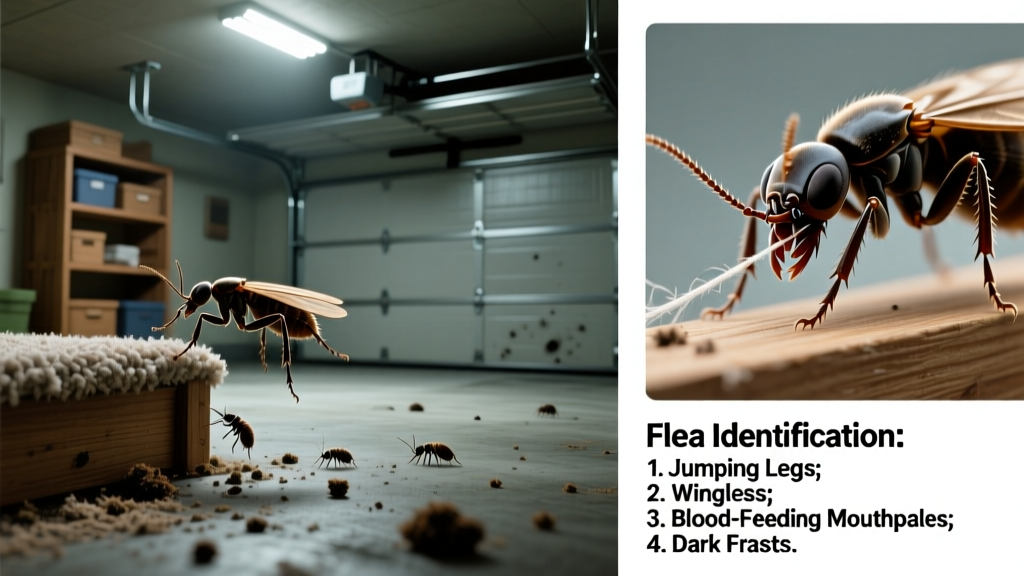
Fleas in the garage aren’t just a nuisance—they’re a red flag that pets, wildlife, or even stored items have introduced a persistent, biting pest into a space meant for tools and storage. Unlike indoor infestations, garage fleas often go unnoticed until they jump onto shoes, pets, or clothing—and then spread into living areas. Left unchecked, a single female flea can lay up to 50 eggs per day, rapidly turning a minor issue into a full-blown household problem.
Identification
Flea adults are tiny (1–3 mm), reddish-brown, wingless insects with flattened bodies built for slipping through fur—and concrete cracks. They don’t fly, but they jump up to 7 inches vertically using powerful hind legs. In garages, you’ll rarely see them crawling; instead, look for signs like black pepper-like “flea dirt” (digested blood) on concrete floors, pet bedding, or cardboard boxes. Flea bites on ankles or shins after entering the garage are another telltale clue—even if no pets are present.
| Pest | Size & Color | Behavior | Key Distinguisher |
|---|---|---|---|
| Flea | 1–3 mm, reddish-brown | Jumps erratically; avoids light | Flea dirt turns rust-red on damp paper towel test |
| Springtail | 0.5–2 mm, gray or white | “Jumps” using a forked tail (not legs) | Harmless; thrives in damp concrete, not blood-fed |
| Carpet beetle larva | 3–5 mm, tan/brown with bristles | Crawls slowly; found near lint or wool | No jumping; feeds on organic debris, not blood |
What Attracts Them
Fleas don’t live in garages by choice—they hitchhike in. The top three attractors are: rodents nesting in insulation or wall voids (especially mice and rats), stray or un-treated pets using the garage as shelter, and used furniture, rugs, or moving boxes that harbor eggs or larvae. High humidity (above 70% RH) and temperatures between 65–80°F accelerate development—conditions common in poorly ventilated, cluttered garages during spring and early fall.
- Mouse nests in attic access points or behind drywall often contain flea pupae waiting for a host
- Cardboard boxes stored on concrete floors absorb moisture—and trap flea eggs in corrugated layers
- Old pet beds, blankets, or kennels left in corners serve as breeding hubs, even without current pet use
Treatment Methods
Natural Methods
Start with mechanical removal: vacuum daily for two weeks using a crevice tool along baseboards, under workbenches, and inside storage bins. Immediately seal and discard the vacuum bag—or empty the canister into a sealed plastic bag and freeze for 48 hours to kill eggs and larvae. Diatomaceous earth (food-grade) works well on dry concrete surfaces: sprinkle a thin layer where pets rest or rodents travel, leave for 48 hours, then vacuum. It dehydrates fleas on contact but loses effectiveness if damp.
Chemical Methods
For active infestations, use an insect growth regulator (IGR) like methoprene combined with an adulticide such as permethrin. Spray only on non-porous surfaces (e.g., concrete floors, metal shelves) and avoid overspray near stored food, tools, or vehicles. According to the National Pesticide Information Center’s 2022 label review, products containing both ingredients reduce reinfestation by 92% when applied correctly and followed by 10-day retreatment. Never use foggers in garages—they disperse unevenly and pose fire risk near gasoline, paint thinners, or vehicle batteries.
Prevention
Seal entry points first: fill gaps >¼ inch around doors, windows, and utility lines with copper mesh and caulk. Store all pet items—including leashes and collars—in sealed plastic bins, not cardboard. Keep humidity below 50% with a dehumidifier or exhaust fan—especially if the garage shares a wall with a damp basement. Sweep and mop concrete floors weekly with vinegar-water (1:1) to disrupt pheromone trails.
"Garage flea infestations almost always trace back to a rodent nest or forgotten pet item—not random invasion. Find the source, or you’ll treat the symptom forever." — Dr. Lena Cho, Urban Entomologist, Purdue Extension, 2023
- Install door sweeps with rubber flaps to block gaps under garage doors
- Rotate stored items every 3 months to disrupt hidden life cycles
- Wash any fabric brought into the garage (e.g., gardening gloves, shop rags) weekly in hot water
When to Call an Exterminator
Call a licensed pest control pro if you’ve vacuumed, treated, and sealed for 3 weeks with no reduction in bites or flea dirt—or if you find live fleas on garage walls, ceiling joists, or inside HVAC ducts. These indicate deep-seated pupal clusters or secondary infestations from adjacent attics or crawlspaces. A technician will perform thermal imaging to locate hidden rodent nests and apply targeted IGR dusts in wall voids, which DIY sprays can’t reach.
Can fleas survive winter in my garage?
Yes—if temperatures stay above 35°F and humidity remains high. Flea pupae enter diapause and can remain dormant for up to 5 months. A cold snap alone won’t eliminate them unless sustained below freezing for 10+ days with low moisture.
Will flea bombs work in a garage?
No. Foggers fail in open, drafty spaces and don’t penetrate cracks, insulation, or under shelving where fleas hide. They also risk igniting fumes from stored solvents or vehicle exhaust residue. Stick to targeted sprays or dusts instead.
Do garage door gaps let fleas in?
Not directly—but gaps allow mice, raccoons, and stray cats to enter, bringing fleas with them. Seal gaps wider than ¼ inch, and inspect the weatherstripping monthly for wear. Replace cracked or brittle rubber immediately.
Can fleas live in my car parked in the garage?
Absolutely. Fleas thrive in car upholstery, floor mats, and under seats—especially if pets ride regularly. Vacuum your vehicle interior weekly, and treat with a pet-safe IGR spray like Advantage II for Dogs on seat seams if infestation is confirmed.
Why do I only get bitten in the garage—not the house?
This usually means the infestation is localized: flea pupae hatched when you entered, triggered by vibration and CO₂. It’s a sign the garage is the epicenter—not your home. Check behind the water heater, in old cardboard, or under the lawnmower for clusters of flea dirt.
Does washing garage rugs kill fleas?
Hot water (140°F+) kills adults and eggs, but most home washers max out at 120°F. For guaranteed results, soak rugs in boiling water for 10 minutes before machine washing—or replace heavily infested ones. See our guide on washing flea-infested clothes for temperature-tested methods.
Garages are transitional zones—between outdoors and indoors—and fleas exploit that ambiguity. Consistent monitoring, moisture control, and sealing off wildlife access break the cycle faster than reactive spraying ever can. If you’ve found flea dirt near your bike rack or under the workbench, act now—not when the dog starts scratching at the back door.