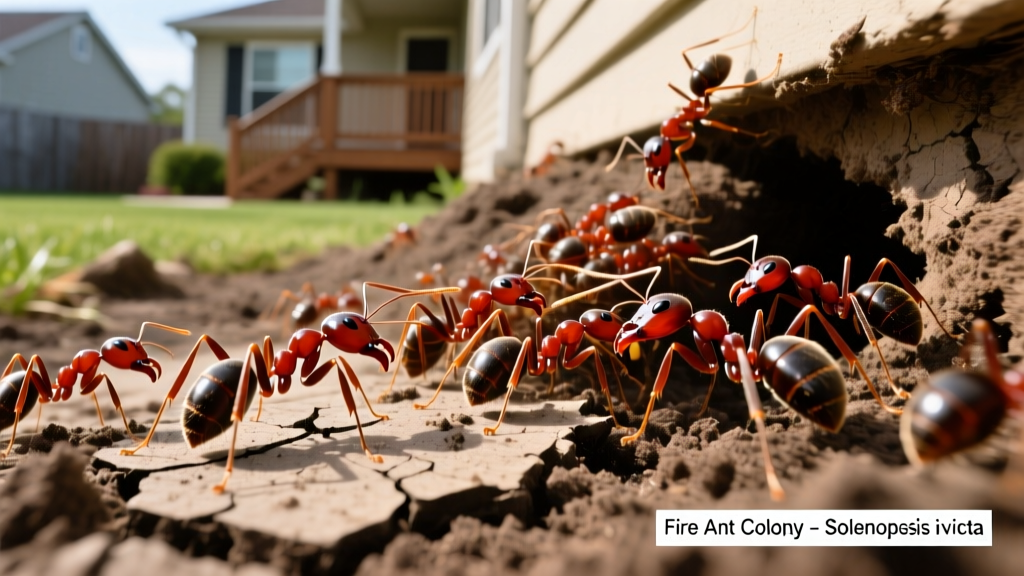
Fire ants are aggressive, invasive stinging ants—most commonly the red imported fire ant (Solenopsis invicta)—that build conspicuous dome-shaped mounds in sunny, open areas of lawns, gardens, and driveways. Unlike nuisance ants that forage indoors, fire ants defend their colonies fiercely: a single mound can house 100,000–250,000 workers, and their venomous stings cause burning pain, sterile pustules, and, in rare cases, anaphylaxis (U.S. Department of Agriculture, 2022).
Identification
Fire ants are tiny but unmistakable once you know what to look for. Workers range from 1/8” to 1/4” long, with reddish-brown heads and bodies and darker, almost black abdomens. They have a two-segmented waist (petiole) and 10-segmented antennae ending in a distinct two-segmented club. Most tellingly, they build loose, irregular, soil-based mounds—often 6–18 inches tall and up to 30 inches wide—that lack visible entry holes.
Key Signs You’re Dealing with Fire Ants
- Painful, burning sting followed by itchy, white pustules within 24 hours
- Mounds appearing suddenly after rain or warm, humid weather
- Ants swarming aggressively when the mound is disturbed
- Foraging trails radiating outward from mounds—not along foundations or walls
| Feature | Red Imported Fire Ant | Allegheny Mound Ant | Odorous House Ant |
|---|---|---|---|
| Size | 1.5–4 mm (workers) | 3–4 mm | 2.4–3.3 mm |
| Mound Material | Loose, granular soil | Tightly packed soil & plant debris | No mound — nests indoors or under objects |
| Sting Reaction | Burning pain → sterile pustule | Non-stinging | No sting (bites only) |
| Preferred Habitat | Open sun: lawns, fields, playgrounds | Wooded edges, shaded soil | Moist indoor areas, mulch beds |
What Attracts Them
Fire ants thrive where conditions mirror their native South American grasslands: warm temperatures (70–95°F), high humidity, and well-drained soil. They avoid heavy shade and saturated ground—but love recently disturbed soil, overwatered lawns, and yards with poor drainage or compacted turf. According to the Texas A&M AgriLife Extension’s 2023 field survey, 68% of infested residential yards had at least two of these three traits: frequent irrigation, sparse grass cover, and proximity to sidewalks or patios (which retain heat and create microclimates).
- Excess moisture from leaky sprinklers or poor grading
- Abundant food sources: pet food left outdoors, fallen fruit, aphid-honeydew on ornamentals
- Soil disturbance from landscaping, new sod, or construction
- Warm pavement edges that radiate heat into adjacent turf
Treatment Methods
Natural Treatments
For light infestations or sensitive areas (e.g., vegetable gardens or near pets), start with non-chemical options. Diatomaceous earth (food-grade) dehydrates ants on contact—but only works when dry and must be reapplied after rain. Boiling water poured directly onto a mound kills ~60% of the colony (University of Florida IFAS, 2021), though it also kills surrounding grass and may not reach deep queens. Spinosad-based baits (like Entrust SC) are OMRI-listed organic and disrupt nervous systems without harming bees when applied at dusk.
Chemical Treatments
For established infestations, broadcast baiting is the most effective strategy—especially with active ingredients like hydramethylnon, indoxacarb, or spinosad. These slow-acting compounds are carried back to the colony by foragers, killing queens within 2–4 weeks. Spot-treat individual mounds only as a secondary step using acephate drenches or fipronil granules. Never combine multiple chemical products: overlapping neurotoxins increase resistance risk and reduce efficacy.
"Broadcast baiting in late afternoon during dry, 70–85°F weather gives >90% control in 3 weeks—if you skip baiting for 7 days before application to increase forager hunger." — Dr. Bart Drees, Texas A&M Entomology, 2022 Field Protocol Guide
Prevention
Long-term prevention focuses on habitat modification—not just killing ants. Raise mower height to 3 inches to shade soil and reduce surface temps; aerate compacted areas annually; fix irrigation leaks and redirect downspouts away from lawn zones. Keep compost bins tightly covered and store pet food indoors. Trim tree branches that touch the ground to eliminate bridge pathways. And avoid using broad-spectrum insecticides—they kill fire ant predators like phorid flies and native ant species that naturally suppress fire ant expansion.
- Apply preventive bait treatments twice yearly: first in early spring (April–May), second in late summer (August–September)
- Use mulch sparingly—fire ants avoid thick cedar or cypress mulch but colonize loose pine straw
- Install perimeter bait stations every 20 feet along property lines to intercept migrating colonies
When to Call an Exterminator
Call a licensed pest management professional if you have more than 20 active mounds per acre, experience repeated reinfestation despite proper baiting, or need treatment near wells, septic systems, or edible gardens. Licensed applicators can use restricted-use products like metaflumizone or sulfluramid—and many offer seasonal monitoring contracts with free retreatments. According to the National Pest Management Association’s 2023 industry report, homeowners who partnered with pros reduced mound counts by 82% year-over-year versus 41% for DIY-only efforts.
Can fire ants damage electrical equipment?
Yes. Fire ants are strongly attracted to warmth and electromagnetic fields. They’ve been documented nesting inside outdoor AC units, traffic signal boxes, and utility meter enclosures—causing short circuits and costly failures. The U.S. Department of Transportation estimates $14 million annually in infrastructure repairs tied to fire ant activity (FHWA, 2021).
Do fire ant mounds indicate poor soil health?
No—quite the opposite. Fire ants prefer healthy, biologically active soil. Their presence often signals good organic matter content and earthworm activity. However, their tunneling can destabilize slopes and undermine newly seeded turf. For erosion-prone areas, consider planting deep-rooted native grasses like little bluestem to discourage mound formation.
Are fire ants worse after rain?
Yes—especially following prolonged dry spells. Rain triggers mating flights (alates) and prompts colonies to rebuild mounds above flooded tunnels. Within 24–48 hours after heavy rain, expect new mounds to appear in previously clean areas. This is the optimal window for bait application, since foragers are highly active and hungry.
Can I relocate a fire ant mound?
No—and don’t try. Disturbing a mound provokes mass stinging and causes satellite colonies to split off underground. Even moving soil 100 feet away risks spreading queens and brood. If a mound is in a dangerous location (e.g., near a sandbox or patio), treat it in place using labeled bait or drench—not shoveling or flooding.
Do fire ants eat plants?
Not directly. They don’t chew leaves or stems. But they protect honeydew-producing pests like aphids and scale insects—so heavy fire ant activity often coincides with sooty mold, yellowing foliage, or distorted growth on shrubs and fruit trees. Managing aphids with lady beetles or horticultural oil indirectly reduces fire ant traffic.
Why do some mounds look different?
Mound shape reflects soil type and moisture. In sandy soils, mounds are taller and looser; in clay, they’re flatter and denser. After heavy rain, ants build temporary “raft mounds” with twigs and debris to stay above water. Young colonies (<6 months) form small, scattered mounds; mature ones merge into large, interconnected supercolonies spanning hundreds of yards.
If you’ve confirmed fire ants in your yard, act quickly—but thoughtfully. Prioritize broadcast baiting over spot treatments, monitor for reinfestation every 3–4 weeks, and adjust watering and mowing habits to make your landscape less hospitable. For persistent problems, pair cultural controls with professional support—and always keep children and pets away from active mounds until treatment takes full effect. You’ll find more on related pests in our guides to carpenter ants outside and ants in grass.