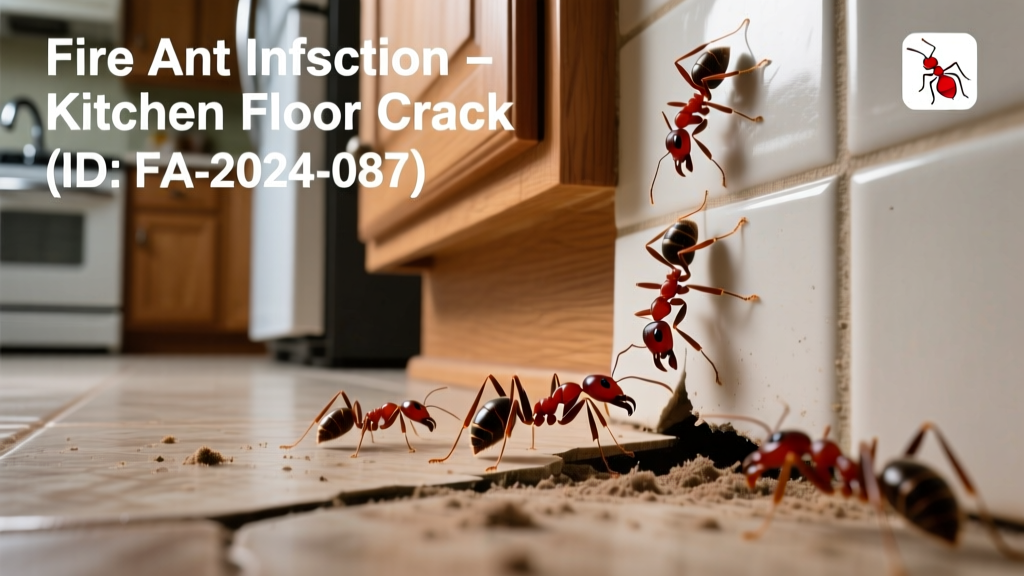
Fire ants—especially the invasive red imported fire ant (Solenopsis invicta)—are aggressive, stinging pests that rarely belong in kitchens. Unlike occasional invaders like ants that trail sugar, fire ants establish satellite colonies inside wall voids or under appliances, posing real health risks: their venom causes painful, itchy pustules and can trigger anaphylaxis in sensitive individuals. The U.S. Department of Agriculture reports over 14 million people are stung by fire ants annually, with kitchens serving as frequent entry points due to warmth, moisture, and accessible food residues.
Identification
Fire ants in kitchens are often mistaken for pavement or odorous house ants—but key differences matter. They’re reddish-brown to dark brown, 1/8”–1/4” long, with a two-segmented waist and a distinct 10-segmented antenna ending in a two-segmented club. Workers are polymorphic (varying sizes), unlike most indoor ants. Look for sudden, aggressive swarming around crumbs, pet food bowls, or near baseboards—especially after rain or high humidity.
| Feature | Fire Ant | Pavement Ant | Odorous House Ant |
|---|---|---|---|
| Size | 1.5–4 mm (polymorphic) | 2.5–3 mm (uniform) | 2.4–3.3 mm (uniform) |
| Color | Reddish-brown head, darker abdomen | Dark brown to black | Brown to black, uniform |
| Sting | Yes — painful, sterile pustule forms in 24 hrs | No sting | No sting |
| Nesting | Soil mounds outdoors; wall voids, under slabs indoors | Cracks in pavement, under floors | Moist areas: sinks, dishwashers, wall voids |
| Trail Behavior | Erratic, aggressive when disturbed | Strong, straight trails | Wandering, irregular trails |
What Attracts Them
Fire ants don’t seek kitchens for sugar alone—they follow pheromone trails to reliable protein, grease, and moisture sources. Leaky faucets under sinks, crumbs behind the toaster, spilled cooking oil on stove backsplashes, and pet food left out overnight all act as magnets. According to the Texas A&M AgriLife Extension’s 2022 Urban Pest Survey, 68% of confirmed indoor fire ant infestations originated from exterior nests within 20 feet of a kitchen door or garage entry.
- Greasy residues on stovetops, range hoods, and oven doors
- Unsealed pet food containers or feeding stations near cabinets
- Standing water in drip pans, under refrigerators, or near dishwashers
- Crumbs trapped in toaster slots, drawer tracks, or behind baseboards
Treatment Methods
Natural Methods
Start with non-toxic interventions if you spot only a few foragers. Diatomaceous earth (food-grade) applied as a fine dust along baseboards and behind appliances dehydrates ants on contact—but it loses efficacy when wet. A 50/50 vinegar-water spray disrupts pheromone trails and deters movement, though it won’t kill colonies. Boiling water poured directly into visible nest entrances (e.g., cracks in tile grout or gaps under cabinets) kills ~60% of workers on contact, per University of Florida IFAS research (2021).
Chemical Methods
For established activity or suspected nesting, targeted baiting is safer and more effective than sprays. Use fire ant-specific baits containing hydramethylnon, indoxacarb, or spinosad—these are slow-acting, allowing foragers to carry toxin back to the queen. Apply bait granules near trails (not directly on food prep surfaces) at dusk when ants are most active. Avoid spraying perimeter insecticides indoors: aerosol pyrethrins may flush colonies deeper into walls, worsening infestations.
"Baiting is the only method proven to eliminate entire fire ant colonies indoors. Spraying worker ants gives false confidence—you’re just killing scouts while the queen keeps laying eggs." — Dr. Molly Keck, Texas A&M AgriLife Extension Entomologist, 2023
Prevention
Seal every possible entry point: use silicone caulk on gaps around pipes, windows, and electrical outlets. Install door sweeps (≤1/8” gap) and replace damaged window screens. Store dry goods—including flour, cereal, and pet food—in rigid, lidded containers made of glass or thick plastic. Wipe down countertops and sweep floors nightly, especially after cooking with oils or meats. Run dishwasher and garbage disposal regularly to remove organic buildup.
- Clean under and behind refrigerator, stove, and dishwasher weekly
- Fix leaky faucet aerators and insulate cold water lines to reduce condensation
- Vacuum baseboard cracks with crevice tool before applying diatomaceous earth
- Trim shrubbery and mulch at least 12 inches away from foundation walls
When to Call an Exterminator
Call a licensed pest professional if you see more than 20 ants/hour in one area, find mounds in adjacent soil or mulch beds, or notice ants emerging from electrical outlets, light switches, or cabinet hinges. These indicate a mature colony has nested inside your structure—a scenario requiring specialized dusting or foam treatments inaccessible to DIYers. Certified applicators can also apply broadcast bait treatments to your yard, reducing reinvasion pressure by up to 90% (EPA Pesticide Registration Notice 2020-1).
Can fire ants build nests inside kitchen walls?
Yes—and it’s more common than most realize. Fire ants exploit insulation voids, plumbing chases, and gaps behind drywall. You may hear faint rustling at night or see ants streaming from outlet plates. Thermal imaging during inspections often reveals hidden nest heat signatures.
Are fire ant stings dangerous to pets?
Absolutely. Dogs and cats frequently get stung on noses, paws, and ears while investigating trails. Swelling, drooling, and pawing at the face are early signs. The American Veterinary Medical Association reports fire ant envenomation accounts for 12% of seasonal emergency vet visits in Gulf Coast states (2022).
Will cleaning alone get rid of fire ants?
No. Cleaning removes attractants and disrupts trails, but does not affect the colony. Without targeting the queen—located in soil outside or deep in wall voids—the infestation will persist and likely worsen. Think of cleaning as step one, not the solution.
Can I use outdoor fire ant bait indoors?
Not safely. Many outdoor granular baits contain higher concentrations of active ingredients and inert carriers (like cracked corn) that attract rodents or pose inhalation risks indoors. Always use products labeled specifically for *indoor* use—and read the EPA registration number to confirm indoor approval.
Do fire ants contaminate food?
Yes. Fire ants defecate and regurgitate while foraging, potentially introducing Salmonella, E. coli, and Staphylococcus onto surfaces and open food. Discard any uncovered food, spices, or utensils that had direct ant contact—even if no visible residue remains.
Why do fire ants appear suddenly after rain?
Rain saturates outdoor nests, forcing colonies to relocate upward—often through utility conduits, expansion joints, or slab cracks leading straight to kitchens. This explains why many homeowners report “overnight” infestations following heavy spring or summer storms.
Fire ants in the kitchen demand urgency—not panic. Accurate identification, strategic baiting, and structural sealing work together to break the cycle. For persistent issues, pair professional treatment with ongoing monitoring using sticky traps near suspected entry zones. Keep learning: explore our guides on ant control basics, other kitchen pests, and how to seal cracks in kitchen walls.