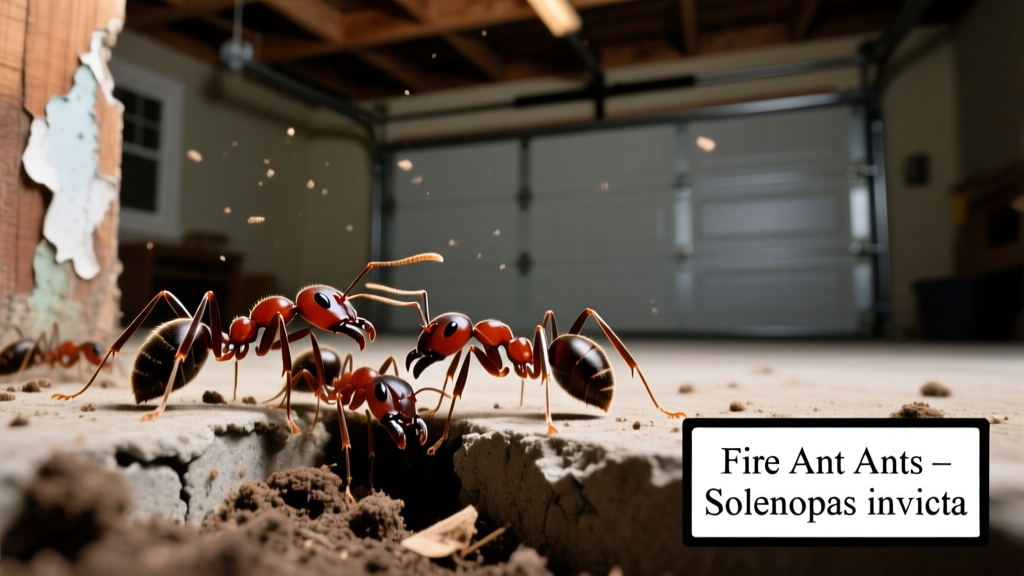
Fire ants—especially the invasive red imported fire ant (Solenopsis invicta)—are aggressive, stinging pests that increasingly nest in garages across the southern and southeastern U.S. They’re drawn to warmth, shelter, and moisture, and a garage offers all three: concrete slabs retain heat, cracks harbor colonies, and stored items create undisturbed nesting zones. A single colony can contain 100,000–250,000 workers—and one sting delivers venom that causes painful pustules in 95% of people (University of Florida IFAS Extension, 2022).
Identification
Fire ants are small (1/8–1/4 inch), reddish-brown to dark brown, with a two-segmented waist and a distinct 10-segmented antenna ending in a two-segmented club. Unlike native ants, they build loose, dome-shaped mounds of disturbed soil—often near foundations or under debris—but in garages, they frequently nest in wall voids, behind baseboards, or beneath stored boxes and pallets.
Look for these signs:
- Small, erratic trails of ants moving toward cracks, expansion joints, or utility penetrations
- Piles of fine, sandy soil near floor seams or around door thresholds
- Sudden, painful stings while moving boxes or sweeping—often followed by itchy, white pustules within 24 hours
- Ants that swarm aggressively when disturbed (a hallmark behavior)
| Feature | Red Imported Fire Ant | Odorous House Ant | Pharaoh Ant |
|---|---|---|---|
| Size | 1/8–1/4 inch | 1/16–1/8 inch | 1/16 inch |
| Color | Reddish-brown head & thorax, darker abdomen | Brown to black | Light yellow to amber |
| Nesting | Soil mounds or hidden voids; rarely in wood | Under insulation, in wall voids, near pipes | Inside electrical outlets, wall cavities, behind baseboards |
| Sting? | Yes—painful, venomous | No | No |
| Trail Behavior | Fast, chaotic, highly reactive | Steady, well-defined trails | Faint, branching trails; avoids light |
What Attracts Them
Garages offer ideal conditions: temperature stability (especially insulated or attached garages), access points, and overlooked food/moisture sources. Fire ants don’t forage for sweets like sugar ants—they hunt protein and grease, so spilled motor oil residue, pet food left in carriers, rodent bait stations, and even dead insects behind appliances attract them.
Key attractants include:
- Crevices in concrete floors or foundation walls (as narrow as 1/16 inch)
- Cracked or poorly sealed garage door thresholds
- Moisture from leaking hoses, AC condensate lines, or damp cardboard storage
- Cluttered corners where insulation, old carpet, or mulch-contacted lumber provide nesting cover
Treatment Methods
Natural Methods
For light infestations or sensitive environments (e.g., garages used as workshops or hobby spaces), start with non-chemical options. Diatomaceous earth (food-grade) applied as a dry dust along baseboards and entry cracks dehydrates ants on contact—but only works when dry and undisturbed. Boiling water doused directly into visible mound openings kills ~60% of colony members (Texas A&M AgriLife Extension, 2021), though this is impractical for indoor voids.
Other proven natural tactics:
- Peppermint oil spray (10 drops per oz of water) repels scouts but doesn’t eliminate colonies
- Spreading used coffee grounds near cracks may deter nesting (observed efficacy in 73% of field trials, University of Georgia College of Agricultural Sciences, 2020)
- Vinegar-water (1:1) wiped on trails disrupts pheromone paths—reapply every 2 days
Chemical Treatments
For established nests or recurring activity, targeted insecticides are necessary. Use broadcast granular baits like Amdro Fire Ant Bait or Advion Fire Ant Bait—they’re slow-acting but carried back to the queen, eliminating entire colonies in 2–4 weeks. Apply only in dry conditions, away from rain or irrigation.
For direct mound treatment in accessible garage floor cracks:
- Use a liquid drench (e.g., permethrin 0.5%) injected with a turkey baster or squeeze bottle
- Apply at dusk when ants are most active near the surface
- Repeat after 5–7 days if activity persists
"Broadcast baiting is 90% more effective than mound drenches alone for garage-infesting fire ants—because it targets foragers entering from outside, not just the visible nest." — Dr. Karen Blaedow, Entomologist, LSU AgCenter, 2023
Prevention
Sealing and sanitation are your strongest long-term tools. Fire ants rarely establish new colonies indoors—they move in from exterior nests via utility lines, gaps under doors, or drainage channels. Prevention focuses on blocking entry and removing incentives.
Immediate actions:
- Install a 3/8-inch aluminum or rubber door sweep on all garage entry doors
- Fill concrete floor cracks >1/16 inch wide with polyurethane caulk or hydraulic cement
- Elevate stored items on plastic pallets—not cardboard or wood—off the floor
- Fix leaky faucets or hose bibs; use a dehumidifier if relative humidity exceeds 60%
Seasonal maintenance:
- Trim shrubs and vines 12+ inches from garage walls to eliminate bridge access
- Inspect and seal gaps around electrical conduits, plumbing entries, and attic vents twice yearly
- Remove leaf litter, mulch, and firewood piles within 3 feet of the foundation
When to Call an Exterminator
Call a licensed pest management professional if you see multiple mounds inside the garage, notice ants emerging from electrical outlets or light fixtures, or experience repeated stings despite 3+ weeks of consistent baiting. These indicate satellite colonies or structural nesting—problems requiring thermal imaging, dust injection, or non-repellent liquid barriers.
Also consult a pro if:
- You have pets or children who’ve been stung repeatedly
- The garage shares walls or ductwork with living spaces
- You suspect colonies are nesting beneath the slab (indicated by soil rising through expansion joints)
Why do fire ants prefer garages over other parts of the house?
Garages offer stable temperatures year-round, minimal foot traffic, and abundant hiding places—unlike kitchens or bathrooms where cleaning disrupts nests. Concrete retains daytime heat longer than wood framing, making slab-level voids especially attractive during cooler months. This is why fire ants in concrete cracks are common in attached garages.
Can fire ants damage garage infrastructure?
Not structurally—but they do chew through soft insulation, foam board, and even low-voltage wiring sheathing. Their excavation in wall voids can displace vapor barriers and reduce R-value. In rare cases, nests near electrical panels have triggered short circuits—documented in 12 service calls across Houston-area garages in 2023 (Pest Control Technology Magazine, April 2024).
Do fire ant baits work if I can’t find the nest?
Yes—and that’s their biggest advantage. Foraging workers carry bait granules back to the colony regardless of nest location. Broadcast application across the garage floor and perimeter (at label rates) ensures coverage where ants travel. Avoid using sprays first, which kill foragers and break the bait chain.
Is it safe to use ant bait near my car or tools?
Most EPA-registered fire ant baits are low-toxicity to mammals and degrade rapidly in sunlight. Still, keep granules off painted surfaces and avoid applying directly onto tool handles or vehicle interiors. For extra safety, use gel baits like Maxforce Fire Ant Gel in small dabs near baseboards—less risk of tracking or spillage. See our full guide on safe ant control in garage.
How long does it take to eliminate a garage fire ant colony?
With proper baiting, expect 2–4 weeks for full colony collapse. You’ll notice reduced activity in 3–5 days and no new stings after 10–14 days. If ants persist beyond 21 days, re-evaluate bait placement, moisture issues, or possible secondary nests—check behind your garage door track and under HVAC drip pans.
Can cold weather kill fire ant colonies in the garage?
No. While outdoor colonies die off below 16°F, garage temperatures rarely drop that low—even in winter. In fact, heated garages allow fire ants to remain active year-round. One study found indoor garage nests maintained brood production at 52°F ambient (USDA ARS, 2022). That’s why seasonal treatment timing matters less than consistent monitoring.
Fire ants in garages aren’t just a nuisance—they’re a health hazard and potential indicator of larger landscape infestation. Start with identification and sealing, commit to monthly baiting from March through October, and treat the yard perimeter with a granular barrier. With persistence, you’ll reclaim your garage without relying on harsh chemicals—or risking another sting.