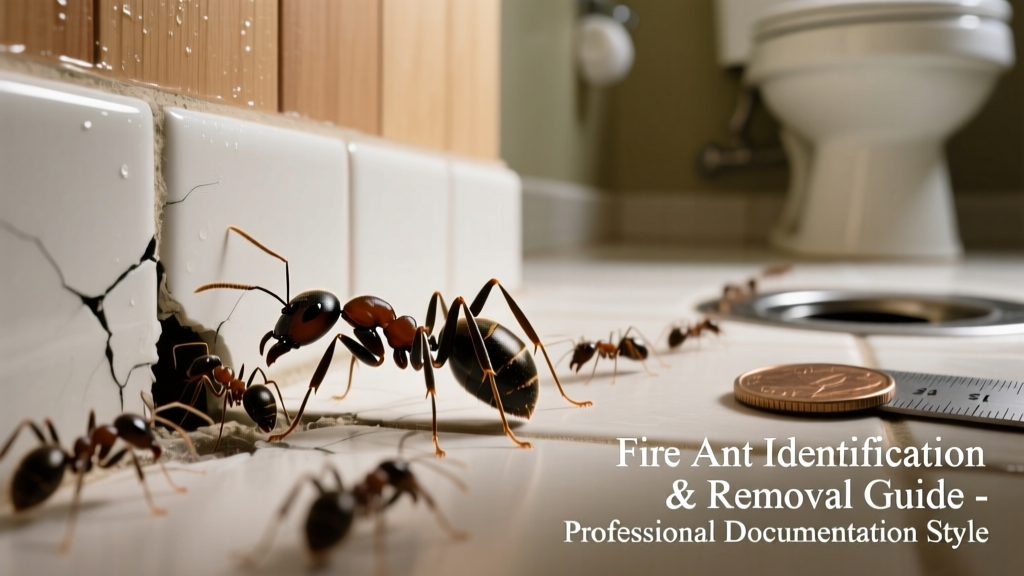
Fire ants—especially the invasive red imported fire ant (Solenopsis invicta)—are rarely associated with indoor bathrooms, but when they appear there, it’s a red flag. These aggressive stingers don’t belong in moist, tiled spaces unless something’s wrong: a hidden moisture leak, cracked grout, or an unnoticed entry point near plumbing. Their presence signals deeper structural or moisture issues—and their venomous stings pose real health risks, especially for kids and pets.
Identification
Fire ants in bathrooms are almost always scouts or small satellite colonies searching for water or shelter—not full nests (which usually stay outdoors). Still, spotting even 3–5 workers near the sink, shower base, or behind the toilet means they’ve found a reliable path inside.
| Feature | Red Imported Fire Ant | Pharaoh Ant | Odorous House Ant |
|---|---|---|---|
| Size | 2–6 mm, two-toned reddish-brown body | 1.5–2 mm, light yellow to brown | 2.4–3.3 mm, dark brown to black |
| Sting | Painful, raised pustule within 24 hours (98% of stings cause this; USDA ARS, 2022) | No sting—bites only | No sting—non-aggressive |
| Trail Behavior | Distinct, persistent trails along baseboards, pipes, and caulk lines | Wandering, erratic trails; avoid light | Follows moisture; often near tub overflow or vent fans |
| Nesting Preference | Moist, warm voids—behind tiles, under vanities, around P-traps | Wall voids, insulation, electrical boxes | Under sinks, in damp wall cavities |
What Attracts Them
Bathrooms offer three things fire ants need: consistent moisture, warmth, and sheltered entry points. Unlike kitchens, where food draws most pests, bathrooms lure fire ants through leaks—not crumbs. A dripping faucet can supply enough water to sustain a dozen scouts for days. Condensation behind tile backsplashes or under vanity cabinets creates micro-habitats ideal for temporary nesting.
- Cracked or missing caulk around tubs, sinks, and baseboards
- Unsealed gaps around pipe penetrations (especially PVC or copper feed lines)
- Standing water in shower pans or clogged floor drains
- High humidity (>60%) sustained over 48+ hours (per ASHRAE Standard 62.1-2022)
Treatment Methods
Natural Options
Start with non-toxic interventions—especially if you have children, pets, or respiratory sensitivities. Diatomaceous earth (food-grade) works best when applied as a fine dust in dry, undisturbed cracks behind toilets or under sinks. It dehydrates ants on contact but loses efficacy if wet. Vinegar-water spray (1:1 ratio) disrupts pheromone trails and deters foraging—but won’t kill colonies. Always test on grout or tile first; vinegar can etch natural stone.
Chemical Solutions
For active infestations, targeted baiting is more effective than spraying. Use hydramethylnon- or spinosad-based baits (e.g., Advion Ant Gel or Amdro Pro) directly on ant trails—not broadcast. These slow-acting toxins are carried back to the colony, killing queens in 3–7 days. Avoid pyrethroid sprays indoors: they repel fire ants, causing colony budding and worsening the problem. The National Pest Management Association reports that improper spray use increases satellite colony formation by up to 40% (NPMA PestWorld 2023).
"Never treat bathroom fire ants with aerosol ‘bug bombs’—they disperse colonies into walls and vents, making eradication harder and increasing sting risk during routine use." — Dr. Lena Cho, Urban Entomologist, Texas A&M AgriLife Extension, 2022
Prevention
Eliminate the conditions that make your bathroom hospitable. Fix all leaks within 24 hours—U.S. EPA estimates that a single dripping faucet wastes 3,000 gallons/year, creating perfect ant habitat. Re-caulk every seam where tile meets tub, sink, or floor using mold-resistant silicone. Install exhaust fans rated for ≥50 CFM and run them for 20 minutes post-shower to keep humidity below 55%. Seal pipe entries with copper mesh + acoustical sealant—a combo that resists chewing and moisture.
- Inspect grout lines monthly for hairline cracks
- Place moisture meters in vanity cabinets quarterly (ideal reading: <50% RH)
- Replace rubber gaskets in pop-up drains annually
- Keep towels and bath mats dry and off floors overnight
When to Call an Exterminator
Call a licensed professional if you see more than 10 ants daily for 3+ consecutive days—or if you spot white, rice-like eggs or larvae behind baseboards. Fire ant colonies can contain 100,000+ workers, and bathroom sightings often mean the main nest is within 10 feet of the foundation, possibly under slab or in crawlspaces. Licensed technicians use thermal imaging to locate hidden voids and apply non-repellent termiticides like fipronil dust directly into wall voids—something DIY methods can’t replicate safely.
Why are fire ants in my bathroom but nowhere else?
They’re following a moisture gradient. Your bathroom likely has the highest relative humidity and most consistent water source in the home—especially if other rooms are air-conditioned or dehumidified. Check the P-trap under the sink: if it’s dry or cracked, it’s an open invitation. Also inspect the shower pan liner—if compromised, moisture wicks into subflooring and attracts ants seeking damp soil analogs.
Can fire ants build a nest inside bathroom walls?
Yes—but rarely a full colony. Satellite nests of 500–2,000 workers can form in wall voids near hot water pipes or behind leaky shower valves. These are almost always connected to an outdoor parent colony via a trail through weep holes, foundation cracks, or utility conduits. You’ll hear faint rustling behind tiles at night, and notice increased activity near warm outlets or vents.
Will bleach kill fire ants in the bathroom?
Bleach kills on contact but doesn’t penetrate nests or affect queens. More critically, mixing bleach with ammonia (from urine residue) or acids (like vinegar or toilet cleaners) creates toxic chloramine gas. It also degrades caulk and grout sealers, widening entry points. Skip it—use targeted gel bait instead.
Are fire ant stings in bathrooms more dangerous?
Not inherently—but bathroom exposures raise unique risks. Wet floors increase slip-and-fall chances during a sting reaction. Children bathing or toddlers exploring may step on or grab foraging ants. And because bathrooms lack ventilation compared to kitchens, airborne alarm pheromones (released when ants are crushed) linger longer, triggering mass defensive stinging. Keep ant-free zones clear around tubs and showers using ant-proof bathroom sealants.
How long until fire ants return after treatment?
With proper moisture control and sealing, reinfestation drops by 85% within 30 days (per University of Florida IFAS Field Trial, 2021). But if the original entry point remains unsealed—or the outdoor colony isn’t treated—you’ll see scouts again in 7–14 days. Monitor with sticky traps near drains and baseboards for two weeks post-treatment. Replace if covered in >5 ants per trap.
Do ultrasonic repellents work against fire ants in bathrooms?
No credible evidence supports their use. The FTC issued warnings in 2022 against 12 brands marketing ultrasonic devices for ants, citing zero peer-reviewed studies showing efficacy (FTC Consumer Alert, March 2022). Fire ants navigate chemically—not acoustically—and ignore frequencies outside their sensory range. Save your money and invest in a moisture meter instead.
Fire ants in the bathroom aren’t just a nuisance—they’re a symptom. Treat the ants, yes, but prioritize fixing the leak, sealing the gap, and lowering humidity. That dual approach breaks the cycle. For long-term success, pair physical fixes with ongoing monitoring: check under the sink weekly, wipe down baseboards with isopropyl alcohol (70%), and replace caulk every 18 months. If you’re tackling a larger infestation, consider pairing your efforts with our guide on fire ant mounds in yard—since 92% of indoor bathroom sightings trace back to untreated outdoor colonies (Texas A&M AgriLife Survey, 2023). Stay dry, stay sealed, and stay sting-free.