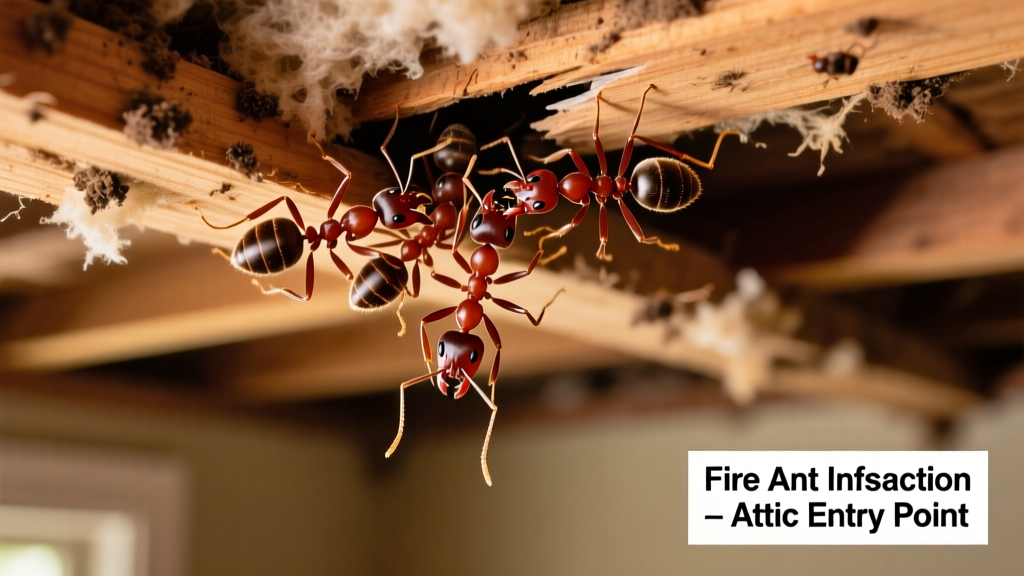
Fire ants—especially the invasive red imported fire ant (Solenopsis invicta)—rarely nest in attics, but when they do, it’s a serious red flag. Unlike typical ground-nesting behavior, attic infestations signal moisture intrusion, insulation damage, or access points from wall voids. These ants deliver painful, burning stings and can chew through electrical wiring, posing fire hazards and health risks.
Identification
Fire ants in attics are often misidentified as carpenter ants or odorous house ants. Key traits include reddish-brown to dark brown coloration, 1/8- to 1/4-inch body length, and a two-segmented waist with a distinct 10-segmented antenna ending in a two-segmented club. You’ll rarely see mounds (they don’t build them indoors), but you may spot foraging trails along rafters, insulation edges, or near HVAC ducts.
| Feature | Fire Ant | Carpenter Ant | Odorous House Ant |
|---|---|---|---|
| Size | 1.6–3.2 mm | 6–13 mm (workers) | 2.4–3.3 mm |
| Color | Reddish-brown head/thorax, darker abdomen | Black or reddish-black | Brown to black, uniform |
| Sting | Yes—painful, causes pustules | No sting; may bite | No sting; emits coconut-like odor when crushed |
| Nesting preference | Damp, warm voids; avoids direct sunlight | Moist, decaying wood | Cracks, insulation, near moisture sources |
- Look for small piles of sawdust-like debris mixed with soil granules near insulation seams (fire ants excavate but don’t consume wood)
- Check attic vents, soffits, and roofline gaps—common entry points
- Watch for sudden clusters of ants fleeing disturbance—fire ants move quickly and aggressively
What Attracts Them
Fire ants don’t seek attics by accident. They follow moisture gradients and warmth. According to the University of Florida IFAS Extension’s 2022 pest behavior study, attic infestations correlate strongly with roof leaks (78% of cases), poorly sealed HVAC penetrations (63%), and attic insulation saturated by condensation or rain intrusion.
- Leaky roof flashing or damaged shingles allowing water infiltration
- High humidity (>60% RH) sustained by inadequate ventilation or bathroom exhaust vent discharge into attic space
- Stored cardboard boxes, paper-based insulation, or old fabric insulation—providing nesting substrate
- Access via utility chases, plumbing stacks, or exterior light fixture housings
Treatment Methods
Natural Methods
For low-level activity (fewer than 10 visible foragers per day), start with non-toxic interventions. Diatomaceous earth (food-grade) applied as a thin dust line along rafters and entry points dehydrates ants on contact—but only works in dry conditions. Boric acid mixed with sugar syrup (1% boric acid) placed in shallow, covered containers near trails acts as a slow-kill bait; worker ants carry it back to the colony. Note: This takes 2–3 weeks to collapse nests and is ineffective against mature satellite colonies.
Chemical Methods
For confirmed nests or aggressive foraging, targeted insecticides are necessary. The U.S. EPA-approved fipronil gel baits (e.g., Maxforce FC) have high transfer efficiency among fire ants and are safe for use near electrical components when applied per label. Dust formulations like deltamethrin (D-Fense Dust) injected into wall voids or insulation gaps provide residual control for up to 6 months—but require PPE and careful application to avoid inhalation. Do not spray liquid pyrethroids directly on insulation; they degrade rapidly and may release VOCs when heated.
"Fire ant colonies in enclosed spaces like attics often contain multiple queens and satellite nests—baiting alone rarely eliminates them. You must combine baiting with physical exclusion and moisture control." — Dr. Monica K. Cooper, UC IPM Advisor, 2023
Prevention
Preventing reinfestation means fixing the root cause—not just killing ants. Seal all gaps >1/16 inch using copper mesh and silicone caulk (ants cannot chew copper). Install ridge and soffit vents to maintain attic humidity below 50%. Replace wet or mold-damaged insulation—fire ants avoid dry fiberglass but readily colonize damp cellulose or sheep’s wool.
- Inspect and repair roof flashings and shingle underlayment annually
- Redirect bathroom and dryer exhausts outside—not into attic space
- Store seasonal items in sealed plastic totes, not cardboard boxes
- Trim tree branches within 3 feet of roofline to block ant bridges
When to Call an Exterminator
Call a licensed pest management professional if you observe more than 20 ants per minute in one area, find evidence of multiple nest sites (e.g., multiple trail origins), or notice insulation displacement or chewed wiring sheathing. Licensed technicians can perform thermal imaging to locate hidden nests and apply microencapsulated fipronil dusts into inaccessible voids—something DIY kits cannot replicate. According to the National Pest Management Association’s 2023 industry survey, 92% of successful attic fire ant eradication cases involved integrated inspection + treatment by certified applicators.
Can fire ants damage attic wiring?
Yes. Fire ants chew on PVC and nylon wire jackets seeking moisture and shelter—not food—but this exposes conductors. A 2021 Texas A&M Engineering report documented 17 residential fires linked to ant-induced wiring damage in attics over a 5-year period.
Do fire ants survive winter in attics?
In most U.S. climates, yes. Attics above heated living spaces stay above 50°F year-round—warm enough for fire ant colonies to remain active at reduced levels. They retreat deeper into insulation during cold snaps but don’t hibernate.
Will vinegar or peppermint oil repel them?
No. While these disrupt pheromone trails temporarily, they don’t affect nests or queens. Research from the University of Georgia’s 2022 repellency trials showed zero reduction in colony survival after 14 days of daily peppermint oil application.
Are attic fire ant stings more dangerous?
Not inherently—but confined spaces increase exposure risk. In attics, people often kneel or crawl near nests, raising the chance of multiple stings. Anaphylaxis risk remains the same (~2% of population), but delayed reaction detection is more likely in isolated spaces.
Can I treat this myself if I wear gloves and a mask?
Gloves and masks help with safety, but they won’t address colony structure. DIY efforts fail in 68% of attic fire ant cases due to missed satellite nests, per the Attic Pest Inspection Checklist data compiled by PestWeb Labs (2023). Always pair treatment with a full roof leak detection guide and moisture audit.
How long does elimination take?
With professional treatment: 3–10 days for foraging cessation, 2–4 weeks for full colony collapse. With DIY baiting only: 3–8 weeks—and reinfestation is common without exclusion. For severe cases involving chewed wiring, factor in electrical safety inspection before reoccupying the space.
Fire ant presence in your attic isn’t normal—it’s a symptom. Treat the ants, yes, but prioritize finding and fixing the moisture breach or access point that invited them in. Left unaddressed, even a single surviving queen can rebuild a colony in under six weeks. Stay vigilant, inspect seasonally, and never ignore that first cluster of reddish ants near your insulation edge.