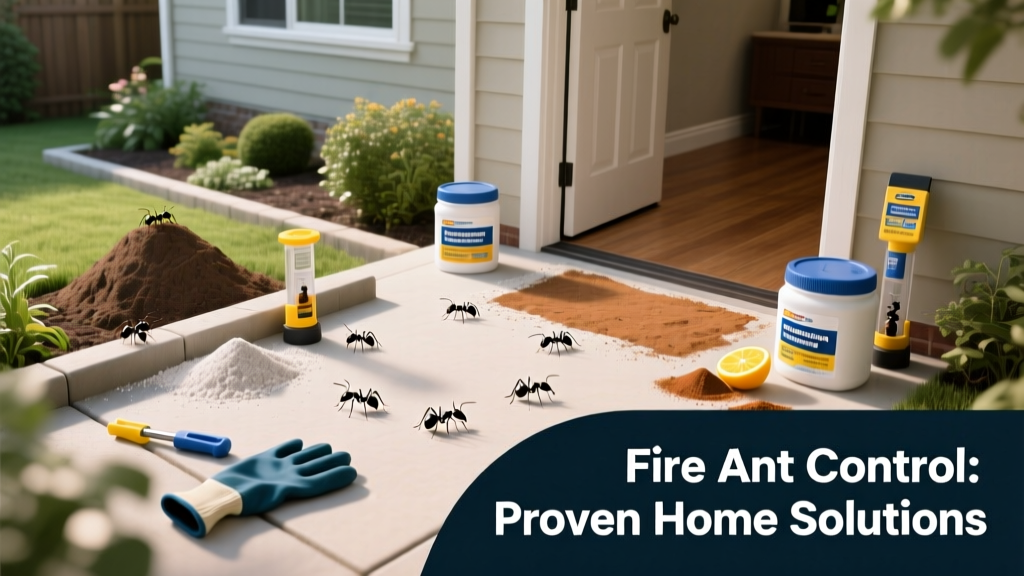
Fire ants are aggressive, stinging insects native to South America but now widespread across the southern U.S., especially in Texas, Florida, and Georgia. A single colony can contain 100,000–250,000 workers—and their venomous stings cause painful, itchy pustules that can trigger severe allergic reactions in up to 2% of people (American College of Allergy, Asthma & Immunology, 2022).
Identification
Fire ants are reddish-brown to dark brown, 1/8–1/4 inch long, with a two-segmented waist and a distinct 10-segmented antenna ending in a two-segmented club. Unlike most ants, they build dome-shaped mounds in open, sunny areas—often 12–18 inches wide and up to 18 inches tall—with no visible entrance hole at the top.
| Feature | Fire Ant | Odorous House Ant | Carpenter Ant |
|---|---|---|---|
| Color | Reddish-brown to black | Brown to black | Black, red, or bicolored |
| Mound-building | Yes—visible soil mounds | No—nests indoors or under debris | No—excavates wood, leaves sawdust |
| Sting reaction | Painful, sterile pustule within 24 hours | No sting—just foul odor when crushed | No sting—bites but doesn’t inject venom |
| Preferred habitat | Sunny lawns, driveways, gardens | Kitchens, wall voids, moist basements | Rotted wood, tree stumps, structural framing |
What Attracts Them
Fire ants seek warmth, moisture, and food sources. They’re drawn to irrigated lawns, leaky outdoor faucets, compost piles, pet food left outside, and cracks in pavement or foundations. According to the USDA’s 2021 Southern Pest Management Report, 73% of residential fire ant complaints occurred within 10 feet of irrigation lines or mulched garden beds.
- Overwatered turf grass (especially Bermuda or St. Augustine)
- Outdoor electrical boxes (they nest inside for warmth)
- Uncleaned grill areas and picnic tables
- Wood piles, landscape timbers, and stacked bricks
Treatment Methods
Natural Remedies
For small, isolated mounds (<5), natural methods can suppress activity—but rarely eliminate entire colonies. Boiling water (2–3 gallons per mound) kills ~60% of workers and queens on contact, though it risks killing surrounding grass and may scatter survivors. Diatomaceous earth (food-grade) applied dry to mound entrances dehydrates ants over 3–5 days. Spinosad-based baits (e.g., Entrust SC) are OMRI-listed and disrupt nervous systems without harming bees when applied at dusk.
Chemical Treatments
For established colonies, broadcast baiting is the gold standard. Use products containing hydramethylnon (Amdro), indoxacarb (Advion), or spinosad (Extinguish Plus) across the entire yard at label rates—preferably in dry, warm weather when ants are actively foraging. Follow up with mound drenches (e.g., acephate or lambda-cyhalothrin) only if live activity persists after 7–10 days. The Texas A&M AgriLife Extension recommends treating in late spring and early fall for maximum queen mortality.
"Broadcast baiting followed by targeted drenches controls >90% of mounds when timed correctly—but skipping the bait step and jumping straight to drenches often spreads colonies underground." — Dr. Molly Keck, Texas A&M Extension Entomologist, 2023
Prevention
Long-term control means making your property uninviting. Maintain a 12-inch gravel or mulch-free zone around foundations. Seal cracks in sidewalks and patios with polyurethane caulk. Keep trash bins tightly lidded and rinse pet bowls after each use. Mow regularly and avoid over-fertilizing—dense, lush turf holds more moisture and attracts foragers.
- Install drip irrigation instead of overhead sprinklers to reduce surface moisture
- Remove fallen fruit, birdseed spills, and rotting wood within 10 feet of the house
- Inspect and seal gaps around utility lines, AC units, and exterior outlets
- Apply perimeter granular bait every 6–8 weeks from April through October
When to Call an Exterminator
Hire a licensed pest management professional if you have more than 20 active mounds in your yard, notice ants entering interior walls or electrical boxes, or someone in your household has a known fire ant allergy. Licensed pros use restricted-use insecticides like fipronil and can treat inaccessible zones—like beneath concrete slabs or inside wall voids—where DIY methods fail.
Can fire ant stings cause serious illness?
Yes. While most people experience localized swelling and itching, systemic reactions—including hives, nausea, dizziness, or throat tightening—require immediate epinephrine and ER care. Anaphylaxis occurs in roughly 1 in 100 stings among sensitized individuals (AAAAI Practice Parameter, 2022). Keep an EpiPen on hand if diagnosed with fire ant allergy.
Do fire ants damage structures?
Not directly—but they exploit existing cracks and voids. Their nesting in electrical boxes causes short circuits: the National Pest Management Association reports fire ants triggered over 1,200 documented power outages in Florida alone in 2020.
Will vinegar kill fire ants?
No. Household vinegar (5% acetic acid) repels but doesn’t kill fire ants. Lab studies show it takes >20% acetic acid concentration to achieve 50% mortality—and even then, queens survive underground. Save vinegar for cleaning surfaces—not ant control.
How fast do fire ant colonies grow?
A newly mated queen lays her first eggs within 48 hours. Within 30 days, she produces 20–30 workers. By 6 months, a mature colony may exceed 5,000 ants—and begin producing new reproductive alates (winged queens and males) that swarm in spring and fall.
Are fire ants active in winter?
In southern states, yes—though activity slows. Colonies move deeper into soil (up to 3 feet) during cold snaps. Mounds may disappear above ground, but foraging resumes rapidly after daytime temps exceed 65°F. Don’t skip winter monitoring in Zone 7+.
Can I treat fire ants near a vegetable garden safely?
Yes—if you choose OMRI-listed baits like Spinosad granules or diatomaceous earth. Avoid liquid drenches within 10 feet of edible plants. Always follow label instructions for pre-harvest intervals; most spinosad products allow harvest after 1 day.
Consistent monitoring beats reactive treatment. Walk your yard weekly from March through November, mark active mounds with flags, and treat before colonies expand into play areas or patios. Pair smart watering, tight sanitation, and seasonal baiting—and you’ll keep fire ants where they belong: out of your shoes, off your kids’ ankles, and away from your porch swing.