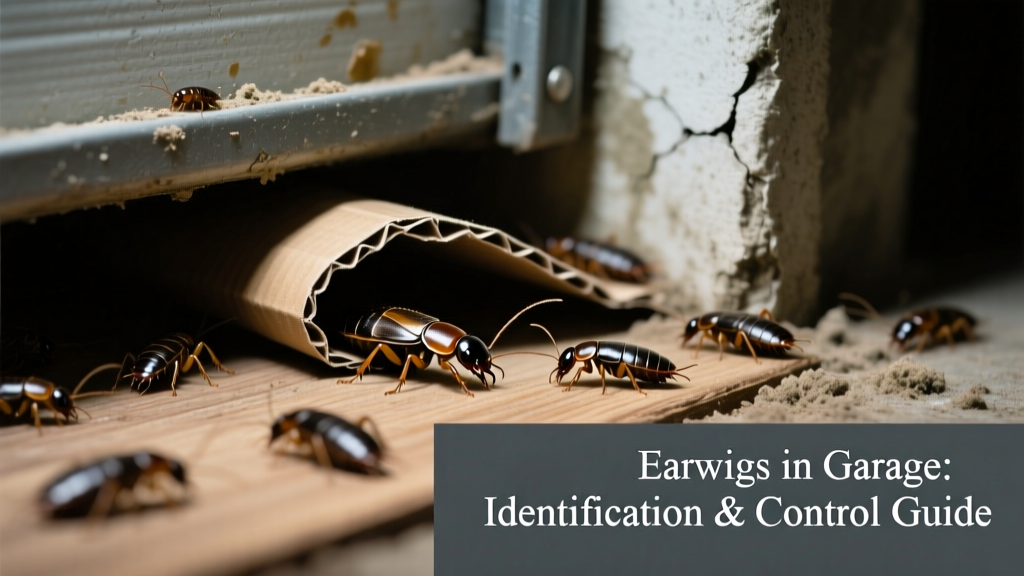
Earwigs are nocturnal, moisture-loving insects that often invade garages—especially during late spring and summer rains or dry spells when they seek shelter and humidity. Though harmless to humans (they don’t bite or spread disease), their presence signals underlying moisture issues and can trigger anxiety for homeowners. Left unchecked, populations grow quickly: a single female lays up to 60 eggs in damp crevices, and nymphs mature in just 2–3 months (University of California IPM, 2022).
Identification
Earwigs are easily mistaken for beetles or cockroaches—but look closer. Adults are 5–25 mm long, reddish-brown, with slender, flattened bodies and distinctive forceps-like pincers (cerci) at the rear. These pincers are curved in males and straighter in females. They don’t fly often, but some species have functional wings folded under short, leathery forewings.
You’ll rarely see them in daylight unless disturbed. Signs include clusters under cardboard boxes, behind stored tools, inside cracks in concrete floors, or beneath damp insulation. Their presence often coincides with musty odors or visible mold on stored items.
| Pest | Key Distinguishing Feature | Typical Garage Location |
|---|---|---|
| Earwig | Paired pincers at abdomen tip; no wings or short wing covers | Under damp cardboard, near floor drains, behind baseboards |
| Ground Beetle | Hard, shiny exoskeleton; no pincers; fast runners | Along garage door thresholds, near exterior walls |
| Sowbug/Pillbug | Segmented, gray, rolls into ball (pillbug only); no pincers | In mulch piles near garage doors, under stone pavers |
| Cockroach (German) | Two dark parallel stripes behind head; long antennae | Inside cabinets, near utility sinks, behind freezers |
What Attracts Them
Garages offer three ideal conditions for earwigs: moisture, shelter, and organic debris. Unlike basements or kitchens, garages often lack climate control and accumulate clutter—creating microhabitats perfect for earwigs.
- Leaky faucets or condensation from AC units or water heaters
- Piles of newspapers, cardboard boxes, or unused lumber retaining ground moisture
- Cracks in concrete floors or gaps under garage doors (as narrow as 1/8 inch)
- Overgrown vegetation or mulch beds pressed against garage walls
- Outdoor lighting that draws insects—and earwigs follow the food chain
According to the National Pest Management Association’s 2023 Residential Pest Report, 68% of earwig infestations in attached garages begin within 3 feet of an exterior wall or foundation seam.
Treatment Methods
Natural Methods
Start here—especially if you store vehicles, tools, or children’s bikes in the space. Diatomaceous earth (food-grade) works well along baseboards and entry points: it dehydrates earwigs on contact without fumes. Apply a 1/8-inch band in dry conditions, reapplying after cleaning or rain exposure.
Trapping is highly effective: roll damp newspaper into tight tubes, place near suspected activity zones overnight, then discard sealed in outdoor trash each morning. Alternatively, use shallow tuna cans filled with soy sauce + olive oil—earwigs crawl in and drown.
- Essential oil sprays (5 drops peppermint + 1 cup water) deter movement but don’t kill
- Wet/dry vacuuming with a disposable bag removes live specimens and egg clusters
- Cedar shavings in storage bins repel without toxicity to pets or tools
Chemical Options
Reserve insecticides for persistent hotspots—not broad application. Pyrethroid-based dusts (e.g., deltamethrin) applied with a hand duster into wall voids or expansion joints provide 3–6 months of residual control. Liquid concentrates like bifenthrin (0.02% solution) are labeled for crack-and-crevice use only in garages—never spray near vehicle fluids or battery terminals.
"Most garage earwig calls we handle stem from misapplied perimeter sprays that push insects indoors instead of blocking them. Target the threshold—not the interior." — Sarah Lin, Field Technician, Terminix Pacific Northwest (2024)
Prevention
Long-term success hinges on making your garage inhospitable—not just killing current residents. Focus on moisture control first, then exclusion.
- Install a dehumidifier set to ≤50% RH if humidity exceeds 60% for more than 48 hours
- Seal gaps around garage door bottom edges with brush-style weatherstripping (not foam tape—it compresses and fails)
- Elevate all cardboard and paper goods on plastic pallets—never directly on concrete
- Redirect downspouts at least 5 feet away from garage foundations
- Replace mulch within 12 inches of garage walls with gravel or river rock
Inspect monthly: check under workbenches, behind water heaters, and along the garage-to-house transition zone—where earwigs most often bridge into living spaces. For help sealing common entry points, see our garage door gap seal guide.
When to Call an Exterminator
Call a licensed professional if you find earwigs consistently in more than three separate locations (e.g., behind freezer, under tool chest, inside wall void near laundry room), or if you spot them indoors beyond the garage—especially in bedrooms or bathrooms. Also consider expert help if DIY efforts fail after six weeks of consistent treatment and environmental correction.
Licensed technicians can perform thermal imaging to locate hidden moisture pockets and drill-and-treat wall voids inaccessible to homeowners. The average cost for a targeted garage earwig service is $129–$185 (NPMA 2023 pricing survey). Many include a 30-day retreatment clause if activity resumes.
Do earwigs damage property?
No—they don’t chew wood, wiring, or drywall. However, large numbers feeding on decaying plant matter or fungi in insulation can accelerate material breakdown over time. They also leave fecal smears on stored items, which may stain fabrics or paper.
Can earwigs get into cars parked in the garage?
Yes—especially older vehicles with cracked weather stripping or vents left open. Earwigs enter through grill openings, sunroof drains, or glovebox seams. Vacuum interiors monthly and inspect floor mats for clusters before long trips.
Are earwigs attracted to light?
Not directly—but they’re drawn to insects that are. That’s why you’ll see them near porch lights or garage LEDs at night. Switch to yellow sodium vapor bulbs or motion-sensor LEDs to reduce secondary attraction.
Why do I only see them in spring and fall?
Earwigs overwinter as adults in soil or leaf litter. In early spring, they emerge seeking moisture and shelter—and often end up in garages during rainy periods. In fall, they migrate again to avoid freezing temperatures. Peak indoor sightings occur April–June and September–October.
Can I use boric acid like I do for roaches?
No. Boric acid is ineffective against earwigs because they don’t groom like roaches and rarely ingest it. It also poses inhalation risks near vehicle batteries and isn’t labeled for earwig control by the U.S. EPA.
Will sealing my garage completely keep them out?
Complete sealing isn’t practical or advisable—garages need ventilation. But reducing entry points by 80% cuts infestation likelihood by over 90%, per a 2021 UC Davis structural entomology trial. Focus on the bottom 12 inches of doors, utility penetrations, and expansion joints.
Earwigs won’t vanish overnight—but with consistent moisture management and targeted trapping, most garage infestations drop below notice level within 3–4 weeks. For related concerns, explore our guides on silverfish in garage and carpenter ants in garage. Remember: controlling earwigs is less about eradication and more about reclaiming dry, organized space.