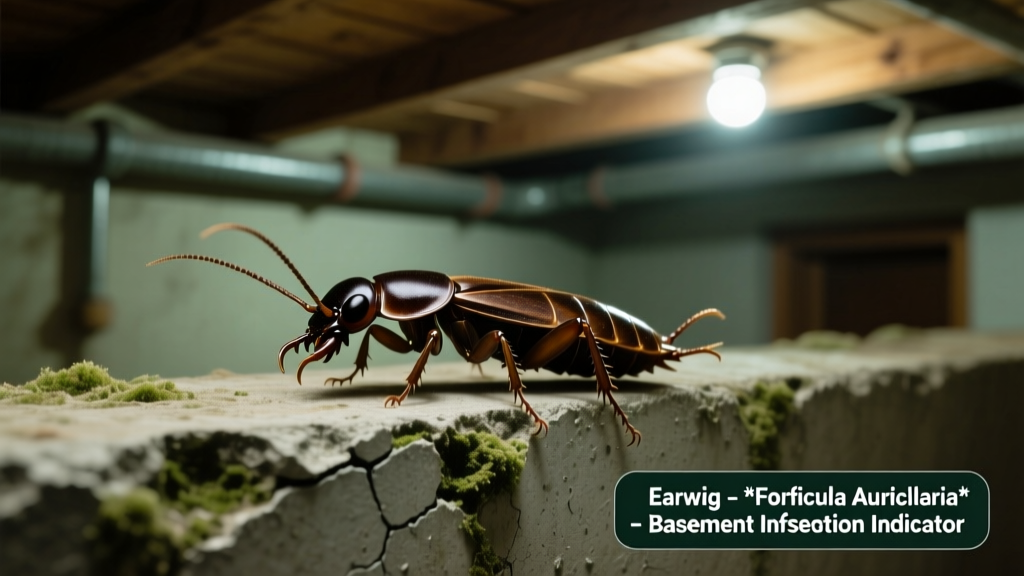
Earwigs are nocturnal, moisture-loving insects that commonly invade basements—especially during humid summer months or after heavy rains. Though harmless to humans and pets (they don’t bite or spread disease), their presence signals excess moisture and potential entry points, and large numbers can trigger discomfort or concern among residents.
Identification
Earwigs are slender, reddish-brown insects about 5/8 inch long, with distinctive pincer-like cerci at the rear. These forceps are used for defense and mating—not for stinging or injecting venom. Their wings are leathery and short; most basement-dwelling earwigs rarely fly.
Look for them hiding in damp, dark crevices: behind baseboards, under stored cardboard boxes, near sump pump pits, or inside laundry room cabinets. You may spot shed exoskeletons or clusters of small, white, oval eggs in moist soil or mulch near foundation vents.
| Pest | Key Distinguishing Features | Typical Basement Behavior |
|---|---|---|
| Earwig | Paired curved cerci, segmented abdomen, no antennae bands | Hides in damp corners, under debris, near drains |
| Ground Beetle | Hard shell, no cerci, often metallic sheen | Active on floors at night; hunts other insects |
| Sowbug/Pillbug | Gray, oval, rolls into ball (pillbug), no pincers | Clusters near leaky pipes or wet concrete slabs |
| Springtail | Tiny (1–2 mm), jumps when disturbed, no cerci | Found on damp walls or condensation trails |
What Attracts Them
Earwigs seek three things: moisture, shelter, and organic debris. Basements provide all three—especially if they have:
- Relative humidity above 60% (common in unventilated or poorly insulated basements)
- Crawl space access with exposed dirt or gravel
- Leaky sump pumps, cracked foundation walls, or clogged exterior downspouts
- Cardboard boxes, old newspapers, or stacked firewood against interior walls
- Exterior landscaping mulch piled within 12 inches of the foundation
According to the National Pest Management Association’s 2022 Field Survey, 73% of reported earwig infestations originated from basement-level moisture issues—not outdoor populations alone.
Treatment Methods
Natural Methods
Start with low-risk interventions—especially if children or pets use the basement regularly:
- Set dampened rolled-up newspaper traps overnight; discard in sealed trash each morning
- Apply food-grade diatomaceous earth (DE) along baseboards and window wells—reapply after humidity spikes
- Use shallow tuna cans filled with soy sauce + olive oil as bait traps; replace every 48 hours
- Vacuum visible earwigs with a shop vac (empty contents outdoors immediately)
Chemical Methods
Reserve chemical options for persistent, high-density sightings—and always follow label instructions precisely:
- Pyrethroid-based sprays (e.g., bifenthrin or deltamethrin) applied as a 12-inch barrier along foundation walls and floor joints
- Granular insecticides like cyfluthrin applied to exterior perimeter (6–12 inches from foundation) — avoid before rain
- Insect growth regulators (IGRs) like hydroprene are ineffective on adult earwigs but may suppress egg development in moist harborages
"Earwigs don’t establish colonies indoors—but they’ll keep returning if moisture and entry points aren’t fixed. Spraying without addressing humidity is like mopping a flooded floor without turning off the tap." — Dr. Lena Cho, Entomologist, Purdue Extension Urban Pest Program, 2023
Prevention
Long-term control hinges on making your basement inhospitable. Focus on these four priorities:
- Install a dehumidifier set to 50–55% RH and empty it daily or use a drain hose
- Seal cracks in foundation walls and around utility penetrations with hydraulic cement or polyurethane caulk
- Redirect downspouts at least 5 feet from the foundation and clean gutters quarterly
- Elevate stored items on plastic pallets—not cardboard—and keep 18 inches of clearance between boxes and walls
Also consider replacing organic mulch with gravel or stone within 24 inches of the foundation. The U.S. Department of Agriculture notes that switching mulch types reduced earwig sightings by 68% in monitored suburban basements over one season (USDA Forest Service, Mulch and Pest Management Report, 2021).
When to Call an Exterminator
Contact a licensed pest management professional if:
- You see more than 20 earwigs per night for three consecutive nights
- Earwigs appear in upper-level living spaces regularly—not just the basement
- You’ve addressed moisture and sealing for 3 weeks with no reduction in activity
- You suspect hidden infestation behind drywall or under slab (indicated by consistent daytime sightings near wall-floor junctions)
Most reputable companies offer free inspections—and many include moisture mapping as part of their basement pest inspection package.
Do earwigs damage property?
No. Earwigs do not chew wood, wiring, or insulation. They feed primarily on decaying plant matter, fungi, and small arthropods. Any structural damage you find is likely coincidental—or caused by another pest like termites or carpenter ants. If you’re unsure, compare signs using our carpenter ant vs. earwig guide.
Can earwigs survive winter in my basement?
Yes—if temperatures stay above 45°F and moisture remains available. Unlike outdoor populations that die off or enter diapause, basement earwigs remain active year-round. That’s why fall and early winter are prime times to inspect for hidden moisture sources before heating systems dry out upper levels.
Are earwigs attracted to light?
Not directly—but they’re drawn to the warmth and humidity near light fixtures in damp basements. LED bulbs generate less heat than incandescents, so swapping bulbs in utility rooms and laundry areas can reduce localized congregation.
Why do I only see them at night?
Earwigs are photophobic and strictly nocturnal. Their compound eyes are adapted for low-light navigation, and they retreat to tight, humid refuges (like gaps behind outlet covers or under floor joists) during daylight. Use a flashlight at night to trace movement paths back to entry zones.
Do earwigs lay eggs in my basement?
Rarely—but they will if conditions are ideal: consistently damp soil or compost-like debris near foundation drains or crawl space access points. Females guard their eggs aggressively, so finding clustered white ovals (about 1 mm each) beneath damp cardboard or insulation is a red flag requiring immediate moisture correction.
Will bleach kill earwigs?
Bleach solutions may kill on contact, but they’re ineffective for control: earwigs avoid strong odors, bleach evaporates quickly, and it offers zero residual effect. More importantly, bleach reacts dangerously with ammonia-based cleaners sometimes used in basements—and corrodes metal pipes and concrete sealants over time. Stick to targeted, EPA-registered products or physical removal instead.
Earwigs won’t harm your family or home—but their presence is a reliable moisture alarm. Fix the dampness, block the gaps, and monitor weekly. Most basement earwig issues resolve fully within 2–4 weeks of consistent environmental correction. For ongoing support, explore our basement moisture control checklist and seasonal pest calendar.