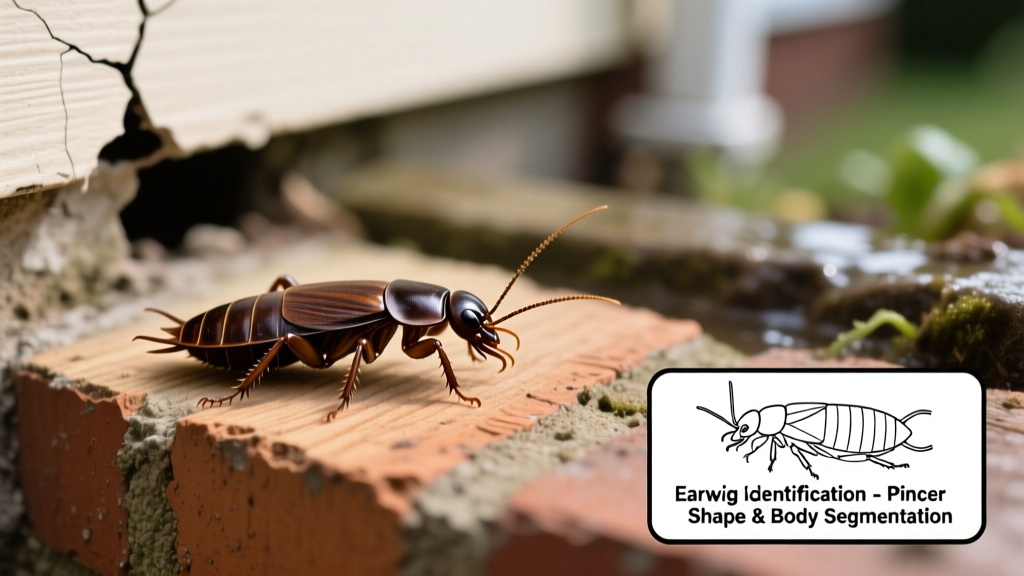
Earwigs are nocturnal, pincer-bearing insects that rarely bite or damage structures—but their sudden appearance in damp basements, bathrooms, or under mulch can trigger alarm. Though mostly harmless to humans, they damage seedlings, flowers, and soft fruits, and large numbers signal underlying moisture or entry-point issues in your home.
Identification
Earwigs range from 5–25 mm long, with elongated, flattened reddish-brown bodies, six legs, threadlike antennae, and distinctive curved cerci (pincers) at the abdomen tip. Males have more curved pincers; females’ are straighter. They don’t fly often, but some species possess short, leathery forewings and membranous hindwings.
Look for these signs:
- Clusters under moist debris (mulch, leaf litter, stones)
- Small, irregular holes in soft plant tissue (lettuce, strawberries, marigolds)
- Faint, musty odor in high-moisture areas where they aggregate
- Shiny, dark droppings near baseboards or window sills
| Pest | Key Distinguishing Feature | Typical Habitat |
|---|---|---|
| Earwig | Paired, forceps-like cerci; no wings or short wings; 12-segmented antennae | Damp soil, under bark, flower pots, bathroom sinks |
| Ground beetle | Hard, shiny exoskeleton; no pincers; fast-running | Under logs, rocks, garden beds |
| Woodlouse (pill bug) | Segmented, grayish body; rolls into ball; 7 pairs of legs | Moist, decaying wood or compost piles |
What Attracts Them
Earwigs seek shelter, moisture, and food—not human dwellings specifically. They’re drawn to conditions you may not realize are inviting:
- Excess humidity above 60% RH, especially in basements, crawl spaces, and bathrooms
- Organic debris within 3 feet of your foundation (leaf piles, grass clippings, stacked firewood)
- Cracks wider than 1/8 inch around doors, windows, utility entries, or foundation vents
- Night lighting—especially white or mercury-vapor bulbs—that attracts their prey (aphids, mites) and them indirectly
According to the University of California Statewide IPM Program’s 2022 Pest Notes, over 70% of residential earwig reports correlate with recent heavy rainfall followed by warm, humid nights.
Treatment Methods
Natural Remedies
Start here—especially if you have pets, children, or garden beds nearby. Diatomaceous earth (food-grade) creates microscopic cuts in their exoskeletons when applied as a dry barrier along baseboards, window wells, and foundation perimeters. Reapply after rain or watering.
Oil traps work reliably: fill a shallow container with ½ inch of soy oil + a drop of soy sauce. Place near suspected activity at dusk. Earwigs are lured in and drown overnight. Empty and refresh daily.
Remove harborages first—clear mulch back 12 inches from foundations, prune dense ground cover, and replace wet cardboard or newspaper piles immediately.
Chemical Options
If populations exceed 20–30 earwigs per trap night for three consecutive nights, consider targeted insecticides. The U.S. EPA lists bifenthrin and carbaryl as effective residual options when applied as a 3-foot band along the exterior foundation and key entry zones.
Indoors, use aerosol pyrethrins only as spot treatments—not broadcast sprays—and always ventilate thoroughly. Never apply near HVAC intakes or pet bedding. Avoid foggers: earwigs hide deep in crevices and won’t be affected.
"Earwigs rarely infest in true 'colonies'—they’re solitary scavengers. If you’re seeing dozens daily, it’s almost always a sign of multiple unnoticed entry points plus ideal microclimates nearby." — Dr. Lena Torres, UC Riverside Entomology Extension, 2023
Prevention
Sustained control hinges on making your property less hospitable. Install dehumidifiers in basements (target ≤50% RH), clean gutters quarterly to prevent overflow onto foundation walls, and seal gaps with copper mesh + silicone caulk—especially around pipe conduits and door thresholds.
Switch outdoor lighting to yellow sodium vapor or LED bulbs with <5000K color temperature—they emit less UV light and attract far fewer insects overall. Trim ivy and shrubs at least 18 inches from walls to eliminate climbing access and reduce retained moisture.
For gardens, avoid excessive organic mulch near vegetable starts. Use straw or gravel instead of shredded bark near seedlings. Introduce beneficial predators like lacewings or parasitic nematodes (Steinernema carpocapsae) in early spring to suppress nymph populations before summer peaks.
When to Call an Exterminator
Contact a licensed pest management professional if:
- You find earwigs inside during winter months (indicates nesting within wall voids or insulation)
- Trapping yields >50 individuals nightly for five days despite moisture control and sealing efforts
- You discover live earwigs inside attics, wall outlets, or ceiling fixtures—signs of structural compromise
Certified technicians can perform infrared moisture scans and apply non-repellent termiticides like fipronil in wall voids—treatments impossible for homeowners to replicate safely.
Do earwigs crawl into ears?
No. This myth dates to Old English folklore (“ear-wig” meaning “ear creature”) but has zero biological basis. Earwigs lack the instinct, anatomy, or behavior to enter human ear canals. They prefer dark, damp, still places—not warm, waxy, moving tunnels.
Are earwigs dangerous to pets?
Not directly. Their pincers can’t pierce pet skin, and they carry no known zoonotic pathogens. However, if a dog ingests several earwigs, mild GI upset may occur due to chitin irritation. More concerning is the cockroach or silverfish infestation that often co-occurs with earwigs—those pests pose greater health risks.
Can earwigs damage my home?
No structural damage occurs. Unlike termites or carpenter ants, earwigs don’t chew wood, drywall, or insulation. Their presence signals moisture problems that could lead to mold or rot—so treat the conditions, not just the bugs.
Why do I see them after rain?
Rain saturates their natural outdoor habitats—soil, leaf litter, mulch—forcing them to migrate upward and outward seeking drier refuge. That’s why post-storm sightings spike, especially near downspouts, basement windows, and garage doors.
Do earwigs lay eggs indoors?
Extremely rarely. Females guard eggs in soil burrows outdoors and require consistent 70–80°F temperatures and >80% humidity to develop. Indoor conditions almost never meet those thresholds. Finding nymphs inside usually means recent migration—not reproduction.
What’s the fastest way to reduce numbers this week?
Combine three actions: (1) empty all indoor traps by dawn, (2) pull mulch 12 inches from the foundation and replace with gravel, and (3) run bathroom and basement exhaust fans continuously for 48 hours to drop localized humidity. Most homeowners report >60% reduction in sightings within 5 days using this triad.
Earwigs aren’t invaders by choice—they’re opportunists responding to conditions we’ve created. Fix the moisture, block the gaps, and remove the clutter, and they’ll recede naturally. For persistent cases, pair physical fixes with targeted treatment—and remember, seeing one or two earwigs in spring is normal ecology, not an emergency. Stay dry, stay sealed, and keep your garden edges tidy.